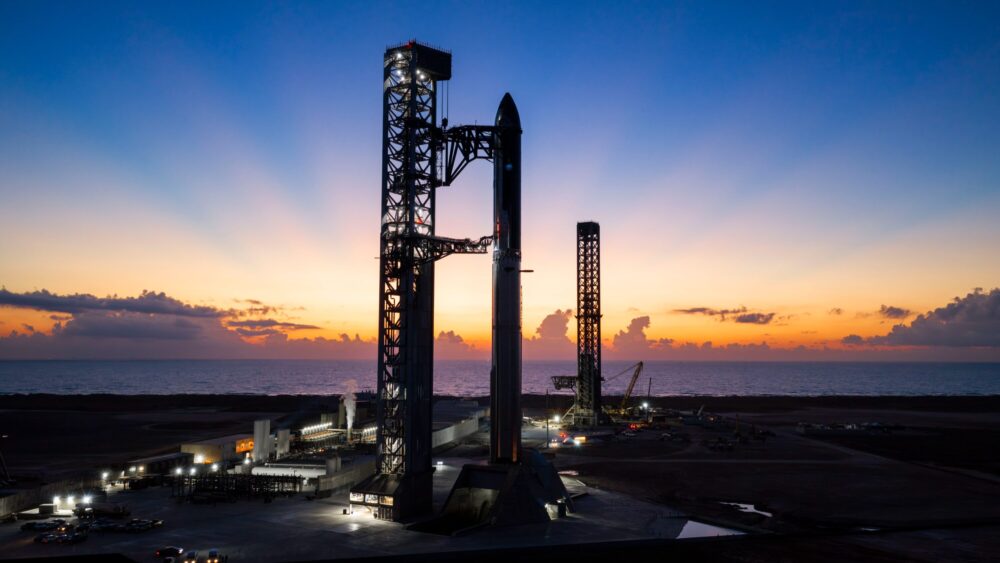
SpaceX's Starship completed its first orbital flight on September 28. The rocket lifted off from Boca Chica, Texas and splashed down in the Pacific Ocean west of Chile. The vehicle deployed 26 Starlink V3 satellites along the way. SpaceX called it a success. It was the 14th integrated test of the Starship system.
But it was not a clean run. According to BBC reporting, one of the upper stage's six RVac engines shut down unexpectedly during ascent. Engineers reviewed whether to continue and voted to proceed after checking the remaining engines.
SpaceX cut the mission short from its planned 10-hour, six-orbit profile. Starship returned to Earth after roughly three hours.
The engine shutdown was not an isolated event. Starship's Flight 12 in May also saw a RVac engine fail during the climb to space, according to Spaceflight Now's coverage of that launch. Flight 13 in July was aborted on the launch pad when four of the Super Heavy booster's 33 engines failed to ignite, according to reporting by the Associated Press.
SpaceX treats anomalies as expected features of an active test program. For the insurance market watching Starship's path toward commercial operations, each failure event adds data to an underwriting picture that is still being drawn.
The global space insurance market is projected to reach $6.23 billion by 2030, up from $4.06 billion in 2025, according to The Business Research Company's 2026 analysis of the sector. Commercial satellite launches and rising third-party liability requirements are the primary drivers of that growth.
The capacity base underwriting that growth is structurally thin. Roughly a dozen specialist underwriters worldwide handle space risk, concentrated primarily at Lloyd's of London, according to Gallagher Specialty's Q4 2025 space market update.
The market's recent profit rebound has attracted new capacity. Gallagher Specialty's space market update also put net profit on track to reach approximately $500 million for the year. The market had suffered heavy losses in 2023 and 2024. That recovery came largely from a low-claims year and favorable pricing on traditional geostationary satellite programs. Starship represents a different order of risk.
The vehicle SpaceX is positioning for commercial cargo, crew missions, and NASA's Artemis lunar program is not priced like a conventional satellite launch. Its payload values will grow as commercial operators begin using it.
NASA awarded SpaceX a $4.05 billion contract for two human-rated Starship vehicles, and a crewed lunar landing remains on the Artemis schedule. That contract ties government liability to a vehicle with documented in-flight engine anomalies across multiple consecutive test flights.
Space launch insurance premiums typically range from 5% to 12% of the insured value for a proven vehicle. For a new or unproven system, underwriters can price considerably higher or decline to write the risk at all.
Gallagher's Q4 2025 update noted that new-technology risks attract very cautious deployment of capacity. Underwriters cited mission failures and limited data spread as the primary constraints.
SpaceX self-insures its Starlink constellation, so the 26 satellites on today's flight were almost certainly not insured on the open market. The insurance question around Starship sits instead with third-party liability, future commercial payloads, and the government contracts that depend on the vehicle's reliability. Today's first orbital flight, engine anomaly included, was a step closer to that commercial reality.