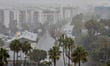
California’s latest atmospheric river is flooding streets, triggering rescues and renewing concern about a flood insurance gap that leaves most properties unprotected.
A prolonged atmospheric river pattern has battered the West Coast for nearly two weeks, Fox Weather reported. Los Angeles firefighters made multiple water rescues Thursday morning, and mudslides were reported across the San Fernando Valley. Los Angeles County and Malibu issued evacuation warnings for areas near recent wildfire burn scars.
On Wednesday, downtown San Francisco set a daily rainfall record of 2.64 inches, according to the National Weather Service. The previous record, 2.24 inches, dated to 1918. Early insured loss estimates were not immediately available.
“What we’re seeing in California is a reminder that flood impacts are rarely driven by rainfall alone. When intense rainfall interacts with local drainage capacity, saturated ground, topography, and elevated coastal water levels, impacts can escalate very quickly. For businesses, the consequences can extend well beyond property damage to roads, utilities, employee access and supply chains. Understanding risk at the individual location level is critical to anticipating not just physical damage, but the broader operational consequences that flooding can cause,” said Firas Saleh, director of North American flood models at Moody’s in New York.
“Flood events like this expose the gap between physical risk and financial protection. California faces significant flood exposure, but insurance take-up remains very low. That protection gap means households and businesses may ultimately have to absorb a substantial share of the financial losses when flooding occurs.”
For brokers, Saleh’s point about location-level risk applies directly to both property limits and business interruption exposure. A client whose policy was placed before the most recent atmospheric river seasons may be carrying assumptions about drainage and saturation that no longer hold.
Only 1.4% of California residential properties carry flood insurance, according to an April 2026 analysis by Neptune Flood of federal data. Neptune is a private flood insurer with a commercial interest in higher take-up. About 2.3 million properties face flood risk over the next 30 years, the analysis found.
The National Flood Insurance Program (NFIP) caps residential building cover at $250,000, often well below rebuild costs. NFIP participation has fallen 35% since 2016, while premiums rose more than 33%.
The gap is not new. Guy Carpenter’s post-event report cited Moody’s RMS estimates of $5 billion to $7 billion in economic losses from the 2023 floods. Only $500 million to $1.5 billion was insured.
Commercial policies typically exclude flooding, mudslides and debris flows unless a wildfire or another covered peril causes them, the California Department of Insurance has said. Surplus lines’ share of California commercial property rose from 6% in 2014 to 20% in 2025. Those placements often carry narrower cover and higher deductibles.
For brokers with California commercial accounts, three questions are worth raising before renewal: whether property limits reflect current replacement costs; whether flood cover through the NFIP or the private market is in place and adequate for the specific location; and whether mudslide and debris flow risks are addressed given the interaction between burn scars and rainfall. NFIP policies carry a standard 30-day waiting period, so timing is a constraint if a client acts only after a storm warning is issued.
More storms may follow. NOAA’s Climate Prediction Center put the odds of a strong-to-very-strong El Niño lasting through January to March 2027 above 79%. Specialty insurer Atrium found El Niño winters bring 19% more storm events to the US West Coast.