The pitch for the smart home has always been convenience: lights that dim on cue, doors that lock from a phone, an oven you can preheat from the office. This week, two of the biggest names in technology offered very different pictures of what that connected house might look like a year from now – and the timing is particularly important given the news we broke over the weekend of the huge hack starting fires in French supermarkets through connected fridges.
Earlier today, Apple unveiled HomeView, a $299 wall- or table-mounted screen designed to sit at the center of a household's devices. A day earlier, the AI developer Anthropic published research arguing that the same class of cheap, always-on gadgets could, within months, become a breeding ground for AI programs that copy themselves from device to device with no human at the controls.
Neither company was talking to insurers. But for carriers that write homeowners, personal cyber and small commercial cyber cover, the timing is hard to ignore: the number of connected devices in the average policyholder's home keeps climbing, and the threat model for those devices may be about to change.
Anthropic's Frontier Red Team, the group that probes its own and rival models for dangerous capabilities was careful not to spread immediate fear, but did warn that there could be trouble ahead. No self-spreading AI has been found in the wild, the researchers, William Zhou and Daniel Freeman, wrote. What they found instead were "signs of life."
To test whether household gear could carry a meaningful AI model, the team bought 15 off-brand Android TV streaming boxes at roughly $55 apiece, networked them, and split Google's open Gemma4-26B-A4B model across all of them, with each box holding two of the model's layers. It ran, though slowly: about 0.39 tokens per second.
That slowness is part of the warning. Because a model of this kind can be broken into pieces and spread over many weak machines, there is no single server to unplug. Anthropic likened a future replicator to a slime mold, persistent and spread out, with a doubling time measured in days rather than minutes.
In a second, more controlled test on eight emulated Android devices in the cloud, one open-weight model, GLM-5.2, managed the full cycle on its own: finding a new device, copying itself over and getting a working model running. It reached all eight nodes in four of five trials. The researchers stressed that the hacking step had been made deliberately easy, so the result is a ceiling, not a forecast.
They also noted that real-world IoT security often isn't much harder. The Mirai botnet, which took down major websites in 2016, spread largely by trying lists of factory-default usernames and passwords.
Plotting the progress of small models over time, Anthropic estimated that a model compact enough to fit on household hardware could reach GLM-5.2's level by the end of 2026. The researchers cautioned that the estimate rests on a general capability index and is a rough signal only.
One detail separates this from conventional malware. A traditional botnet is coded to attack specific devices. An AI-driven one could work out unfamiliar hardware for itself, and Anthropic found its test models got better at that over successive "generations" as each copy passed notes to the next.
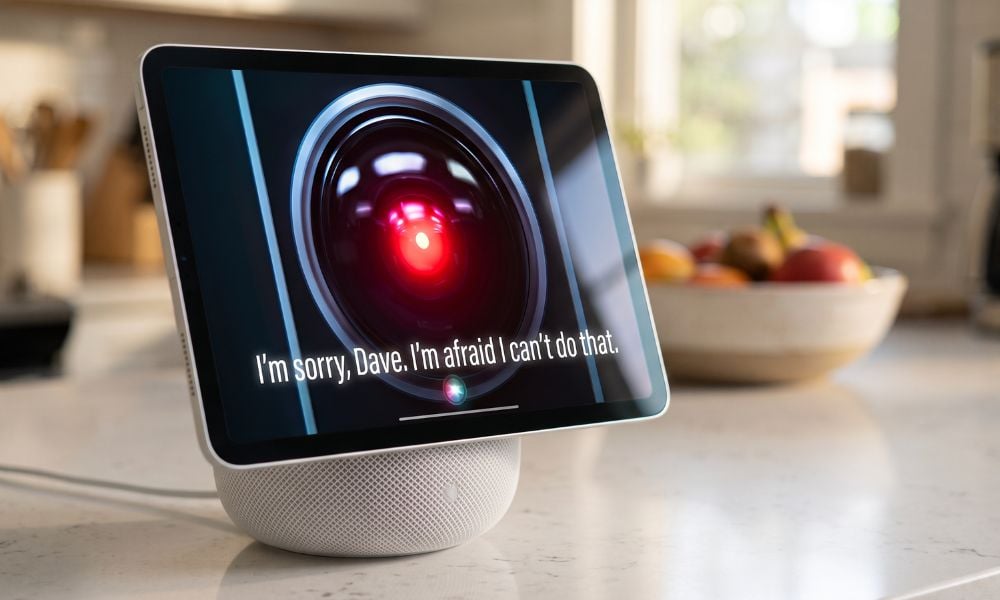
Apple's new hub is a 7-inch display that recognizes household members by face and shows each person their own messages, calendar and reminders. It supports up to six users, runs on an A18 chip and carries a 12-megapixel camera and a four-microphone array that listens for Siri from across the room. Pre-orders opened Tuesday, and it ships November 13. The launch was the second product event under chief executive John Ternus, who succeeded Tim Cook in September.
More relevant to underwriters is what HomeView controls. Apple pitched it as a dashboard for the whole home: viewing camera feeds, changing the thermostat and locking doors. It works with a new line of locks, doorbells and cameras from LG Electronics, with wall mounts from Schneider Electric's home brand, and Apple said adding a new device takes a single tap on an iPhone.
That ease of setup is the point. Apple's home products sit in a segment that, alongside the Apple Watch and AirPods, brought in $7.88 billion in the quarter ended in June, roughly 7 percent of company revenue, by CNBC's figures. Gadgets that tie a household to the iPhone make customers less likely to switch.
Read next: Insurance agents take center stage as homeowners face rising risks and premiums
There is an important difference between Apple's ecosystem and the devices Anthropic tested. Premium, centrally updated hardware from a major manufacturer is a very different security proposition from a no-name streaming box that ships with an outdated fork of Android and never receives a patch. Anthropic's researchers pointed to a botnet called Kimwolf, documented by the security firm Synthient, that infected more than two million devices, mostly off-brand Android TV boxes.
But a home rarely runs on one brand. The same living room that holds an Apple hub may hold a $40 streaming stick, a smart plug bought on sale and a robot vacuum. Anthropic named smart fridges, ovens, vacuums and lawnmowers as hardware with enough memory to host a piece of a model, and flagged security cameras with built-in AI chips as likely targets.
Personal lines insurers have spent a decade nudging customers toward connected devices. Water-flow monitors, smart smoke detectors and connected locks cut claims, and many carriers offer discounts for them. In Nationwide's 2025 Homeowners Report, more than 85 percent of agents said they now recommend smart-home technology to clients as a loss-prevention tool, and 48 percent of homeowners reported using it.
Anthropic's research doesn't suggest those devices will start leaking water or unlocking doors. A replicator, as described, mostly wants the device's memory and processing power. For a homeowner, the likelier symptoms are a sluggish network, higher power use and a gadget that quietly becomes a launch point for attacks on others.
That is where coverage gets murky. Standard homeowners forms generally exclude cybercrime, and the personal cyber endorsements that have grown up to fill the gap typically focus on fraud, extortion, data recovery and system restoration. Whether a policy responds when a device is conscripted, rather than broken into for money, will depend on wording that was written long before anyone imagined a self-propagating AI.
Read next: How Anthropic's Mythos is fueling cyber risk aggregation fears
For commercial cyber, the bigger worry is aggregation. Small businesses run the same cameras, conferencing units and network storage boxes that Anthropic flagged. Erik Tifft, global head of underwriting at BOXX Insurance, told Insurance Business last week that insurers are now pricing for the possibility that a single rogue AI agent hits many policyholders at once. He added that most cyber policies would treat an AI agent's attack as a cyber attack, unless the policy carries AI exclusionary language.
Those exclusions are already appearing in other lines. Brokers have described carriers adding broad AI exclusions to D&O and E&O forms, while many cyber insurers have gone the other way and added endorsements affirming that AI-driven attacks are covered.
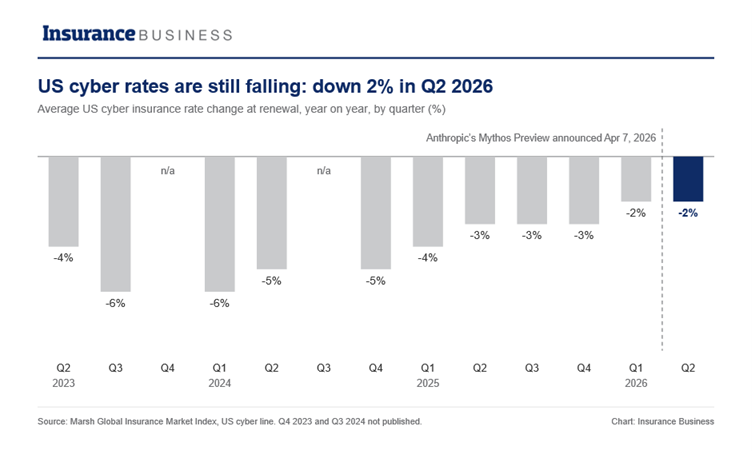
Pricing has yet to reflect any of this. US cyber rates fell 2 percent in the second quarter of 2026, according to Marsh's Global Insurance Market Index, even as JPMorgan's Jamie Dimon warned that AI had increased cyber risk tenfold.
Read next: Cyber insurance looks for stability as AI heightens risks
Anthropic's own prescription borrows heavily from the last great IoT outbreak. A model that spreads by copying multi-gigabyte files between devices would leave a visible trail in internet providers' traffic monitoring. The faster it spreads, the noisier it gets.
When internet providers used outside evidence to quarantine and notify customers infected by Mirai, 92 percent of infections were cleared within 14 days, compared with 74 percent when customers weren't notified. The researchers also pointed to regulation as a lever, citing Britain's rule that makes default passwords on consumer smart devices non-compliant.
The US has no equivalent ban. Its closest tool is the FCC's voluntary US Cyber Trust Mark, a label for smart cameras, appliances, speakers and other wireless devices that pass baseline security tests. The program is still being stood up: the FCC named the nonprofit ioXt Alliance as lead administrator in April and recognized accreditation bodies only on September 28. For underwriters, a widely adopted label could eventually offer a cheap proxy for device hygiene, much as UL listings did for electrical risk.
For brokers, the practical advice sounds familiar: change default passwords, turn off debugging ports, keep firmware current and put cheap gadgets on a separate network from laptops and work devices. What has changed is the urgency, and the question underwriters may soon start asking at renewal: what exactly is plugged into this house or this office?
Read next: Dimon says AI cyber risk is up tenfold. Cyber insurance prices are still falling
Anthropic was careful to say nothing like this exists yet. But its researchers ended with a prediction that reaches past their experiments: a future crowded with AI agents running on all kinds of hardware, some of it beyond anyone's control. For an industry that prices the home, the warning arrived in the same week Apple asked consumers to put a camera-equipped, face-reading computer on the kitchen wall.