For all the talk of runaway algorithms, the early record of artificial intelligence going wrong looks less like science fiction and more like a tabloid inbox and a copyright docket.
That is the picture painted by The Insurability of Artificial Intelligence, a peer-reviewed report published September 16 by the RAND Corporation.
Researchers Sasha Romanosky and Celine Robinson combed through public incident records, AI litigation, enacted state laws and admitted-market policy filings, then interviewed insurance and legal specialists, to work out what kind of risk insurers are really being asked to carry.
Their answer: AI has already caused plenty of harm, but so far most of it involves fake content and copyright fights rather than the operational failures many policyholders worry about. The evidence sits alongside RAND's wider finding, covered in Insurance Business earlier this month, that most carriers are staying silent on AI in their wordings, leaving coverage open to dispute.
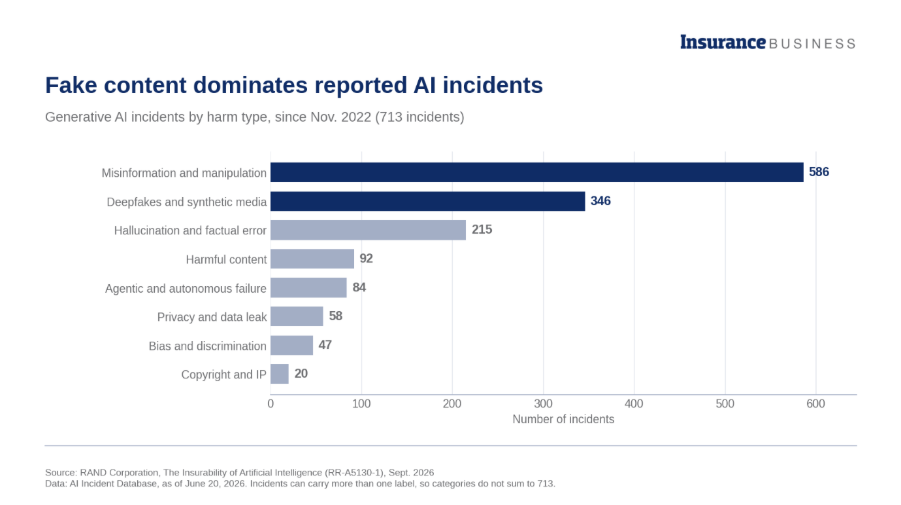
The researchers drew on the volunteer-run AI Incident Database, isolating 713 generative AI incidents logged since ChatGPT's launch in November 2022. Of those, 599, or roughly 84%, involved misinformation or deepfakes.
Fabricated audio of politicians, cloned voices, scams built on synthetic text and images. The two categories overlap heavily, with more than half of the misinformation cases relying on fully synthetic media to do the deceiving.
Audio was the most common medium, appearing in about a third of incidents, ahead of video at roughly a quarter.
The more "operational" failures that keep risk managers up at night are present, but trail well behind. Hallucinations and factual errors featured in 215 incidents, about 30%. Harmful or unsafe outputs accounted for 92. Agentic failures, where an AI system takes an unintended real-world action, numbered 84. One widely reported case this spring involved a coding agent that, according to the company's founder, deleted a software firm's production database and its backups in seconds.
The authors caution that the database is crowdsourced and not fully validated, so it signals the shape of AI harm rather than its true frequency.
Read next: How Anthropic's Mythos is fueling cyber risk aggregation fears
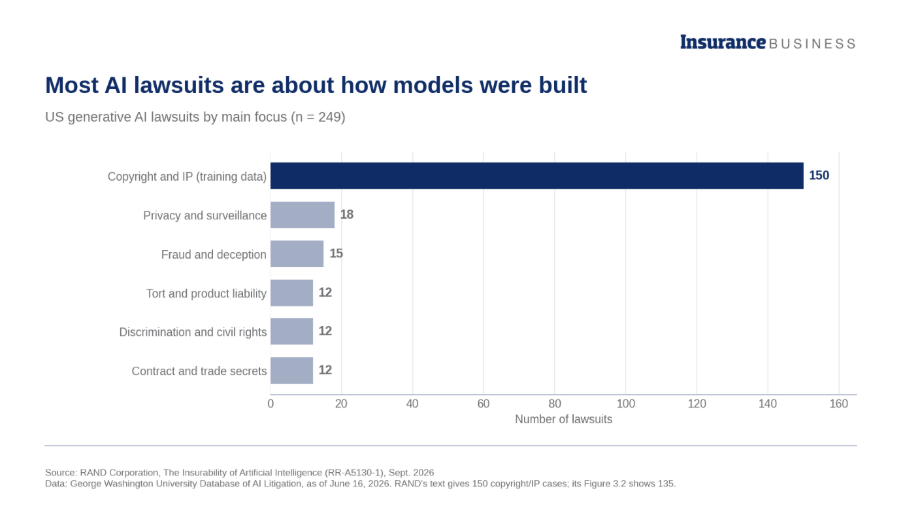
If incidents are mostly about fake content, lawsuits are mostly about training data. Using George Washington University's Database of AI Litigation, RAND examined 249 US generative AI cases and found that 150, or 60%, concern alleged copyright or intellectual property violations in how models were built, not how they were used. The best-known example is the New York Times' suit against OpenAI and Microsoft over the use of its articles to train chatbots.
That matters for underwriters because those cases mostly target AI developers, the frontier labs, which typically try to cap their exposure through contracts.
The businesses that brokers place every day are usually deployers, companies plugging AI into customer service, hiring, lending or underwriting. RAND argues deployers may ultimately be the most exposed to operational, regulatory and end-user harm, yet they barely register in today’s litigation counts.
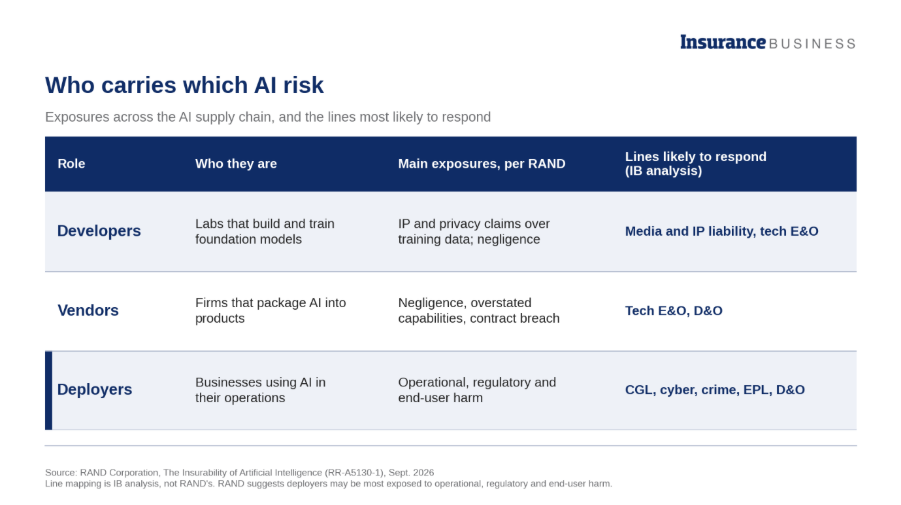
The smaller buckets hint at what may be coming. RAND counted 18 privacy and surveillance suits, 15 fraud and deception cases, including allegations of "AI washing" by executives who overstated their products' capabilities, and 12 tort and product liability claims, among them wrongful-death suits against chatbot makers. Each of those maps to a familiar line: cyber and privacy liability, D&O, and products or general liability.
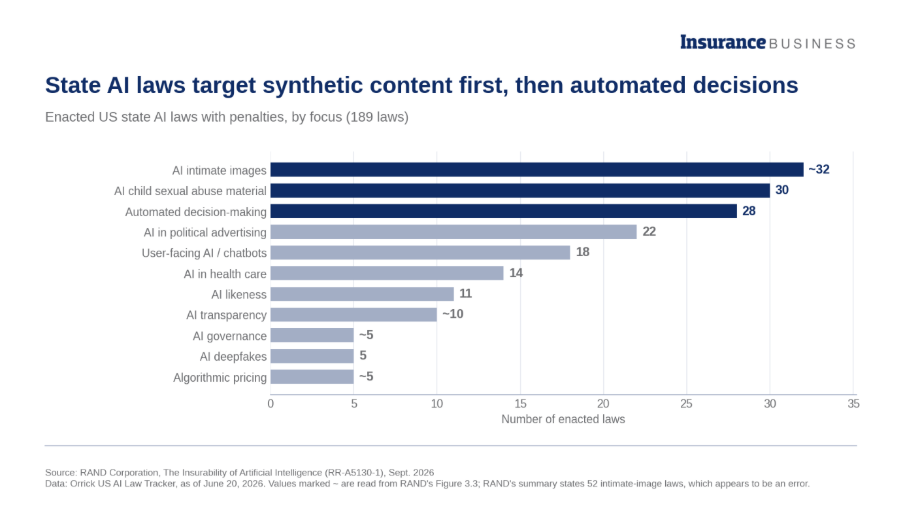
State legislatures have reacted to the same flood of synthetic content. Of the 189 enacted state AI laws with penalties that RAND reviewed, using law firm Orrick's US AI Law Tracker, the largest group targets nonconsensual intimate images and AI-generated child sexual abuse material, with 62 such laws across 33 states.
A second wave is aimed squarely at commercial users. RAND counted 28 laws on automated decision-making, covering opt-out rights, impact assessments and bias audits in hiring, plus 18 laws governing customer-facing chatbots and 14 restricting AI in health care coverage decisions. For employers and insurers alike, those are the rules most likely to generate regulatory and employment practices claims.
Read next: Why insurance AI strategy must start with outcomes: Centre for Economic Justice
It is tempting to treat AI as cyber insurance's younger sibling. RAND argues that would be a mistake. Most cyber claims are first-party costs triggered by an identifiable attack, while most AI losses so far are third-party claims, often from a system doing what it was built to do, just badly.
That moves underwriting away from firewalls and patching toward governance, such as model validation and human review of outputs, and makes causation harder to pin down.
The practical result is that a single AI event can touch a dozen policies. RAND reproduces an Aon mapping of AI perils against 11 potential lines, from media liability and tech E&O to crime and employment practices.
Brokers have already seen insurers move to narrow that sprawl, with some carriers stripping deepfake fraud from social engineering cover at January renewals while others market it as an affirmative extension.
Underwriters would normally settle these questions with claims data. There is almost none.
RAND notes that public AI claims data is effectively nonexistent, lawsuits take years to resolve, and the same model configured the same way can fail in different ways. Benchmarks and governance questionnaires help, the authors say, but measured error rates may miss the rare failures that cost the most.
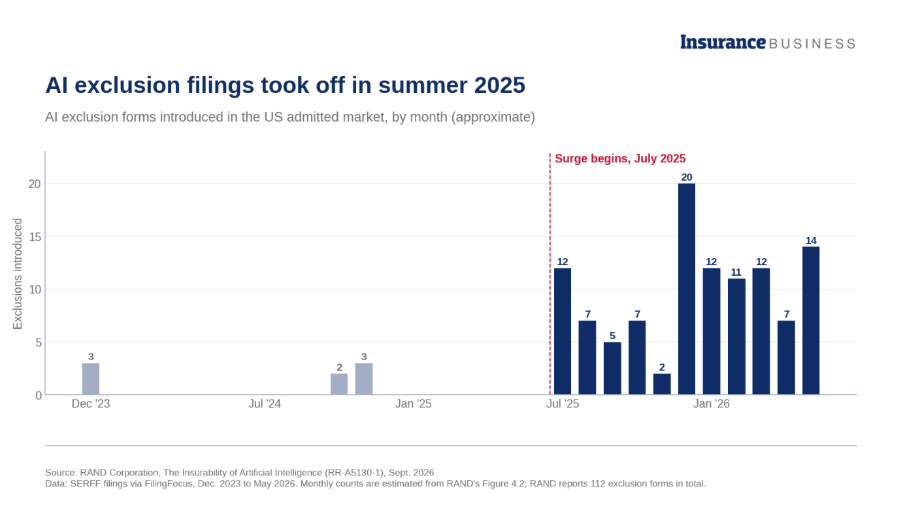
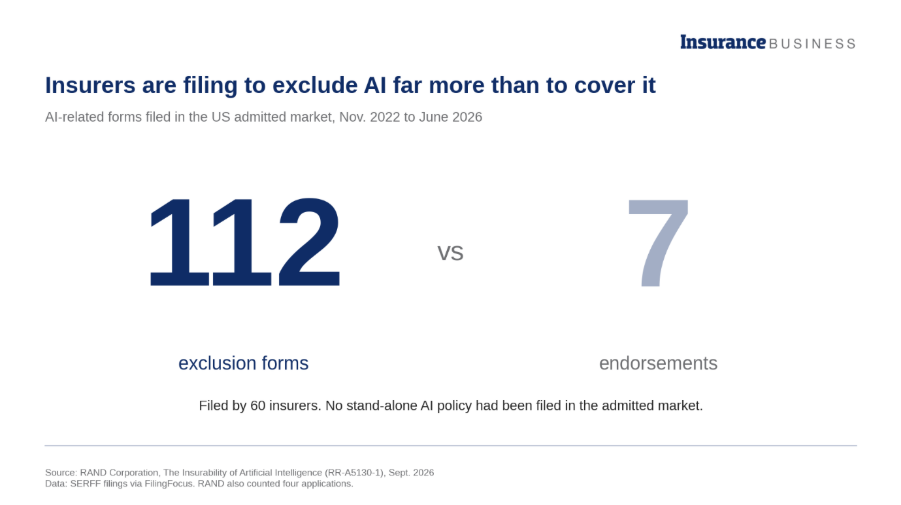
The predictable response is caution: narrower terms, higher retentions, lower limits and more exclusions. Admitted-market filings bear that out. Of the AI-related forms RAND pulled from state filing systems, 112 were exclusions against just seven endorsements, filed by 60 insurers.
The report adds that no stand-alone AI policy had been filed in the admitted market at the time of writing, leaving affirmative cover largely to specialty and non-admitted players, a gap that delegated underwriters are watching closely.
Read next: Insurance is all in on AI, but the foundations are shaky
RAND frames the market's choice as a seesaw. The more AI loss carriers affirmatively cover, the smaller the protection gap for businesses, but the more correlated exposure insurers take on. Exclusions do the reverse. Silence, the most common posture, is the worst of both, because it hides the size of the gap and the size of the accumulation.
The report is candid that no data yet exists to estimate either figure. Its fix is less glamorous than a new product: a shared taxonomy for logging AI incidents, claims and the controls in place at the time of loss, built by brokers, carriers, reinsurers and researchers, with each company's data kept private. Alongside it, RAND wants state regulators and the National Association of Insurance Commissioners to develop a standard AI Coverage Notice, and carriers to stress-test scenarios such as a flawed update to a widely used model or a court ruling that suddenly makes a common AI practice actionable.
The authors steer clear of calling for federal rules, and that debate is still live. A December 2025 executive order directs federal agencies to challenge state AI laws, but as of late September no state law had been struck down under it and Congress had not passed preemption legislation, according to a tracker of the order's implementation.
For brokers, the near-term takeaway is simpler. The losses clients are most likely to face first are not malfunctioning robots but impersonation, fraud, content liability and the regulatory fallout from automated decisions. Those already sit, uneasily, inside policies clients own today. As earlier reporting on hidden AI liability inside conventional policies has shown, finding out which ones respond is now part of the renewal conversation.
Read next: Report: Businesses push for insurance cover as GenAI risks multiply