Orion180 Insurance Group has kicked off the investor roadshow for its initial public offering, putting a price tag on the company of as much as $1.68 billion as it looks to become the newest specialty property insurer on Wall Street.
The Melbourne, Florida-based carrier is offering 20 million shares of Class A common stock at $15 to $17 each, a range that could bring in roughly $340 million before fees, according to the registration statement filed with the Securities and Exchange Commission. Underwriters also have a 30-day option to buy an extra 3 million shares if demand is strong, the company said in a statement announcing the roadshow launch. Shares are expected to begin trading on the Nasdaq Global Select Market under the ticker "OIG."
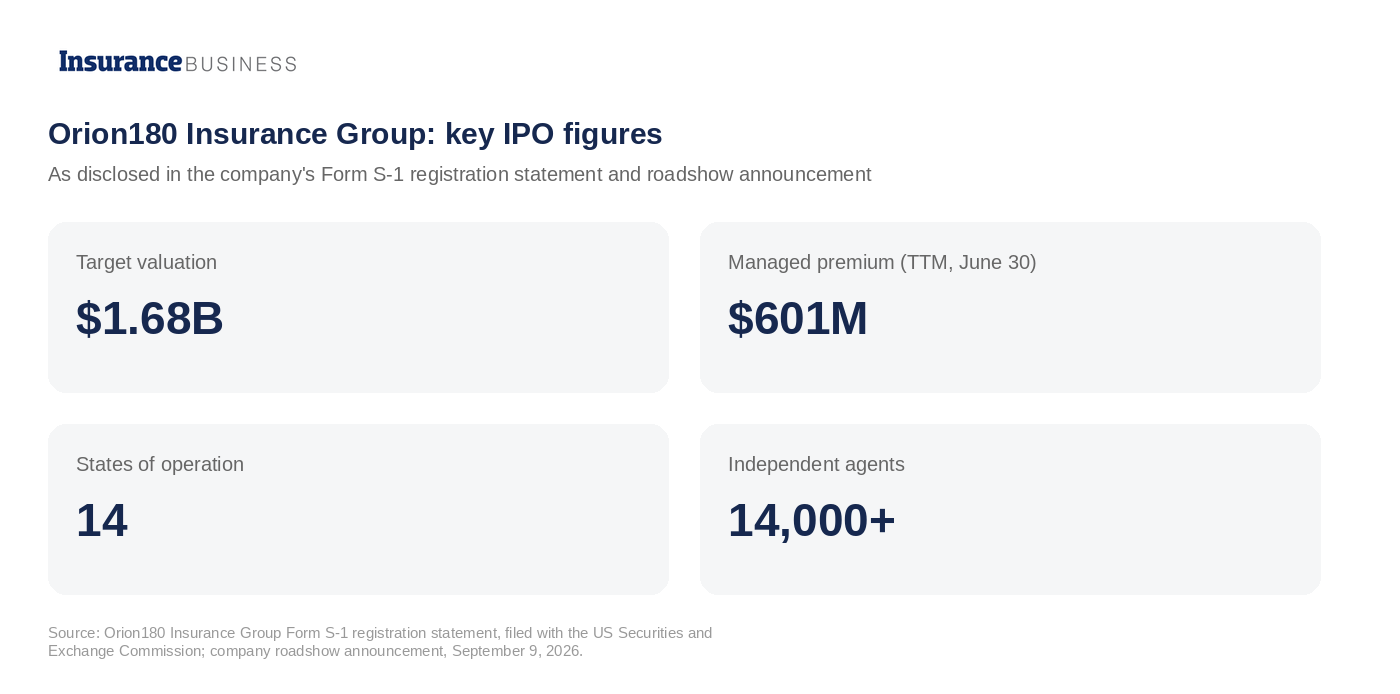
Orion180 has grown almost entirely through organic expansion since Kenneth Gregg founded the company in 2018, building what it describes as the second-largest excess and surplus (E&S) lines homeowners insurance operation in the country by direct written premium. The carrier now writes admitted and E&S homeowners policies, plus private flood coverage, across 14 states, leaning on more than 14,000 independent agents and a proprietary underwriting platform called MY180.
Texas, California and Florida remain its biggest markets. The company had already filed its initial paperwork with regulators last month, a move that came as admitted carriers continued pulling back from catastrophe-exposed homeowners risk.
Read next: Orion180 seeks IPO as admitted market retreat fuels E&S growth
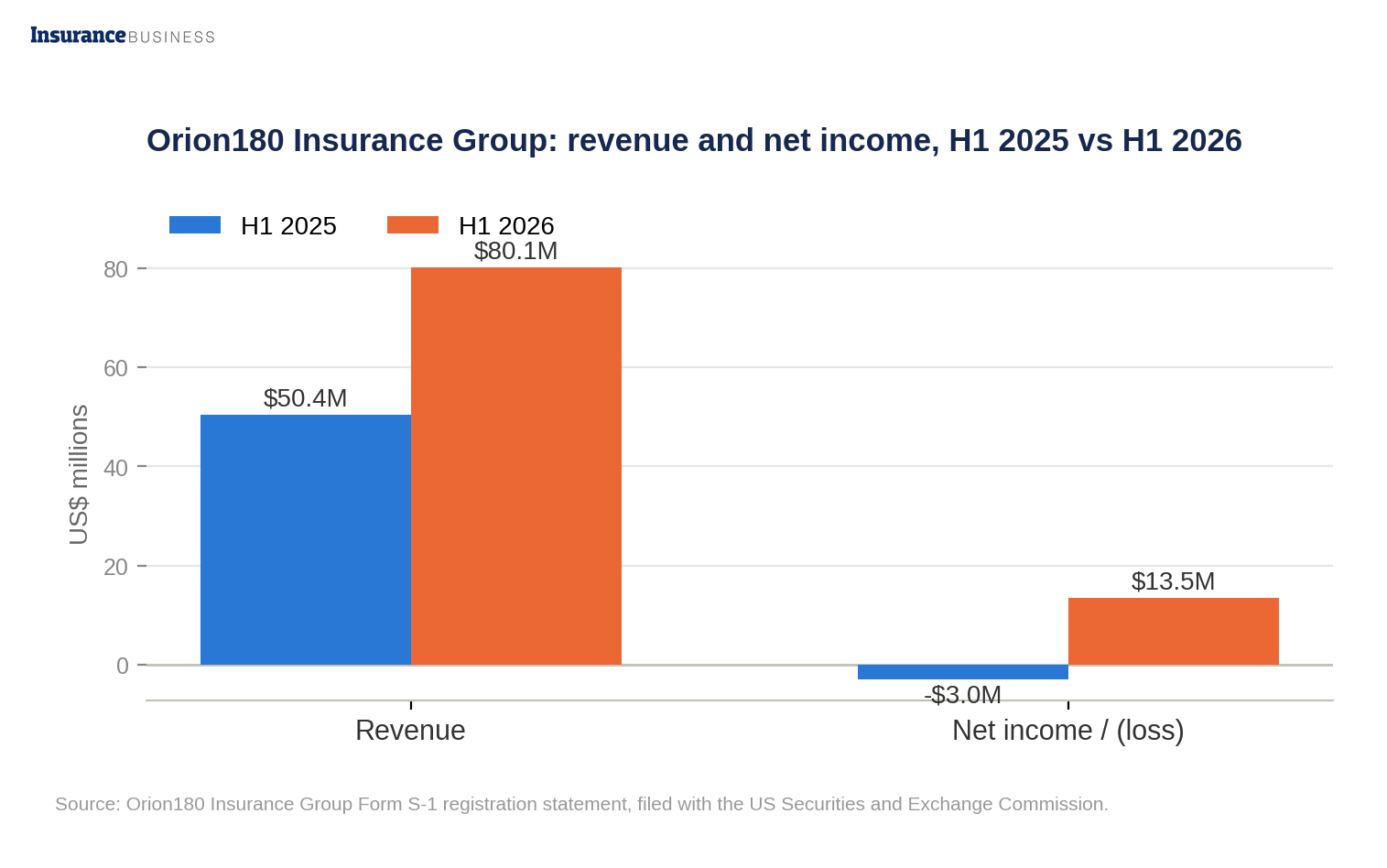
The numbers behind the pitch to investors show a business swinging firmly into profit. Orion180 posted net income of $13.5 million on revenue of $80.1 million for the six months ended June 30, a turnaround from a $3 million net loss on $50.4 million of revenue in the same stretch a year earlier. Managed premiums written over the trailing 12 months came in at roughly $601 million, the filing shows.
Even before Orion180 prices, the numbers seem to be ambitious, putting it in a different valuation bracket than its established, publicly traded peers. Annualizing Orion180's H1 2026 results (a rough approximation, since insurance earnings can be seasonal) works out to roughly $160 million in run-rate revenue and $27 million in net income — against a $1.68 billion target valuation, that's a price-to-sales ratio near 10.5x and a price-to-earnings ratio above 60x.
By contrast, Kinsale Capital Group, the most direct public comparison as a pure-play E&S specialty insurer, trades at a trailing price-to-earnings ratio around 19.4 and a price-to-sales ratio near 5.1, while Florida-focused homeowners insurers like HCI Group trade even cheaper, at a P/E ratio below 7 and a price-to-sales ratio around 2.3.
The nearest apples-to-apples comparison may actually be Bamboo Insurance, the other homeowners MGU headed for an IPO this fall. When CVC Capital Partners took its controlling stake in Bamboo in December 2025, the deal valued the company at approximately $1.75 billion (one industry tracker put the figure closer to $1.8 billion) — against roughly $173 million in first-half 2026 revenue, which annualizes to a price-to-sales ratio closer to 5x, in line with Kinsale rather than with what Orion180 is now asking public investors to pay. That gap suggests Orion180's bankers are pricing in a growth premium — its revenue roughly tripled year over year, well ahead of Bamboo's slower pace of expansion though it also means the stock will have less room for error if that growth rate cools once.
The wider surplus lines market isn't growing quite as fast as Orion180. Premium volume across the 15 stamping-office states rose just 2.8% to $47.6 billion in the first half of the year, a sharp slowdown from 2025's pace, as commercial property rates softened. Homeowners and other residential property premiums moved the opposite way, up more than 20% over the same period, which is one reason a personal-lines specialist like Orion180 is still finding room to grow even as commercial property capacity gets more competitive.
Read next: Property softens, liability hardens: what E&S midyear data means for brokers
Orion180 won't have the market to itself for long. Bamboo Insurance Services, the CVC Capital Partners-backed homeowners MGU based in Midvale, Utah, filed its own registration statement in late August and is aiming for a New York Stock Exchange listing under the ticker "BMB." The two companies are structured differently: Orion180 retains a share of underwriting risk through its own in-house fronting carriers, while Bamboo prices and selects risk but leaves the capital-holding to a panel of third-party fronting carriers. Investors weighing both deals will likely look closely at that distinction.
Read next: Bamboo Insurance files for IPO – what it means for brokers relying on its wildfire capacity
Both deals are landing in the same post-Labor Day window, traditionally one of the busiest stretches for new listings. Holtec Nuclear and American Savings Bank also launched IPO roadshows this week, adding to the sense that the market is picking back up after its usual summer lull.
For agents and brokers, the bigger story may be less about share price and more about what it signals for capacity in hard-to-place homeowners risk. With as much as $340 million in fresh capital, a public Orion180 would have more room to expand into new states and product lines at a time when admitted carriers keep retreating from catastrophe-exposed business, leaving the E&S market to absorb the difference.
Read next: Where admitted carriers retreat, E&S insurers are stepping in
RBC Capital Markets, UBS Investment Bank and Raymond James are leading the offering as book-running managers, with Goldman Sachs, Deutsche Bank Securities, Citizens Capital Markets and Texas Capital Securities also participating, according to the company's announcement. Pricing is expected within days, and the final valuation will depend on how the roadshow lands with institutional investors over the coming week.