When the United Kingdom's Tobacco and Vapes Bill receives royal assent next week, it will do something no major economy has attempted at scale before: it will use the law to permanently remove a generation of people from the pool of future smokers. Children who are 17 or younger today — and everyone born after them — will never legally be able to buy a cigarette in Britain. Not when they turn 25. Not when they turn 50. Not ever.
For public health advocates, this is the headline. For the insurance industry, the implications run considerably deeper, and considerably longer.
Insurance is, at its core, a business of predicting who will get sick, when, and at what cost. Smoking has been one of the most reliable predictors actuaries have ever had. The data is unambiguous and has been for decades: smokers die younger, develop costly chronic diseases at higher rates, and draw far more heavily on health and long-term care resources than non-smokers. According to the CDC, cigarette smoking cost the United States more than $600 billion in 2018 alone — including more than $240 billion in direct healthcare spending and nearly $372 billion in lost productivity — a figure that dwarfs the NHS's equivalent burden many times over.
 Read next: Most risk portfolios are complex. Rochelle Lewis's involves cliff diving.
The British legislation does not make this cost disappear overnight. The cohort affected by the ban — those born on or after January 1, 2009, who will never be permitted to buy tobacco — are still children or teenagers. Their impact on insurance loss ratios, on mortality tables, on group health plan costs, will not be felt meaningfully for another ten, twenty, even thirty years. Actuaries are accustomed to thinking in those timescales. And when they do, the mathematics are striking.
If you model a generation in which the smoking prevalence rate falls to near zero — not through gradual social change, but through a legal floor that prevents uptake entirely — the downstream effects on life insurance mortality, on health insurance claims frequency, on critical illness payouts for lung cancer, heart disease, and chronic obstructive pulmonary disease, are enormous. A cohort that does not smoke at all is a cohort that, on average, lives longer, spends less time in hospital, draws less on long-term care, and generates fewer large catastrophic claims in the middle decades of life.
Read next: Global life expectancy trends – what are the implications for insurance?
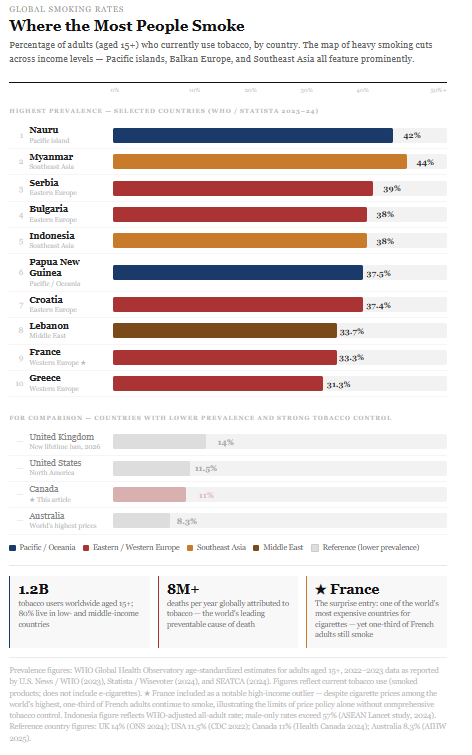 For life insurers, this represents an opportunity: premiums calibrated against a genuinely lower-risk population, over time, translate into healthier margins or more competitive pricing, or both. For health insurers and self-funded employer plans, the long-run claims trajectory bends downward. The compounding effect of removing smoking-related illness from the population — lung cancer, stroke, heart attack, COPD — is not a marginal improvement. Smoking causes roughly one in five deaths in the United States annually. Even a partial, generational reduction in that number reshapes the actuarial landscape in ways that would take decades to fully price.
The key word, of course, is generational. No chief actuary is revising their 2027 loss projections on the basis of a British law passed this week. But the insurers and reinsurers who are already beginning to model what a structurally lower-smoking population looks like — and pricing long-tail products accordingly — will have a significant informational advantage over those who are not.
The actuarial implications of a genuine smoke-free generation are not purely theoretical. New Zealand attempted a similar policy in 2022, before a change of government led to its complete repeal in February 2024 — providing a brief natural experiment in how markets and insurers respond to the prospect of legislated risk elimination. All three pillars of the New Zealand law — the smoking generation ban, de-nicotisation measures, and a 90% reduction in retail tobacco outlets — were scrapped in full by the incoming National-led coalition, which used the tobacco tax revenues to fund unrelated tax cuts. The UK move is more durable, more politically entrenched, and backed by a National Health Service with a powerful institutional interest in its success.
Several reinsurance firms have already begun incorporating smoking trajectory scenarios into their long-term mortality models. Swiss Re and Munich Re both publish regular research on the relationship between lifestyle risk factors and longevity trends. The UK legislation gives those models a hard policy input rather than a social trend estimate — and hard inputs are more valuable to the long-run pricing of term life, whole life, and annuity products than soft ones.
Read next: Reinsurers bring pressure to bear on vaping
For US carriers writing long-tail life products — thirty-year term policies, whole life, universal life — the British data will become genuinely useful within the next fifteen years. If UK mortality data begins to diverge from US mortality data in the ways the actuarial models predict, driven in part by structural differences in smoking prevalence, that divergence will inform reinsurance pricing, product design, and underwriting philosophy on this side of the Atlantic.
There is also a more immediate consideration for US group health insurers and the employers who self-fund their plans. The Affordable Care Act permits insurers to charge smokers up to 50 percent more in premiums than non-smokers. Many carriers and employers use some version of this surcharge, though take-up has been uneven and enforcement is often soft. If UK population data begins to demonstrate measurable improvements in health claims and mortality over the next decade — even early signals, given the relatively young age of the protected cohort — it will strengthen the case for more aggressive smoking-related underwriting and wellness programme investment in the American market.
The honest answer is: not soon, and not easily. But perhaps not never.
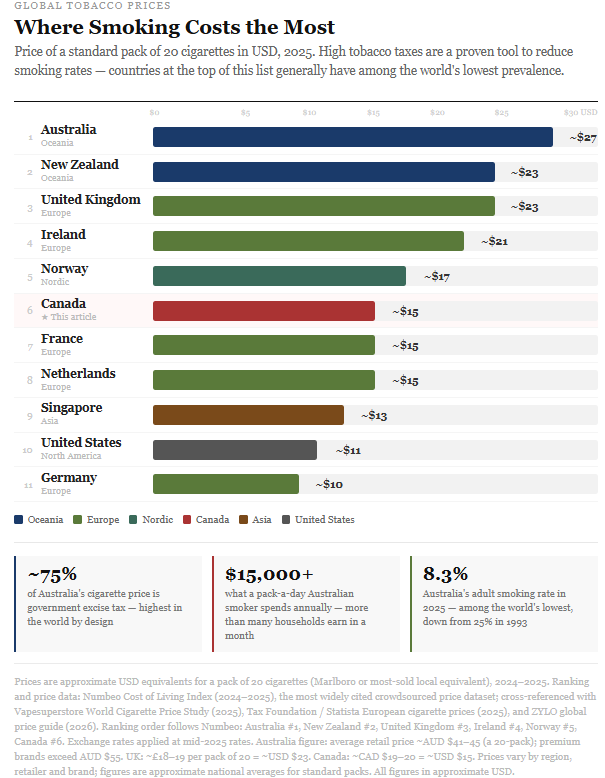
The political and structural barriers to a UK-style lifetime smoking ban in the United States are formidable. The tobacco industry retains significant lobbying power, particularly in states like North Carolina, Kentucky, and Virginia where tobacco agriculture remains economically and culturally significant. The fragmented American regulatory system — in which tobacco policy sits across the FDA, state legislatures, and local jurisdictions — makes the kind of clean, nationwide legislative action Britain achieved far harder to replicate. And the American political tradition of individual liberty as a counterweight to public health paternalism means that a permanent, lifetime purchasing ban would face constitutional and cultural resistance that the more consensus-driven British parliamentary system largely avoided.
The FDA does have authority, under the 2009 Family Smoking Prevention and Tobacco Control Act, to regulate tobacco products — including the power to reduce nicotine levels, restrict flavours, and limit marketing. It has used these powers cautiously, and the current regulatory environment is not one in which significant expansion of federal health mandates seems likely. State-level action is more plausible: California, Massachusetts, and New York have historically been willing to move ahead of federal policy on tobacco regulation, and a state-level rolling age ban is not inconceivable in the medium term.
For the insurance industry, the more immediately actionable question may not be whether US law will replicate the British approach, but whether US insurers should be advocating more loudly for it. The industry has a direct, quantifiable financial interest in reducing smoking prevalence — an interest that is arguably larger and more sustained than that of any other sector of the economy. Trade bodies such as America's Health Insurance Plans and the American Council of Life Insurers have generally supported tobacco control measures, but the industry has not historically positioned itself as a leading voice for aggressive legislative intervention. The UK precedent gives insurers a concrete, internationally tested model to point to, and a powerful economic argument for why the long-term mathematics favour bold action over incrementalism.
Whether American politics allows for that boldness is another matter entirely. But the actuaries are already running the numbers. And the numbers, over a long enough horizon, are compelling.