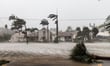
Hurricane Isaias has handed Florida’s reformed property insurance market its first real stress test since Hurricane Milton in 2024, and the initial verdict from Fitch Ratings is that rated carriers are holding.
Hurricane Isaias made landfall in the Florida Panhandle as a Category 3 storm on October 9, near the Santa Rosa-Okaloosa county line, bringing sustained winds of 120mph and life-threatening storm surge. Fitch Ratings, in a new commentary, said insured losses from the storm could reach the mid-single-digit billions of dollars. That is a meaningful earnings hit for large, rated reinsurers with Gulf exposure, but Fitch does not expect it to pressure credit profiles. The distinction between an earnings event and a capital event signals that the industry’s reserve and surplus positions remain intact even as Q4 results take the blow.
The loss picture is not uniform across the market, and where a carrier writes business determines how much of the damage it absorbs directly. Florida specialist homeowners’ insurers cede a large share of their exposure to third-party reinsurers, which insulates their balance sheets when a storm strikes the state. Most large national carriers, meanwhile, have pulled back from Florida through non-renewals and reduced policies in force, limiting their direct exposure there.
The dynamics shift, however, in Alabama and the other states Isaias swept through after landfall. National insurers rely on less reinsurance in those markets than Florida specialists do, so they are expected to retain a more meaningful share of wind-driven losses from the states beyond the Panhandle. Brokers placing commercial risks along the northern Gulf Coast, particularly in Alabama and Georgia, should expect national carriers to be absorbing more of those losses directly rather than ceding them upstream. That dynamic can affect claims settlement speed and behavior under loss pressure.
Florida’s insurer landscape has changed substantially since the state enacted insurance and tort reforms in 2022 and 2023. The reforms targeted litigation practices that had long inflated loss costs and discouraged private-market participation. Citizens Property Insurance Corporation, the state-backed insurer of last resort, saw its policy count fall from a peak of approximately 1.4 million in October 2023 to approximately 266,000 as of September 2026, according to Fitch, as policyholders moved to private carriers. That reduced concentration lowers the likelihood of Citizens suffering losses large enough to pressure its surplus and reinsurance program from a single event like Isaias.
Gallagher Re’s year-end Florida Market Watch report found that the overall market’s weighted-average combined ratio fell to 81.8% in 2025, down from 104.2% the prior year, as 46 of the 61 tracked carriers posted an underwriting gain. Policyholders’ surplus for the full market grew 25.7% to $16.4 billion. Milton’s aftermath reinforced the picture. Fitch noted that the storm’s ultimate insured losses came in manageable relative to initial estimates, with no material adverse reserve development reported in subsequent periods. Isaias now extends that track record, at least for the rated segment of the market.
The most pointed element of Fitch’s commentary concerns insurers it does not rate. A cohort of newer Florida-domiciled carriers has accumulated capital during the improved operating conditions of the past two years, but has not yet been tested by a severe catastrophe. Fitch warned that these insurers could be vulnerable to large events that produce losses exceeding their reinsurance limits, given their concentrated Florida exposures and smaller capital bases relative to national carriers. While Fitch does not expect Isaias to exhaust catastrophe reinsurance protection for most Florida specialists, individual carriers with unusual risk concentrations may report higher-than-expected gross losses.
That caveat carries weight when advising clients on carrier selection in the Florida market, where the difference between a rated, well-capitalized insurer and a newer entrant can determine how quickly and completely a claim gets paid after a major storm.
The broader market context reinforces Fitch’s measured tone. Gallagher Re said ahead of landfall that ample reinsurance capital made it unlikely Isaias would meaningfully affect January 1 renewal discussions. That assessment holds with losses in the mid-single-digit billions, a meaningful event, but one well within the market’s current absorptive capacity.
Florida’s 2026 reinsurance renewals had already reflected an influx of capital and improved carrier results, with Guy Carpenter clients securing more than 12% additional capacity compared with the prior year, even as pricing softened. Isaias does not appear to change that trajectory.