
Mark Walter, the Guggenheim Partners chief and Los Angeles Dodgers owner, is reportedly trying to sell his Cadillac Formula 1 team. For the annuity market, the more important story is the insurers behind him.
Sportico reported that Walter wants at least $3 billion for the team and that at least seven parties are interested, according to three unnamed sources. Bloomberg separately reported buyers circling, but said TWG Global, Walter’s holding company, had not agreed a deal or formally put the team up for sale. General Motors, which partners with TWG on the team, declined to comment, according to IndyStar.
In August, TWG said it was “not considering exiting its stake” in Cadillac or anything else in TWG Motorsports. Around the same time, it also noted that Walter and his partners regularly hear from prospective buyers and weigh serious offers, according to CNBC. That message arrived as TWG pushed back on motorsport sale talk while the insurance probe widened.
Cadillac would be the latest in a run of sports sales. Walter agreed to buy the Los Angeles Lakers at a $10 billion valuation in June 2025. According to Reuters, he then agreed in August to sell them for $12.5 billion to a group led by Josh Kushner and Bob Iger. He sold his Chelsea FC stake in September and has reportedly explored selling the WNBA’s Los Angeles Sparks. He has said the Dodgers will stay.
The F1 team is expensive to run. Sportico estimates that getting onto the grid took a $450 million dilution fee plus at least $1 billion more, and that the team is heading for a loss of about $400 million this year. Sportico’s valuations of the other ten teams averaged $3.42 billion last year, which makes the asking price look modest by F1 standards. On track, Cadillac is the only team still on zero points after the Mexico City Grand Prix.
Read next: Mark Walter’s insurers face federal probe over undisclosed related-party investments
The insurance problem dates to February, when Delaware Life and Clear Spring Life and Annuity received grand jury subpoenas. They disclosed them in June 26 filings first surfaced by Bloomberg Law. Manhattan federal prosecutors and the Securities and Exchange Commission are looking at whether some private credit holdings that the carriers reported as unaffiliated were in fact tied to Walter’s other businesses. No charges have been filed, and TWG Global denies any wrongdoing.
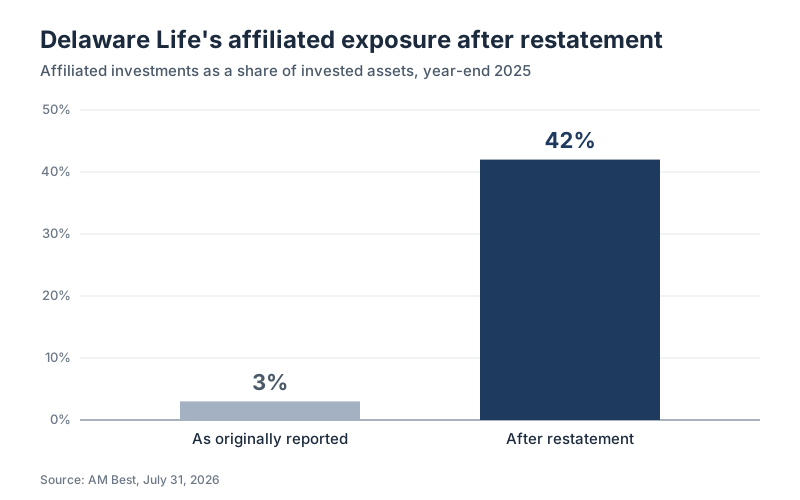
Delaware Life’s restatement was large. Before the subpoenas, it had reported about 3% of invested assets, roughly $1.4 billion, as tied to related parties. The corrected filings showed at least $17 billion, or at least 39%. AM Best uses a slightly different measure, affiliated investments, and found they had jumped to 42% from 3% at year-end 2025. Delaware Life had about $69 billion in assets as of March, and Clear Spring about $16 billion.
Group 1001, the carriers’ parent, has said its capital position and liquidity remain strong.
None of the three major rating agencies has cut Delaware Life’s A- rating, but all three have signaled concern:
S&P has said it could lower the rating if the remediation falters or if penalties significantly weaken the company’s finances.
That remediation is underway. Group 1001 has filed a plan with the Delaware Department of Insurance to eliminate the affiliated exposure, Reuters reported, and Delaware Life agreed to swap up to $6.5 billion of related-party holdings for independent assets. Clear Spring separately cut its related-party transactions by $90 million.
Distribution has also taken a hit. Truist and Fifth Third paused sales of Delaware Life products in late August. This publication found no public report that either bank has resumed.
Read next: Warren presses insurance regulators for answers on private credit ties as Walter probe widens
In September, Florida retiree Ira Rosner filed a proposed class action in federal court in Miami. According to the Associated Press, he accuses Walter’s companies of keeping the probe from customers while routing policyholder money into Walter’s other businesses. Rosner says he paid more than $116,000 in surrender charges and market value adjustments to exit his annuity, Courthouse News reported. The case is summarized in IB’s coverage of the class action against Walter’s insurers.
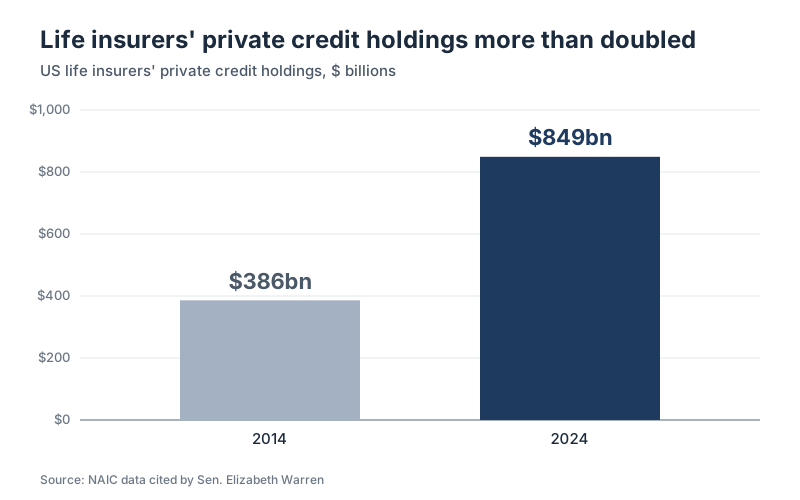
The case has become a reference point in the wider debate over insurers’ private credit exposure. In September, Apollo chief executive Marc Rowan, whose firm built Athene into an annuity powerhouse on private credit, criticized Delaware’s regulators for missing the misclassifications. Speaking at a Bank of America Securities conference, he asked, “what are you doing as a regulator?”
Responding to Sen. Elizabeth Warren, the NAIC estimated that insurers held about $1.2 trillion in private credit at the end of 2025, roughly 13% of cash and invested assets. It also laid out tighter solvency and disclosure rules. Meanwhile, privately placed bonds now make up nearly half of life industry bond holdings.
For brokers and advisors, the takeaway goes beyond Formula 1. A $3 billion sale would bring Walter’s group a lot of cash. The open question is whether that cash, or the $6.5 billion asset swap, moves Delaware Life’s affiliated exposure fast enough to satisfy the rating agencies.
Read next: Life insurers’ fastest-growing private credit vehicle draws NAIC scrutiny
A negative outlook is not a downgrade. AM Best, S&P and Fitch all still rate Delaware Life A-. An outlook signals which way an agency thinks the rating may move. It is not a statement about whether the insurer can pay claims today.
Guaranty associations are the backstop. If an insurer ever failed, state guaranty associations protect annuity holders up to a limit. NOLHGA notes that limits apply to the present value of annuity benefits. Most states cover $250,000, and a few, such as New York, go higher. Limits vary by state, so check with your own association.
Leaving can be costly. Surrender charges and market value adjustments can take a large bite out of an early withdrawal, as the Rosner lawsuit shows. Anyone thinking of moving money should run the numbers with an advisor first.
This is general information, not financial advice.