The State Farm Carrier and Market Review reframes this question from surface-level performance into a structural analysis of the carrier’s operations. Across the carriers’ primary lines of private passenger auto and homeowners’ multi-peril, the latest IB Industry Report traces how premium expansion, loss experience, and competitive positioning interact as a coordinated strategy.
The picture shows State Farm has scaled aggressively in its core lines, capturing relented market share while maintaining losses aligned with peers. That growth has not been seamless: The report shows how underwriting volatility, catastrophe exposure, and shifting policies have placed increasing weight on the company’s financial architecture.
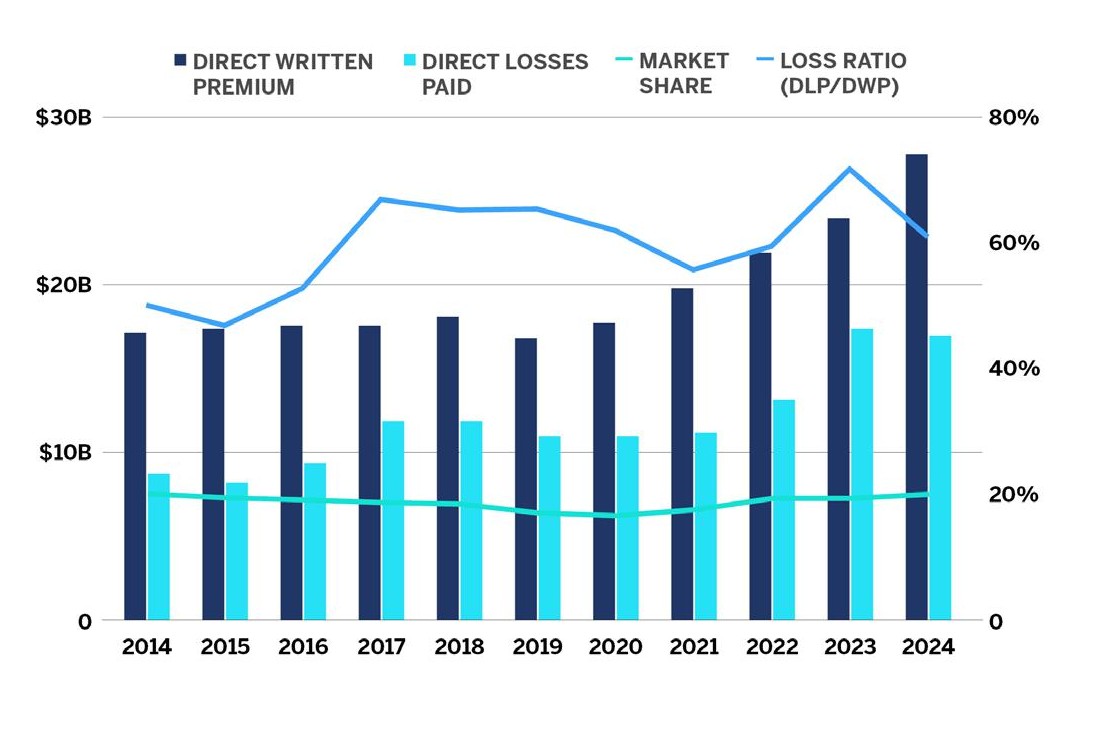
From 2019 to 2024, State Farm expanded its asset base by more than one-third, with equity holdings alone rising from about one-quarter to nearly one-third of total assets. Over the same period, net income more than doubled, reaching ~$4 billion, despite a severe earnings contraction during 2021–2022 driven by elevated claims severity and catastrophe losses.
Rather than relying on external capital or subsidiary structures, State Farm absorbed these shocks internally, with liabilities such as “Funds for the Protection of Policyholders” peaking near ~$90 billion during the downturn. The result is a financial model that is both resilient and exposed: one that can withstand multi-year underwriting losses, but is increasingly sensitive to concentrated catastrophe events and regulatory constraints, particularly in high-exposure states like California.
The report connects these dynamics directly. It links operational growth to capital, reserves, and income, revealing how decisions in underwriting flow through to balance sheet outcomes over time. For insurance professionals, this is a framework for interpreting and repeating State Farm’s successes.
Supported by six full chapters, 29 data-driven figures, and a comprehensive data appendix, the analysis allows readers to benchmark State Farm’s operating model against peers and assess how sustainable its current trajectory truly is.
If you are evaluating carrier strength, placing risk, or competing at scale, understanding how growth translates into financial reality is critical.
Access the full State Farm Carrier and Market Review to benchmark strategy, interrogate balance sheet dynamics, and turn operational insight into competitive advantage.
Get the complete report here.