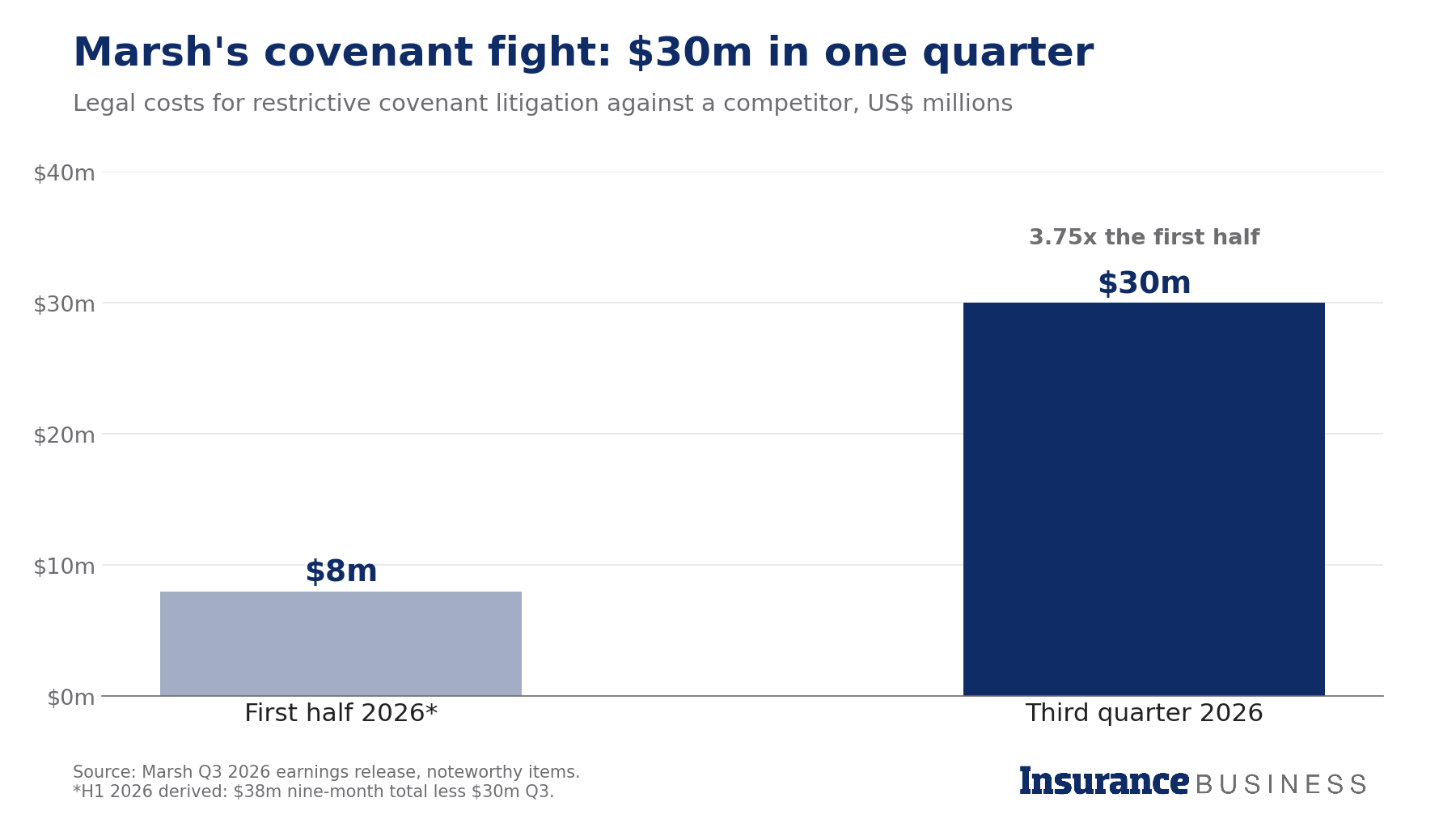
Tucked into the back pages of Marsh’s third-quarter results is a line that most readers will have skimmed past. Among the one-off items the broker stripped out of its adjusted earnings was US$30 million for “a restrictive covenant litigation against a competitor.”
That is US$30 million in legal costs in a single quarter, according to the reconciliation tables in Marsh’s earnings release filed with the US Securities and Exchange Commission. The nine-month figure is US$38 million, which means spending on the case nearly quadrupled in the third quarter compared with the first half of the year combined.
The release does not name the competitor. But the timing, and the scale of the spending, point toward one obvious candidate.
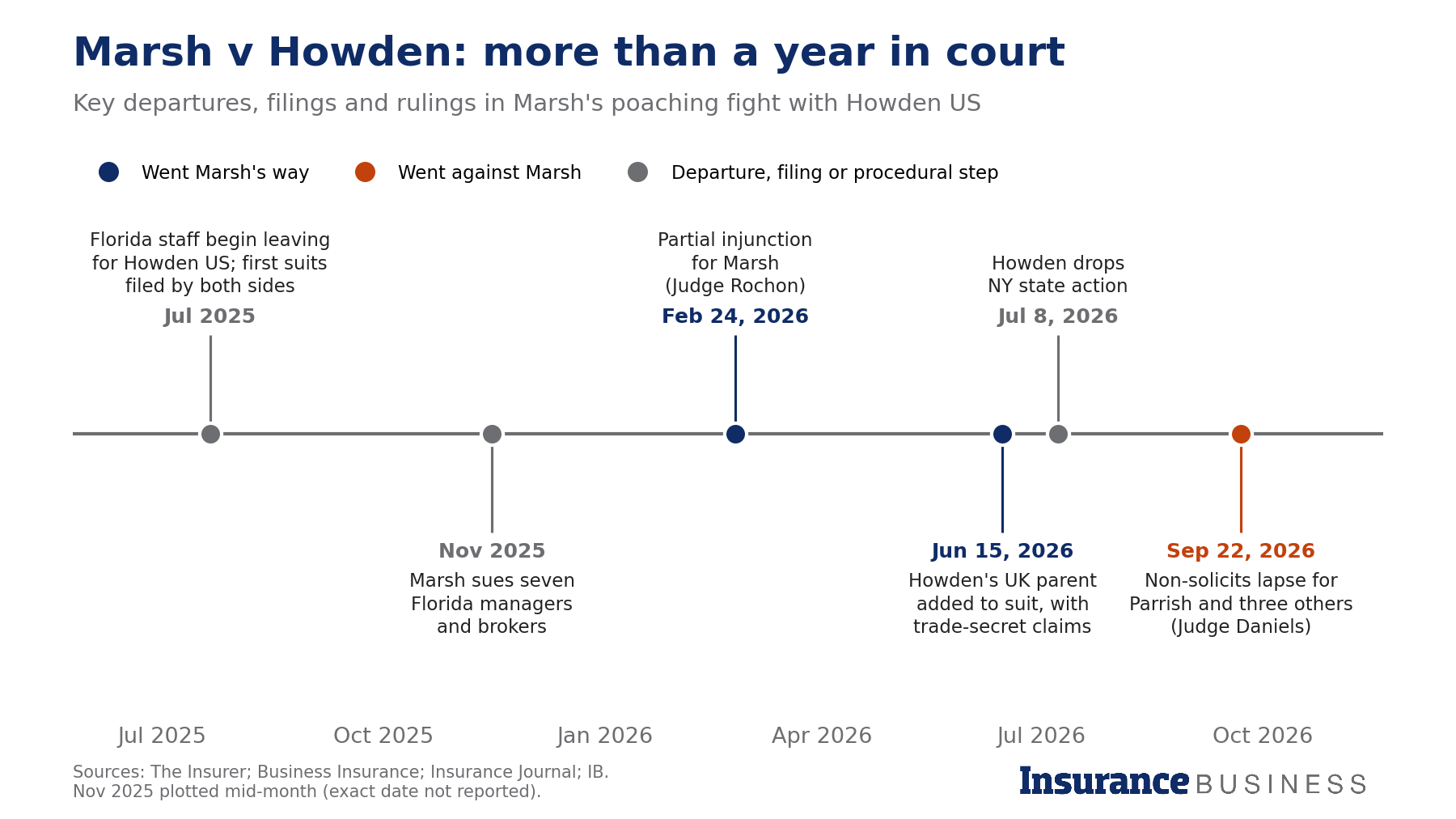
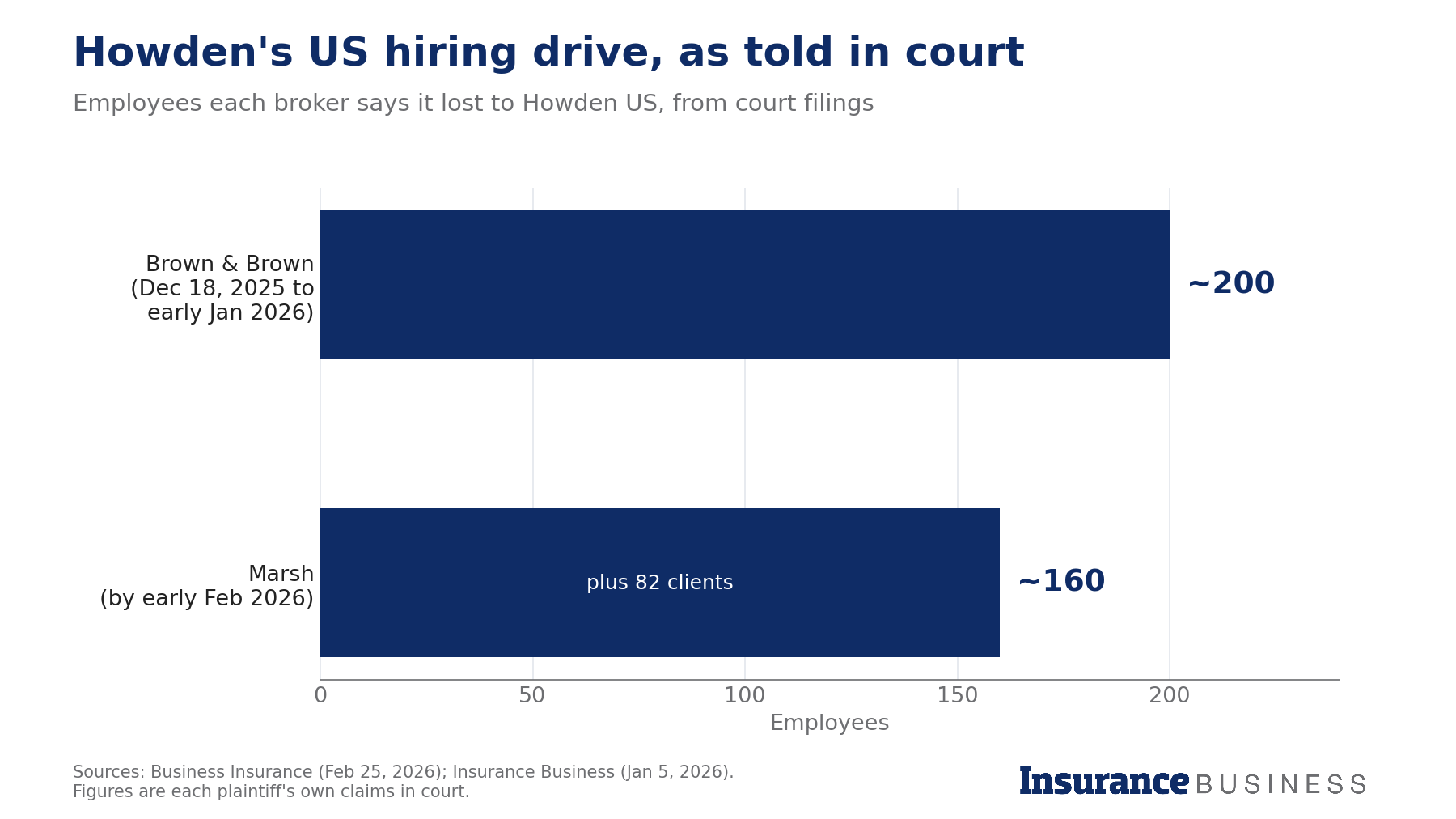
No rival has taken more from Marsh in the past 15 months than Howden. The London-based broker launched its US retail business in mid-2025 under Mike Parrish, a former Marsh executive. More than 140 Marsh staff from its Florida operations followed him, beginning in July 2025. By early February 2026, Marsh said in court that it had lost about 160 employees and 82 clients to Howden.
Marsh responded with a string of lawsuits. At one point five cases between the two brokers were running at once across Delaware, New York state and New York federal courts. The results have been mixed.
In February, a federal judge in Manhattan granted Marsh a partial injunction against seven former Florida managers and brokers who joined Howden. Judge Jennifer Rochon found Marsh was likely to succeed on its breach-of-contract claims, but declined to stop the brokers from serving clients who had already moved. In June, she allowed Marsh to add Howden’s UK parent, Howden Group Holdings, to the case, along with new trade-secret claims.
Read next: The brokerage industry’s litigation epidemic: When poaching becomes a business model
The most recent ruling went the other way. On September 22, Judge George Daniels ruled that Parrish and three other former Marsh executives were no longer bound by a preliminary injunction barring them from soliciting Marsh staff and clients after September 19. They remain barred from misusing Marsh’s confidential information, and the court said Marsh can still pursue damages and permanent relief.
Howden has disputed Marsh’s claims throughout. In earlier filings, the four executives argued that their restrictive covenants had been superseded in 2025 by agreements without non-compete clauses.
Marsh is fighting on several other fronts, which is one reason the footnote cannot be pinned to Howden with certainty. Its US middle-market unit, Marsh Agency, formerly Marsh McLennan Agency, sued three former brokers in June who had joined Lockton earlier this year. It alleged a “corporate raid” on the Birmingham, Alabama, office it acquired with McGriff. The same month it sued Patriot Growth Insurance Services over the alleged poaching of a surety team. It has also litigated against Alliant and WTW.
Read next: Brown & Brown wins TRO against Howden over alleged employee raiding
Marsh is also far from the only broker in court. Brown & Brown has won restraining orders against Howden in Massachusetts and Minnesota, alleging a nationwide raid that took roughly 200 of its employees. Aon took a different route and settled its US and UK cases with Howden in April on confidential terms.
In context, US$30 million is small for a company of Marsh’s size. It is roughly 2% of the US$1.53 billion in adjusted operating income Marsh earned in the quarter. But it is a striking sum to spend on one dispute in three months, and it signals how seriously the broker takes the defence of its people and client relationships.
On Thursday’s earnings call, chief executive John Doyle made no mention of the litigation. He did make clear where he thinks the talent advantage lies. “We have the best talent in the market, hands down,” he told analysts, adding that retention was strong.
Read next: Brown & Brown CEO hits out against rival broker over poaching
Canadian brokers work under a different legal backdrop. Ontario has barred most non-compete clauses in employment agreements signed since October 2021, with exceptions for senior executives and the sale of a business, but it still allows non-solicitation and confidentiality agreements, the kind of covenants at the centre of the Marsh cases. The Supreme Court of Canada has also said, in a case involving KRG Insurance Brokers, that non-competes must be enforced sparingly.
For producers weighing a move, the lesson from this year’s rulings is mixed. Courts have generally been willing to enforce non-solicitation agreements in the short term, but they have also declined to force clients back and have let restrictions lapse once their terms run out. Brokers thinking of leaving should read their covenants closely, and so should the firms hiring them.