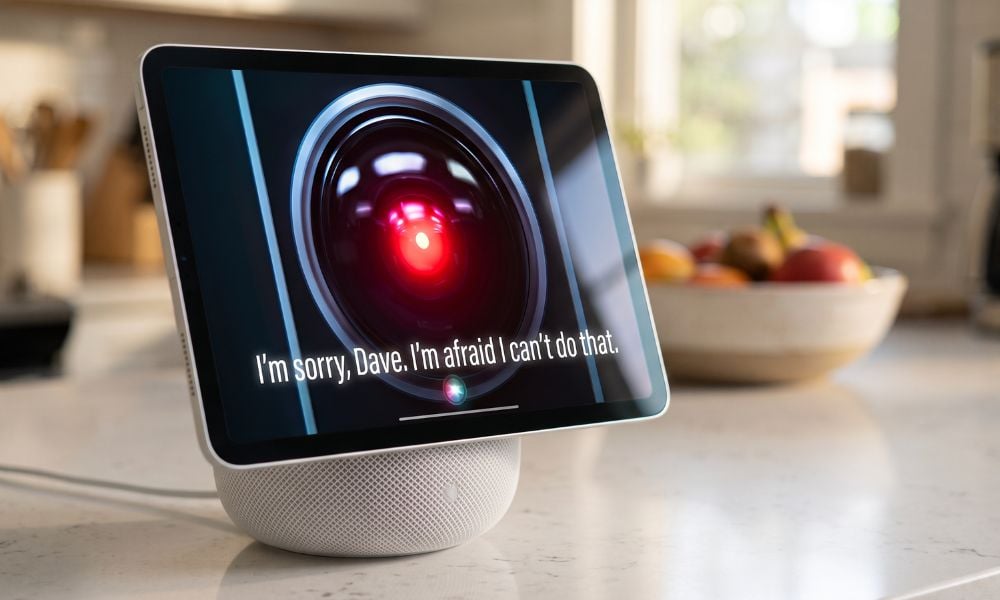
Apple has shown that it wants to put a screen on every Canadian kitchen wall. HomeView announced today, is a 7-inch countertop or wall-mounted display that recognises family members by face and controls the locks, cameras and thermostats around it. Pre-orders opened in Canada the same day, and units ship November 13.
The news arrived just one day after Anthropic published research suggesting the cheaper gadgets sharing those homes may soon face a new kind of threat: compact AI models able to copy themselves from one connected device to the next without human help, running on the spare memory and chips of streaming boxes and smart appliances.
And that news comes hot on the heels of our reporting on how a hack set French connected refrigerators on fire.
Apple's own hardware is not the worry. The bargain devices beside it, however, are - and so is the insurance cover. Canada's home insurers have long encouraged customers to connect their houses, with owners of smart water sensors sometimes treated as preferred risks. Yet data from the comparison site MyChoice suggests just 1.5 percent of Canadian homeowners have a personal cyber endorsement.
Unlike Netflix’s Love Death & Robots, Anthropic's research doesn't describe devices being turned against their owners in dramatic ways. A replicator, as the researchers sketch it, mainly wants a device's memory and processing power. For a household, the likelier signs would be a slow network, a higher hydro bill and a gadget quietly used to attack someone else.
That is an awkward fit for most home policies. Personal cyber endorsements such as BI&I's Home Cyber Protection do pay for malware removal and system restoration on connected home devices, and identity theft cover is far more common, held by 54 percent of homeowners in the same MyChoice data. But whether any wording responds when a device is borrowed for computing power, rather than held to ransom or used to steal money, is far from settled.
Read next: Dimon says AI cyber risk is up tenfold. Cyber insurance prices are still falling
Commercial cyber faces a different problem: accumulation. Small businesses run the same cameras, video-conferencing units and network storage boxes that Anthropic flagged. Erik Tifft, global head of underwriting at BOXX Insurance, and Neal Jardine, BOXX's COO and president for Canada, told Insurance Business last week that insurers are now pricing for the chance that one rogue AI agent hits many policyholders at once.
Tifft said most cyber policies would treat an attack by an AI agent as a cyber attack, unless the wording carries an AI exclusion. Jardine's advice was blunt: "Companies should ask their brokers if AI is covered in their existing cyber policy."
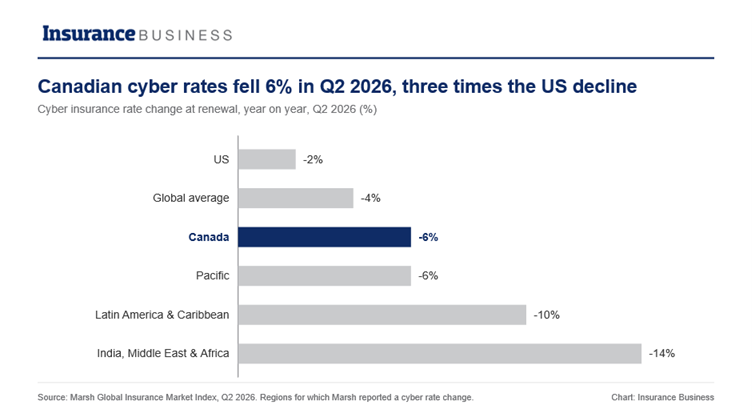
The market has yet to price any of this in. Canadian cyber rates fell 6 percent in the second quarter of 2026, after a 5 percent drop the quarter before, according to Marsh's Global Insurance Market Index, as new entrants added capacity and insurers broadened cover. That is a steeper cut than in the US, where rates slipped 2 percent even after JPMorgan's Jamie Dimon said AI had raised cyber risk tenfold.
Read next: How Anthropic's Mythos is fueling cyber risk aggregation fears
Anthropic's Frontier Red Team tests AI systems for dangerous abilities before they show up in the real world. Its researchers, William Zhou and Daniel Freeman, explained that no self-spreading AI has yet been found outside a lab. Their point is that the gap is narrowing.
The team bought 15 no-name Android TV boxes for about US$55 each, wired them together and ran Google's open Gemma4-26B-A4B model across all of them, two layers per box. Output crawled along at 0.39 tokens a second. That is useless for a chatbot but, the researchers argue, plenty for a patient piece of malware.
That patience is what makes the threat worse – it also has no ‘off’ button. A model sliced across dozens of weak devices has no central server to pull the plug on. Anthropic compared it to a slime mould: slow, scattered and hard to stamp out, with a doubling time of days.
In a separate test on eight emulated Android devices, an open-weight model called GLM-5.2 handled the whole loop without help: finding a new device, copying itself across and getting a working AI model running there. It reached all eight devices in four of five runs. Anthropic stressed it had made the break-in step trivially easy, so the result is a best case for the attacker.
Real devices are rarely much harder to get into. A decade ago the Mirai botnet assembled its army largely from cameras and routers still using the login their manufacturer shipped them with.
By plotting how quickly small models have improved, Anthropic estimated one small enough for household hardware could reach GLM-5.2's level by the end of 2026, while cautioning that the forecast is rough. Unlike conventional malware, which is hard-coded for particular devices, such a model could also figure out unfamiliar hardware on its own, and in testing it got better at that as each copy passed notes to the next.
Under the hood are an A18 chip, a 12-megapixel camera and four microphones that pick up Siri requests from across the room. It supports up to six users, each with their own calendar, messages and reminders, and costs US$299. Apple's Canadian price was not included in the coverage reviewed for this story.
For insurers, the interesting (or concerning) part is the control panel. Apple pitched HomeView as a dashboard for camera feeds, thermostats and door locks, working with a new range of LG Electronics locks, doorbells and cameras, and wall mounts from Schneider Electric's home brand. Adding a new device takes one tap on an iPhone.
Read next: Chubb launches personal cyber policy in US – next stop Canada
Apple's tightly managed, regularly patched hardware is a long way from the devices Anthropic tested. The research singled out cheap streaming boxes running stripped-down versions of Android that rarely, if ever, get security updates. It cited Kimwolf, a botnet tracked by the security firm Synthient that infected more than two million devices, most of them off-brand Android TV boxes.
The trouble is that few homes are single-brand. A household with an Apple hub on the wall may also have a bargain streaming stick, a discount smart plug and a robot vacuum. Anthropic listed fridges, ovens, vacuums and even lawnmowers as hardware capable of running a slice of an AI model, and flagged security cameras with built-in AI chips as an especially attractive target.
None of Anthropic's suggested countermeasures requires new technology. Shifting gigabytes of model files between household devices is conspicuous, and internet providers already watch traffic for exactly that kind of anomaly; a faster-spreading replicator would only be easier to spot. Mirai offers a precedent. Researchers studying the clean-up found that customers who were cut off and told how to fix their devices cleared nearly every infection inside two weeks, a markedly better result than when providers stayed silent.
Regulation is the other lever, and Canada's approach so far leans on guidance rather than rules. The Office of the Privacy Commissioner's advice to IoT manufacturers says devices should force users to change passwords before they go online. For small businesses, the voluntary CyberSecure Canada certification sets a baseline of security practices. By contrast, Britain has made default passwords on consumer smart devices non-compliant, and the US is standing up a voluntary Cyber Trust Mark label for smart devices.
That leaves brokers as the most practical line of defence. At renewal, a short device conversation can do more than any endorsement: which gadgets in the house came from unknown brands, whether anyone ever replaced the password printed on the box, and whether the smart TV and the laptop used for work share the same Wi-Fi. Insurers that already ask about sump pumps and backflow valves may find a similar checklist for connected devices is not far off.
Read next: Can cyber insurance survive the Mythos shock?
Anthropic's researchers ended on a sober note. They described what they found as early "signs of life" rather than a working threat, but predicted that AI agents will eventually run on all sorts of hardware, some of it unsupervised. For Canadian carriers, the more immediate takeaway is simpler: homes are filling with connected devices far faster than policies are being written to cover them.