The Office for National Statistics confirmed this morning that the Consumer Prices Index rose 3.1% in the 12 months to August, up from 2.9% in July, the second straight monthly increase. The CPIH measure, which folds in owner-occupiers' housing costs, moved from 3.1% to 3.3% over the same period.
Neither number was much of a surprise to economists, who had been braced for another uptick. What pushed the rate higher, according to the ONS, was a familiar combination: rising crude oil and pump prices feeding through into factory costs, alongside higher airfares, particularly on long-haul routes.
None of that will come as news to brokers who have spent the summer explaining to clients why renewal quotes keep drifting upward. Today's numbers are being driven by a resumption of hostilities between the US and Iran after a period of relative calm, the same story motor and property insurers have been citing since the spring.
Petrol prices are now at their highest since the conflict first flared on 28 February, and Ofgem's latest energy price cap review confirmed a further 4% rise from October, taking the typical dual-fuel household bill to around £1,723 a year.
For general insurers, the headline CPI figure is almost a lagging indicator. Claims cost inflation has been running well ahead of it for some time. Consultancy Oxbow Partners has forecast that motor claims inflation could hit 7% this year, pointing to the same conflict constraining the flow of fuel and imported parts into the UK, layered on top of pre-existing pressure from vehicle complexity and a growing share of Chinese-built cars on British roads.
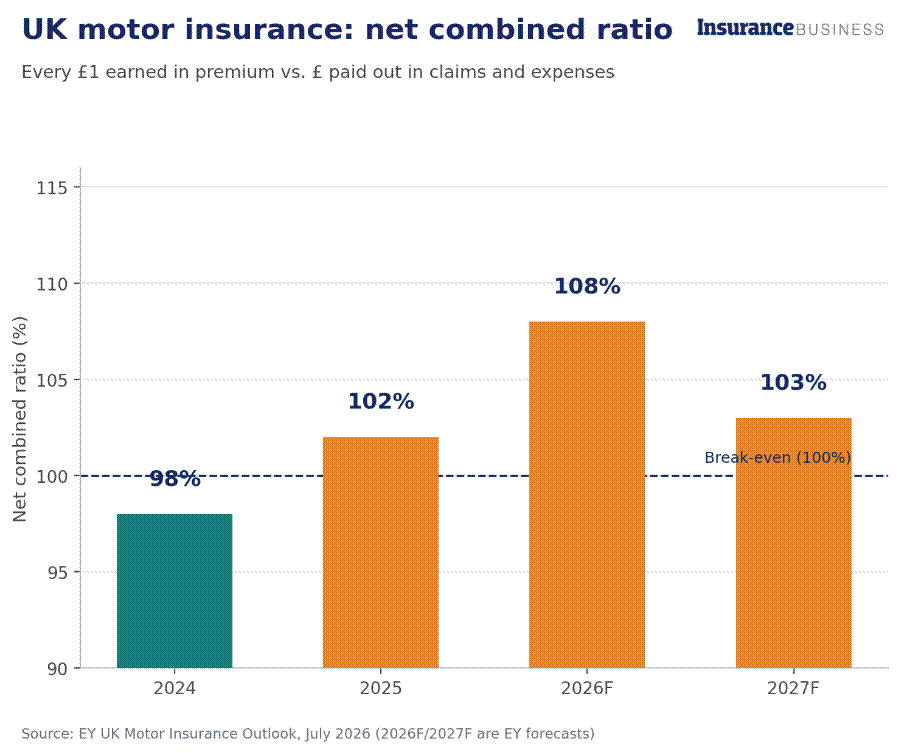
The knock-on effect is already visible in underwriting results. EY's latest market analysis puts the sector's net combined ratio, the amount paid out in claims and expenses for every £1 of premium collected, at 108% for 2026, up from 102% in 2025 and a profitable 98% in 2024, before an expected easing to 103% in 2027. Association of British Insurers data shows why: vehicle damage accounted for £7.5 billion of the £11.9 billion motor insurers paid out across 2025, and the average accidental damage claim hit £3,699 in the first quarter of 2026 alone, an 8% jump in a single quarter.
Pricing is starting to catch up. EY expects motor premiums to rise 4% this year and a further 12% in 2027, a combined 16% over the two years, after comprehensive car insurance posted its first quarterly increase in over two years. EY UK insurance partner Dan Beard has said 2026 could be "the toughest year of the current soft cycle" for the sector, with some relief expected once pricing actions feed through in 2027.
On the property side, the transmission mechanism runs through energy costs into construction prices rather than through the motor supply chain directly. Rebuild cost data from BCIS already showed a 4.9% rise in the year to January 2026, and the wider ABI/BCIS House Rebuilding Cost Index has climbed a further 3.7% since, a trend that has tracked closely with successive spikes in Brent crude.
If sums insured haven't been reviewed at a similar pace, a client can end up underinsured on rebuild cost without realising it, even on a policy with index-linking built in. With UK property insurance claims having already reached a record £6.1 billion in 2025, it's a conversation worth having at renewal rather than after a loss has already exposed the gap.
Worth flagging to commercial clients: rates there have been softening through 2026, not hardening. Marsh's Global Insurance Market Index recorded an 8% composite rate decline in the UK in the second quarter, with abundant reinsurance capital and strong insurer profitability keeping competition intense. That's the reverse of the personal lines picture. Howden Re's David Flandro has cautioned, however, that a sustained energy shock could still feed into broader inflation and interest rates in a way that eventually pressures reinsurance pricing too.
The Bank of England's Monetary Policy Committee announces its next rate decision tomorrow, and today's inflation print will feed straight into that discussion. The Bank Rate has held at 3.75% across five consecutive meetings, and most economists still expect it to stay there this time. But the case for a hike is getting harder to dismiss. Three MPC members, including chief economist Huw Pill, voted to raise rates back in July, and forecasters including Allianz Trade have flagged a possible move to 4%.
A rate rise wouldn't land the same way across the industry. For life insurers writing annuities and bulk pension buyouts, higher gilt yields are helpful, improving both the long-duration assets they hold and the pricing they can offer to schemes looking to buy out.
General insurers are a different story: motor and property books are short-tail, typically matched against shorter-duration, more liquid investments, so the uplift to investment income helps only at the margin and comes nowhere close to offsetting claims inflation running at 7-8% a year.
Two practical takeaways for brokers going into autumn renewals. On motor, EY, Oxbow Partners and the ABI's claims data all point the same way, further increases through 2026 and into 2027, driven by costs that sit largely outside any individual client's own risk profile, so it's worth flagging that trajectory early rather than letting it land as a surprise at renewal.
On property, check rebuild valuations now rather than assuming index-linked adjustments have kept pace: this year's construction cost pressure traces directly back to the same energy shock behind this morning's inflation figures, and a stale sums-insured figure is a gap that only surfaces at claim time.