A number of City of London law firms have just started putting their newest recruits through mandatory training on something that would once have needed no explanation: how to speak to a client down the phone, and how to hold a conversation face-to-face rather than over email or Teams. Addleshaw Goddard and rival firm Winston Taylor are among those that have introduced structured programmes covering phone etiquette, workplace technology and what one firm called "business communication" for trainees moving through their early-career pathways, trade title City AM reported this week.
Some will read that as lawyers being precious. Talk to people in the London insurance market and you'll hear underwriters, brokers and claims managers describe a similar problem, even if they don't use the same language for it.
Insurance Business has previously reported on what one underwriting leader called a "soft-skills crisis" taking hold in commercial lines. Speaking on a webinar hosted by Send, Russell Brown, principal at Safe Harbor Pollution Insurance, described watching a junior underwriter receive a complex submission from a broker and respond with a list of questions by email rather than picking up the phone. That triggered a back-and-forth that dragged on for hours. The hesitation, Brown said, came down to "not having the ability to just pick up the phone."
Hayley Robinson, a non-executive director and former chief underwriting officer at Zurich, told the same webinar that technical knowledge alone isn't enough for anyone dealing with complex commercial risk. Good underwriters, she said, "can clearly understand the technical detail," but they also need to be confident negotiators who can sit across the table from a decision-maker. Deborah McBrearty, client account lead for London Markets Insurance at Accenture, argued the industry needs to actively build time into junior roles for relationship-building rather than assuming it will happen on its own.
Read next: Scared to pick up the phone: Inside insurance's growing soft-skills crisis
The polling behind the law firms' decision is worth a closer look, because it tells a more specific story than "young people don't like phones." According to YouGov research published in March, just a third of Gen Z adults say they're comfortable making phone calls, against roughly two-thirds of baby boomers and around half of millennials.
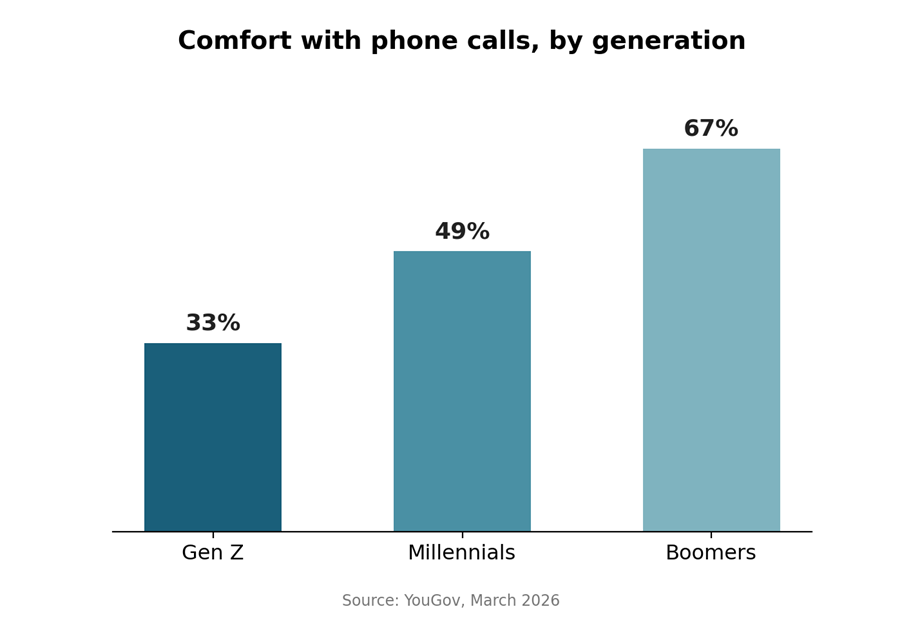
Asked to name their preferred way of getting in touch, only 17% of Gen Z picked the phone, with the rest opting for text, email or instant messaging. The same research found the discomfort sits almost entirely with calls to strangers rather than friends or family, which happens to describe a first-year broker's job fairly well.
Further education providers have spotted the commercial opportunity. Nottingham College now sells businesses a bespoke course designed to "help your Gen Z employees overcome phone anxiety," aimed at professional services firms whose junior staff need to talk clients through case updates or, in an insurance context, policy and claims decisions. The course grew out of one built to prepare students for telephone job interviews, after tutors noticed how many were struggling with the format.
Insurance has a complication that law firms don't have in the same way: a workforce that's already unusually top-heavy. More than a quarter of UK insurance staff are already over 50, and RSM UK's analysis warns that half the current workforce could retire within 15 years, taking decades of underwriting know-how with them. The London Market Group's own figures, cited in the same research, show the over-50s and under-30s now make up roughly equal shares of the talent pool, a change from the pyramid-shaped age structure the market has relied on for decades. That leaves a thinner-than-usual layer of mid-career underwriters and brokers who might otherwise pass on the relationship-building know-how junior staff have traditionally picked up by watching a senior colleague work the phones.

Read next: UK insurers' junior hiring crisis may be about the office, not the algorithm
The Chartered Insurance Institute's New Generation Underwriting group has been looking at the same pipeline problem from a different angle. It found that platforms like TikTok are, somewhat surprisingly, an effective way of getting Gen Z interested in the profession in the first place. Getting them through the door is one challenge. Getting them comfortable calling a broker to query a submission is a separate one.
There's a temptation to assume this gets easier as automation strips out the administrative grind that currently eats up a junior underwriter's day, freeing up time for the human stuff. Accenture's McBrearty made roughly that case in her comments on the soft-skills webinar, suggesting new tools could give juniors more room to focus on relationship-building rather than paperwork. That only holds if firms actually redirect the freed-up time towards coaching, rather than just expecting output per head to rise. Recent hiring data suggests plenty of employers aren't making that trade-off: a growing number are choosing to invest in AI tools instead of recruiting and training entry-level staff at all.
Read next: Is AI replacing entry level Gen Z workers?
Some of the groundwork already exists. The Level 3 Insurance Practitioner apprenticeship standard, the entry-level qualification route used by brokers, underwriters and claims teams across the UK, already builds in professional communication as a core requirement. Individual job listings on it, such as this Sheffield broking apprenticeship, routinely list phone and email client contact as day-one duties. So the raw material for a bootcamp is already sitting inside the existing training framework. What's missing is treating verbal communication as a skill to actively coach and assess, rather than one that new starters are simply expected to pick up. A firm looking at the City law approach might:
None of that means rewriting the apprenticeship system. It means deciding this is worth protecting time for, at a moment when junior staff are already stretched thin.
For an industry built on trust between broker, underwriter and client, where a five-minute call can settle what a day of emails cannot, the law firms' bootcamps look less like a curiosity from a neighbouring profession and more like a preview of what we should be doing. Several parts of the insurance market have already concluded their own junior staff need the same kind of training. What's left to decide is whether firms build it in on purpose, the way Addleshaw Goddard and Winston Taylor have done for their trainees, or wait until the cost of avoided phone calls, in slower renewals and weaker client relationships, forces the issue anyway. The former may be the much smarter way.