In Montana, 74% of all auto comprehensive losses between 2023 and 2026 were caused by animal collisions, according to a three-year analysis from Farmer Insurance. Michigan came in at 72%, Iowa at 71%, South Dakota at 70%, and North Dakota at 68%.
Those figures are percentages of total comprehensive losses within each state, not raw claim counts. That methodological choice reveals states where wildlife is the defining comprehensive peril regardless of population density. Pennsylvania generates far more animal collision claims by volume, but much of its comprehensive loss activity is driven by other causes.
"In some states, animal collisions aren't just occasional incidents," said Jonathan Hart, head of national auto physical damage and regional claims at Farmers. "They're a significant roadway risk."
Six of the top 10 states sit in the Upper Midwest and Northern Plains corridor spanning the Dakotas, Minnesota, Wisconsin, Iowa, and Michigan. West Virginia (66%), Wyoming (65%), New York (64%), and Kansas (63%) also ranked among the highest, a pattern tied to dense rural road networks and high deer populations.
The concentration has direct implications for agents writing personal auto in those markets. Comprehensive coverage is optional in most states, and many clients trimmed or dropped it when full-coverage auto premiums surged 46% between 2022 and 2024. A client renewing now without comprehensive is exposed to the peril that dominates their state's loss profile.
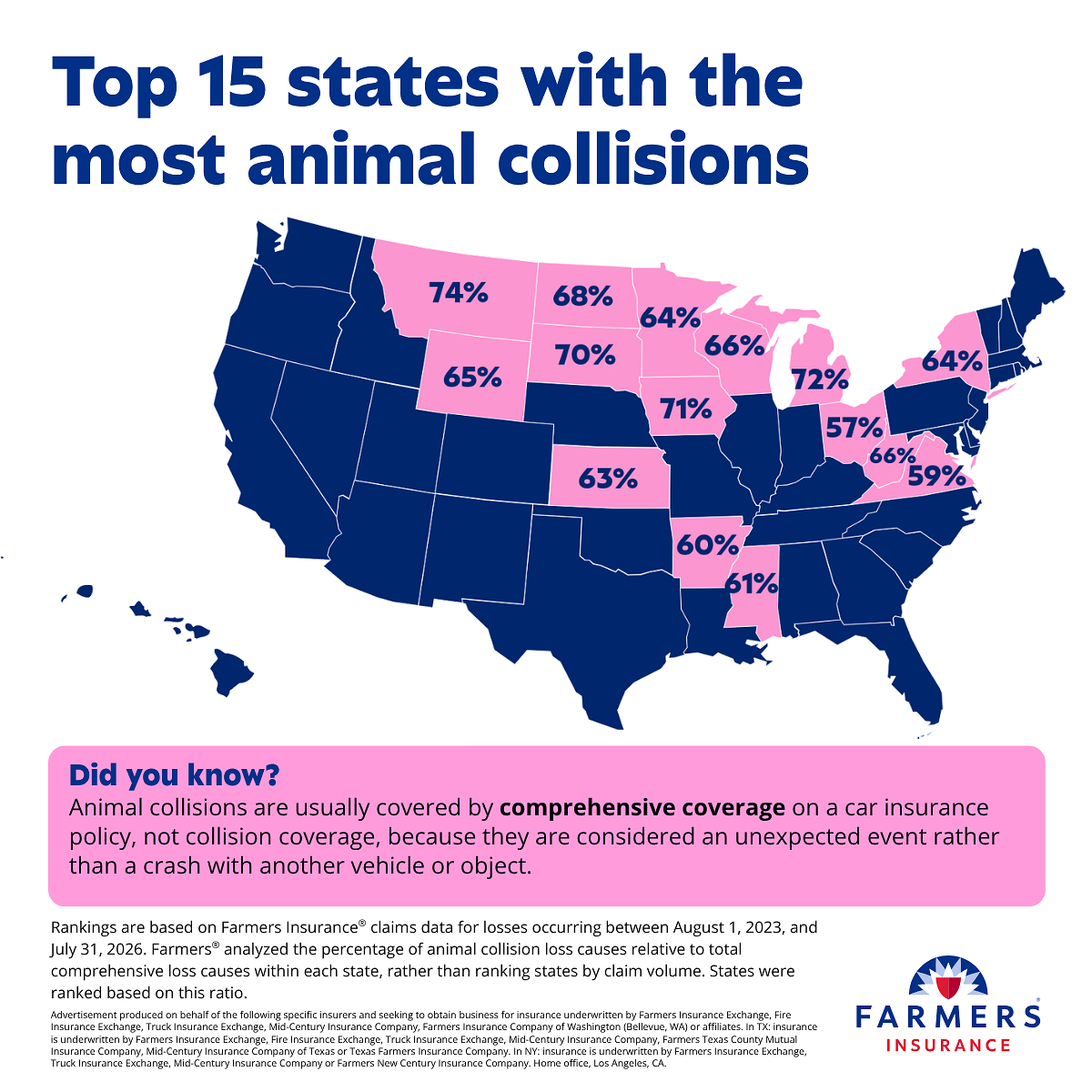
The Farmers analysis covered claims from August 2023 through July 2026. States were ranked by the share of animal collision losses relative to all comprehensive losses, not by volume.
Farmers' data shows that animal collisions cluster sharply by season. Across the three-year study period, they occurred most frequently from October through December. In some states, Farmers recorded animal collision losses only during those three months, yet they still accounted for the majority of comprehensive loss causes statewide for the year.
That window is now open. Agents with clients renewing personal auto in September or October are at the point in the calendar where a coverage adequacy check carries the most weight. A client with a high deductible set during years of premium stress, or without comprehensive at all, faces a loss category that arrives on a predictable schedule.
Broader industry data puts scale on the exposure. State Farm estimated 1.7 million animal collision claims were filed nationally between July 2024 and June 2025, with deer accounting for more than 1.1 million. Average claim costs in high-risk areas reached $5,620 in 2024, up from $5,000 the year before, based on AAA East Central Insurance data.
Personal auto premiums have eased since their 2024 peak. Full-coverage rates declined 6% nationally in 2025, after surging 46% between 2022 and 2024, according to Insurify data. Several carriers have cut rates, restoring affordability to optional coverages that clients had trimmed during the hard market.
That shift changes the coverage conversation. Clients who dropped comprehensive when premiums were at their steepest now have more room to reinstate it, and the Farmers data gives agents in high-exposure states a concrete and data-backed reason to have that conversation before October rather than after.