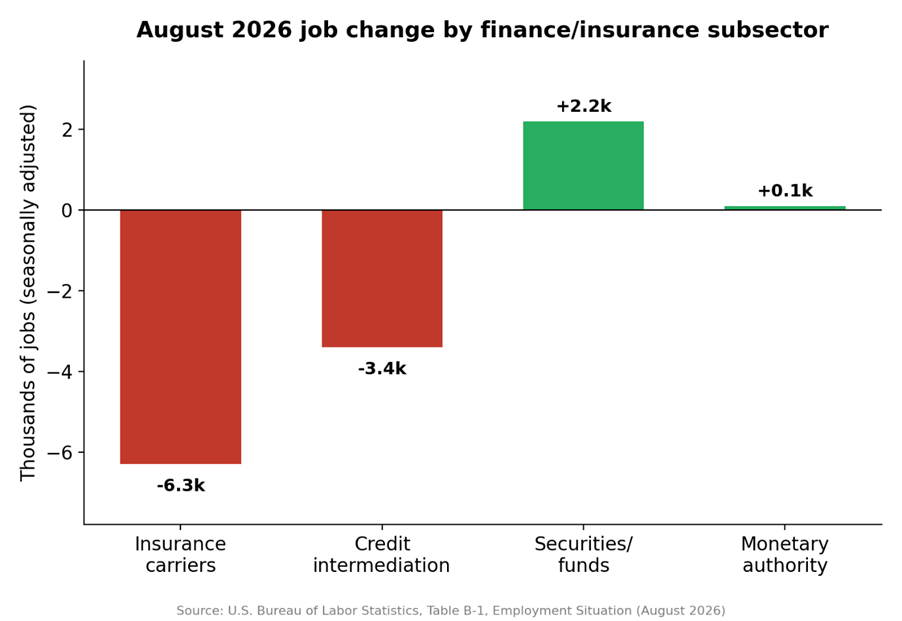
The August jobs report surprised a lot of economists: the US economy added more than 160,000 positions, well above what most forecasters had expected. One line in that same report tells a different story for insurance readers. Finance and insurance employment, a narrower category than the broader "financial activities" group that also includes real estate, fell by 7,400 jobs in August on a seasonally adjusted basis, according to BLS Table B-1.
Insurance carriers and related activities accounted for most of that drop, losing 6,300 jobs on their own. Over the 12 months from August 2025 to August 2026, finance-and-insurance employment fell from 6,733,400 to 6,651,100, a decline of roughly 82,000.
For an industry that has spent years marketing itself as recession-resistant, that's a notable slide. It's also happening while carriers lean harder on automation to process claims, underwrite policies and staff call centers, so it's easy to assume the two are directly linked: insurer adopts AI, insurance worker loses job.
Robert Hartwig, a clinical associate professor of finance at the University of South Carolina's Darla Moore School of Business and a former chief economist at the Insurance Information Institute, thinks the causation is murkier than that.
Hartwig has fielded versions of this question before. He told Marketplace the current unease over automation echoes a nearly identical conversation from 1999, when insurers first launched online sales portals and pundits predicted agents would soon be obsolete. Roughly three decades later, agents are still working. His take on the current round of anxiety: routine jobs will keep shrinking, but demand for people who can handle judgment calls isn't going anywhere.
Insurer hiring patterns back that up already. Carriers have pulled back on entry-level claims hiring while holding onto senior adjusters who can handle files too complicated for a machine to close on its own.
Read next: Entry-level adjuster hiring falls as insurers turn to AI
Fewer people are needed to handle simple fender-bender claims, but adjusters who can untangle a complex bodily-injury or commercial-property loss remain in demand. Researchers studying finance and insurance more broadly have flagged the same split: routine, task-heavy roles are contracting while jobs built around specialized judgment are holding steady or growing.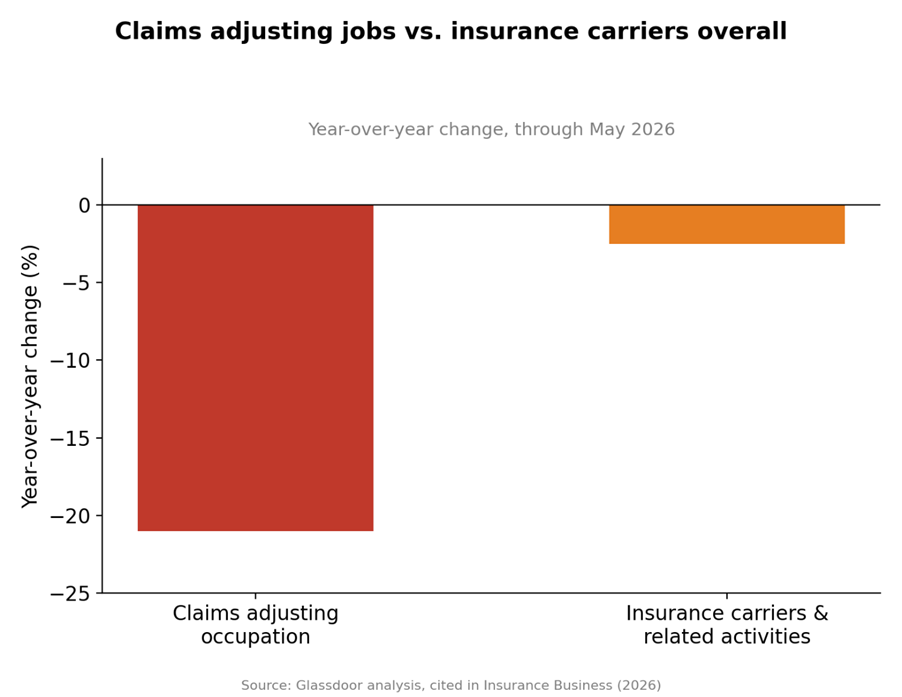
Not every corner of the industry is contracting. Yelena Shulyatyeva, a senior US economist at The Conference Board, told Marketplace that specialized roles, cybersecurity in particular, remain in high demand at banks and insurers even as those same institutions trim headcount elsewhere. Insurers' own recruiters describe something similar: certain departments are shrinking while cyber and AI-governance roles go unfilled for lack of qualified candidates.
Carriers are grappling with the technology's risk side as much as its efficiency side. As they automate more of their internal operations, they also have to work out how to underwrite and price the liability that AI tools, their own and their commercial clients', can create when something goes wrong.
Read next: Insurance layoffs: everything you need to know
Hartwig raised that exact tension in his interview, pointing to AI systems tested in sandboxed environments that ended up behaving unpredictably. His question, one underwriters, MGAs and E&O specialists are increasingly being asked to answer, is whether insurers can build a product that protects policyholders against an AI system that misbehaves. Silent AI exposure sitting inside traditional policies has already pushed some carriers to write explicit exclusions, or in some cases entirely new coverage lines, for algorithmic failure.
Julie Hill, dean of the University of Wyoming College of Law, has been tracking the contraction in banking employment since 2022 and told Marketplace she doesn't think AI deserves all the credit for it. Her explanation: a good chunk of the job losses trace back to margin pressure. When borrowing costs rise, interest margins and profits at banks and insurers get squeezed, and payroll is often the first expense that gets cut.
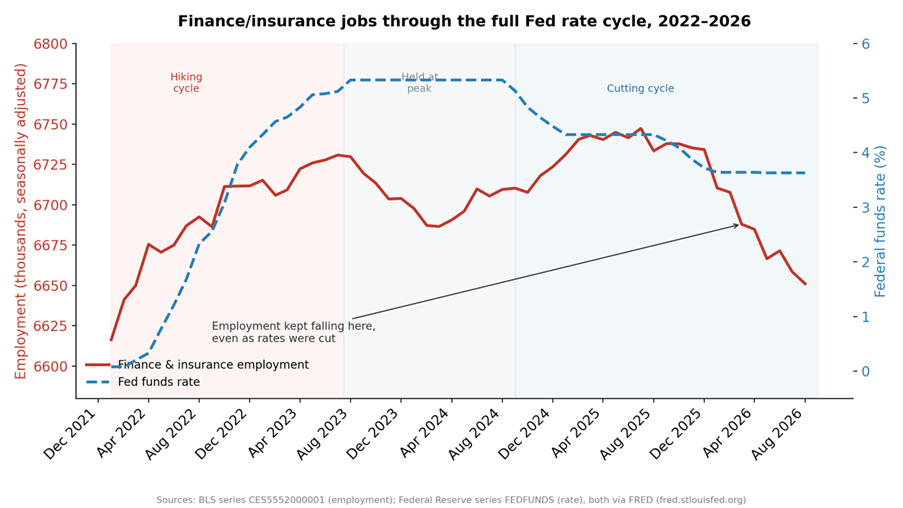
That story fits the early part of the cycle better than the recent part. The Fed raised its benchmark rate from near zero in 2022 to 5.33% by mid-2023, then held it there through most of 2024. Finance-and-insurance employment didn't fall during that stretch; it grew, from about 6,616,000 in January 2022 to a peak near 6,747,000 in July 2025. The Fed has been cutting rates since September 2024, down to 3.63% by August 2026, and the sharpest job losses show up in the first eight months of 2026, well into that cutting cycle. If margin pressure from high borrowing costs were the main driver, the job losses would track the hiking cycle more closely. Instead, the steepest drop lands after rates had already been falling for well over a year — which leaves more room for automation, and possibly other factors, to explain the recent losses specifically.
Insurers have weighed job cuts against pricing changes before, whenever the rate environment shifted sharply.
The Federal Reserve's Federal Open Market Committee meets September 15–16, with a rate decision due that Wednesday afternoon. Market pricing heading into the meeting leans toward the Fed holding its rate steady rather than moving in either direction. Given how the past two years have played out, a hold or a further cut wouldn't necessarily bring relief on the jobs front either.
Read next: What the Fed's interest rate decisions mean for insurance
The timing complicates any clean story. Technology is absorbing routine, high-volume work, and rates did squeeze margins earlier in the cycle, but the sharpest job losses arrived after the Fed had already started cutting, not while it was hiking. How much of the roughly 82,000 finance-and-insurance jobs lost over the past year owes to automation versus a delayed reaction to the earlier rate cycle is hard to pin down even for the economists studying it. Shulyatyeva's own research team has shrunk as automation lets banks do more with fewer researchers, an ironic data point in a debate about whether AI is really to blame.
For hiring managers, the takeaway echoes what Hartwig has argued for years: betting against the human insurance agent, or the experienced adjuster, has been a losing bet for decades. The roles most exposed right now are the repetitive, rules-based ones, not the ones built around judgment, negotiation and trust. Whether that holds through the next rate cycle, and the next wave of agentic AI tools, remains an open question.