
Earth is reflecting less sunlight back into space than it used to – and the rate at which the planet is absorbing extra energy has more than doubled since 2000. For insurers and reinsurers everywhere, that is not just an abstract climate-science curiosity. It is a data point that goes to the heart of how catastrophe models, pricing and long-term underwriting assumptions are built, in every market.
Catastrophe models are only as good as the physical assumptions baked into them. One of those assumptions is that the planet's overall energy budget – how much solar energy it absorbs versus how much heat it sheds back to space – behaves roughly in line with what climate models expect. That assumption is now under strain, and the evidence comes from space rather than any single country's weather station network.
NASA's Clouds and the Earth's Radiant Energy System (CERES) satellites have been measuring that budget since the late 1990s, tracking Earth's albedo (the share of sunlight reflected away) alongside outgoing heat radiation. The difference between the two – Earth's energy imbalance, or EEI – is what actually drives long-run warming, and NASA scientists have confirmed it roughly doubled between the 2000–2010 and 2013–2023 periods, with the upward trend continuing since.
That matters to underwriters everywhere for one specific reason: the observed doubling is arriving faster than most climate models can reproduce, and the discrepancy isn't a rounding error. ETH Zurich's Reto Knutti has estimated that, extrapolated forward, the rate of increase in the EEI implies near-term warming could end up 10% to 30% higher than what current consensus projections build in. Kyle Armour of the University of Washington has gone further, suggesting the models "appear to be missing some processes" entirely. For an industry whose catastrophe pricing depends on multi-decade model outputs – wherever in the world it's written – a persistent and growing gap between observation and model is exactly the kind of basis risk actuaries lose sleep over. Bjorn Stevens, who leads the Max Planck Institute for Meteorology in Hamburg, has called the shift in how scientists now read two decades of satellite and ocean-float data "a game changer."
This isn't a new worry for the industry so much as a sharper version of one. Researchers at the WTW Research Network have previously warned that the climate scenarios insurers rely on globally may already be inadequate because they don't capture non-linear tipping points, such as an ice-sheet collapse with knock-on effects for coastal and property risk (see: Are the climate change scenarios currently used by insurers still fit for purpose?). A widening gap between observed and modeled energy uptake is effectively evidence for that same critique: it suggests the models are missing not just isolated regional thresholds, but a more basic driver of how fast the whole system is heating up.
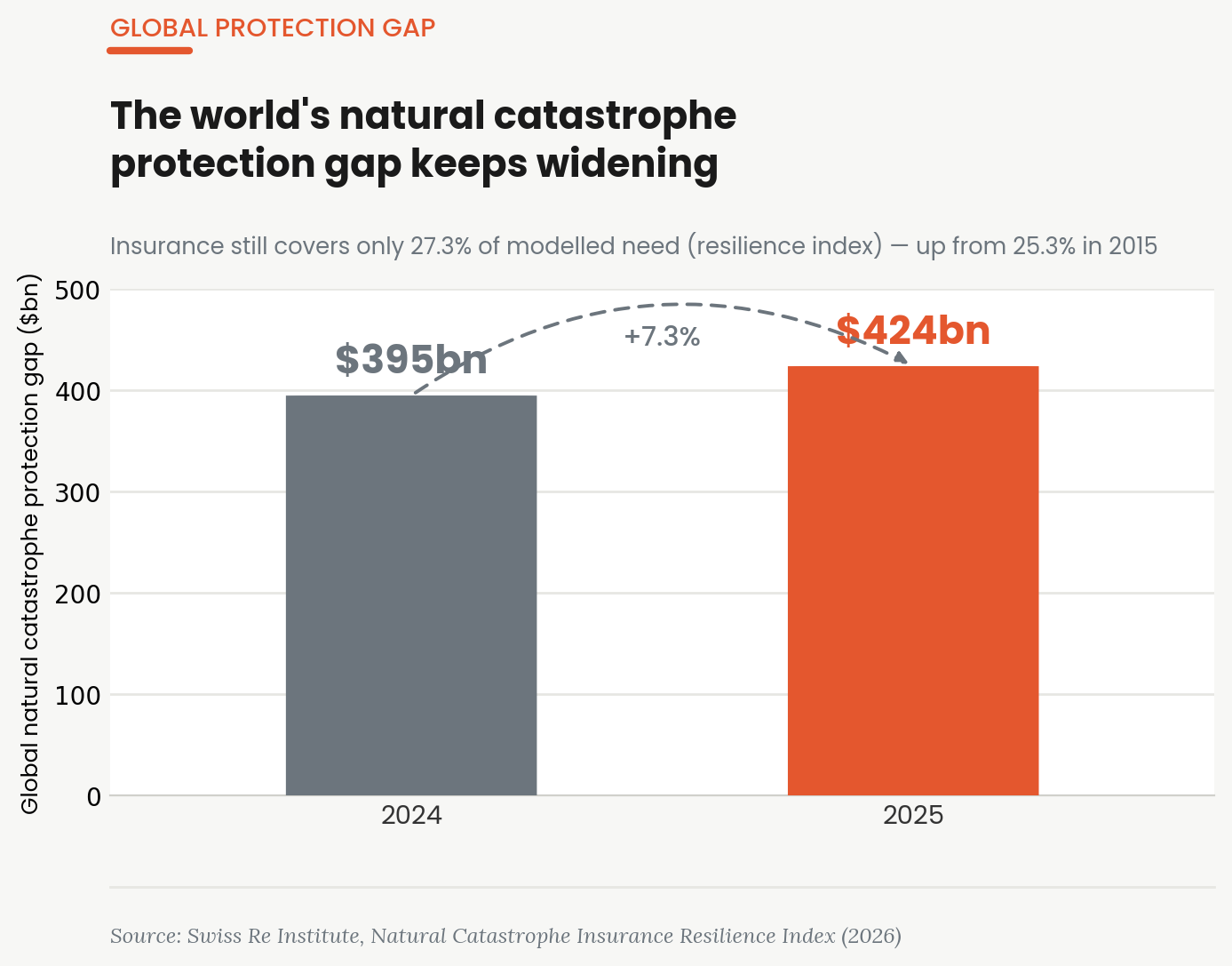
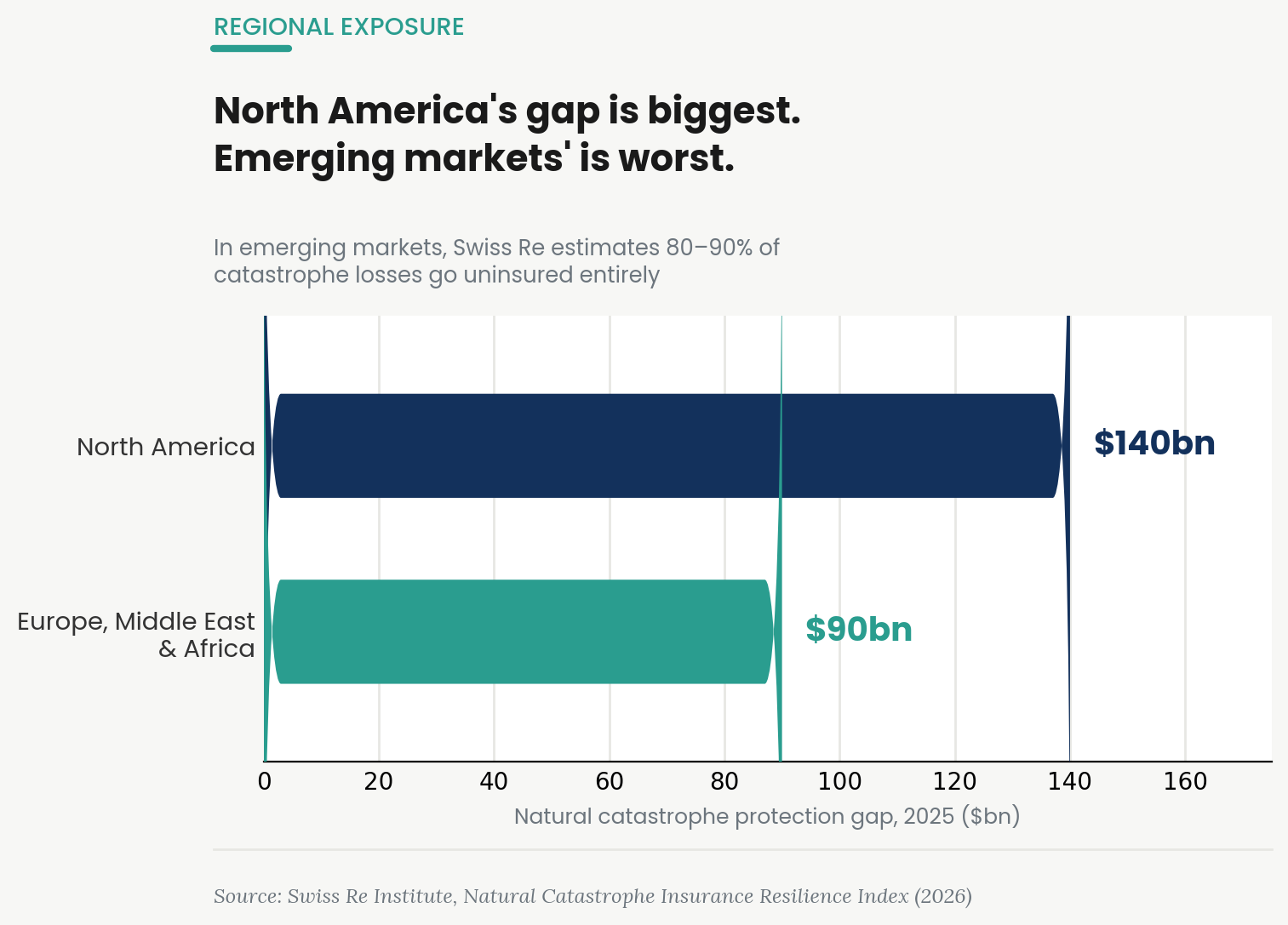
Even before tipping points enter the picture, the industry is struggling to keep up with the catastrophe losses climate change is already generating. Swiss Re Institute estimates the global natural catastrophe protection gap – the difference between insured and total economic losses – widened to $424 billion in 2025, up from $395 billion the year before, even as insurers' overall coverage broadly kept pace with rising exposures. Its Natural Catastrophe Insurance Resilience Index, a measure of how much of that need is actually covered, has improved only marginally over the past decade, to 27.3% in 2025 from 25.3% in 2015. North America accounts for the largest absolute gap, at $140 billion, with Europe, the Middle East and Africa close behind at $90 billion; in emerging markets, Swiss Re notes that 80–90% of catastrophe losses typically go uninsured entirely. If insured losses keep growing at their long-term 5–7% annual pace, the institute projects they could reach $186 billion globally by 2030, up from $107 billion in 2025.
Europe's own regulator paints a similarly stark picture over a longer run: EIOPA notes that only around a quarter of losses from extreme weather events across Europe were insured between 1980 and 2024, and cites warnings from Germany's insurance association that property premiums there could double within a decade as climate-driven claims mount.
Some tipping points carry outsized consequences for specific regions even as they're monitored globally. USS Investment Management, which runs the pension scheme for UK university staff, flags permafrost thaw and a possible breakdown of the Atlantic Meridional Overturning Circulation (AMOC) – the ocean current system that keeps northwestern Europe's winters mild – as plausible within 15 to 20 years. Some recent modeling cited in Bloomberg's reporting points to scenarios where an AMOC collapse could send UK winter temperatures as low as -20°C and push Arctic sea ice as far south as East Anglia, even as summers keep getting hotter and drier elsewhere in the system – a combination that would hit agriculture, subsidence and heating-related claims simultaneously rather than in the gradual, seasonal way current models assume. It's a reminder that "global" risks like tipping points can still concentrate very unevenly by geography and portfolio.
Institutional investors across multiple markets are already trying to price this in. Sarah Kapnick, JPMorgan's global head of climate advisory and a former NOAA chief scientist, has said funds are asking what "climate black swan risks" mean for portfolios on realistic decision horizons, cautioning that "systems can be pushed toward thresholds faster than society and markets can adapt." In the UK, Standard Life plans to run tipping-point simulations across its £317 billion portfolio next year, and USS works to a five-to-ten-year scenario horizon specifically so it stays alert to tipping-point risk before, rather than after, thresholds are crossed. In Frankfurt, AllianzGI's Mark Wade has argued that the insurance industry itself may be the earliest signal of how fast asset prices will start to react to breached climate and biodiversity thresholds. Legal & General's climate modeling team, meanwhile, says some investors are now bracing for a worst-case outcome as confidence in a fast global energy transition erodes.
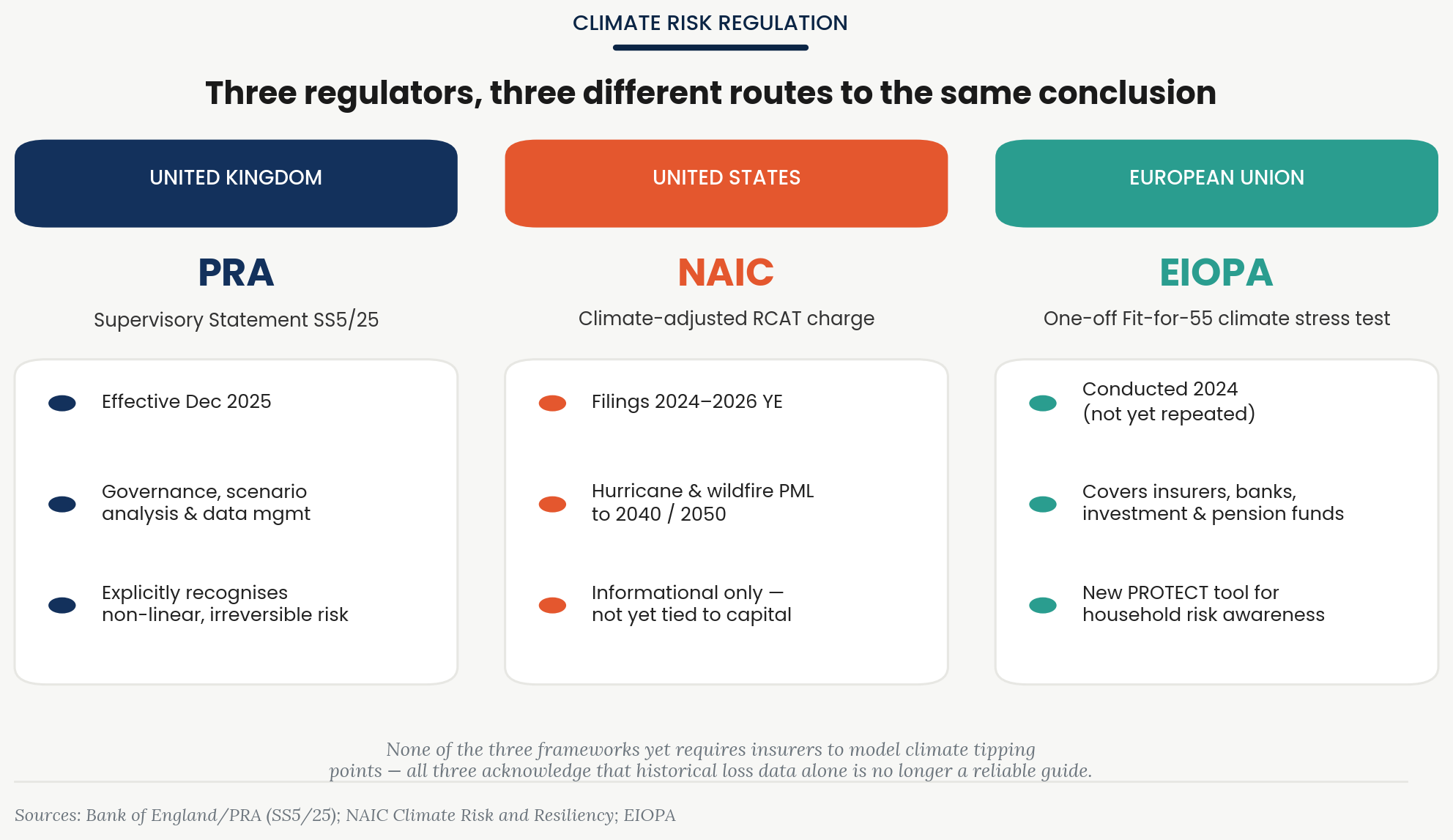
Supervisors in the major insurance markets are converging on the same conclusion via different routes. In the UK, the Prudential Regulation Authority's updated supervisory statement, SS5/25, took effect in December 2025 and requires banks and insurers to strengthen governance, scenario analysis and data management around climate risk, explicitly acknowledging that risks can be non-linear and irreversible. In the US, the National Association of Insurance Commissioners has taken a more targeted approach, requiring property and casualty insurers to disclose climate-adjusted probable maximum losses for hurricane and wildfire risk out to 2040 and 2050, with filings running from 2024 through 2026 year-end. In the EU, EIOPA has been running coordinated climate stress tests across insurers, banks and pension funds since 2024, and is now pushing a demand-side tool, PROTECT, to help households understand their own climate exposure as premiums rise.
None of these frameworks yet directly requires insurers to model tipping-point scenarios. But each is, in its own way, an acknowledgment that historical loss data is becoming a less reliable guide to future risk – which is precisely the concern now surfacing in the satellite record.
Tim Lenton, the University of Exeter climate scientist known for his work on tipping points, has argued that when an underlying shift looks irreversible, markets should reprice ahead of the damage actually materializing rather than waiting for it to show up in claims data. That is the crux of the challenge now facing insurers in every major market: models built on a more stable, better-understood climate system are being tested by a planet that is absorbing energy at a rate few of them anticipated. As Aniket Shah of Jefferies has put it, economies have historically adapted quickly to shocks like wars and pandemics – but tipping-point risk is different, because it may not be reversible once triggered.
Insurers and brokers globally are already responding by extending the time horizons and granularity of their catastrophe modeling – as with new flood datasets built on IPCC scenarios stretching to 2100, and climate-conditioned catastrophe tools from carriers such as Munich Re and AXA XL (see: Future-proof: How climate modeling tools are empowering insurers and brokers). But if the underlying physical trend – Earth absorbing energy faster than models predict – keeps outrunning those tools everywhere they're deployed, insurers may find themselves repricing risk on a much shorter timetable than their models currently assume, regardless of which market they're writing in.
For now, insurers and brokers appear to be treating this less as a single event to model and more as a background risk multiplier – one that specialty insurers describe as a risk that "amplifies all other risks" across property, casualty and life books alike, in every territory they operate in (see: Climate slips down the agenda, but insurers warn it's the "risk that amplifies all others"). Whether that response is fast enough may depend on how quickly the industry's models, wherever they're built, catch up with what satellites are already showing: a planet that is measurably, and increasingly, less shiny than it used to be.