When a storm knocks out power to a strip mall for two days, the sandwich shop at the end loses its stock and its takings. Its business interruption policy will often pay nothing, because nothing was physically damaged.
Gaps like that are where Peter Settel thinks parametric insurance, which pays out when a measurable trigger such as a verified outage is hit, will find its next big market. Until now it has mostly protected governments, farmers and large corporations against droughts, hurricanes and political upheaval.
“Parametric has already established itself as really important in larger-scale, society-level issues – agriculture protection gap, climate volatility, political volatility,” Settel, president and chief executive of commercial insurance distribution platform Bold Penguin, told Insurance Business. “We’re looking at downscaling that into distribution, into small commercial.”
Settel took the top job at the Columbus, Ohio-based company in January 2025, succeeding founder Ilya Bodner after serving as enterprise chief strategy and technology officer at Bold Penguin's parent, American Family Insurance.
He calls parametric one of the next big trends set to reshape the industry, and a good bet for distributors willing to move early.
The obstacle is familiar to anyone who has tried to sell a new product to Main Street. Most small business owners have never heard of parametric cover, and many of the agents who serve them have never quoted it. Pitching it as a standalone conversation is a hard sell.
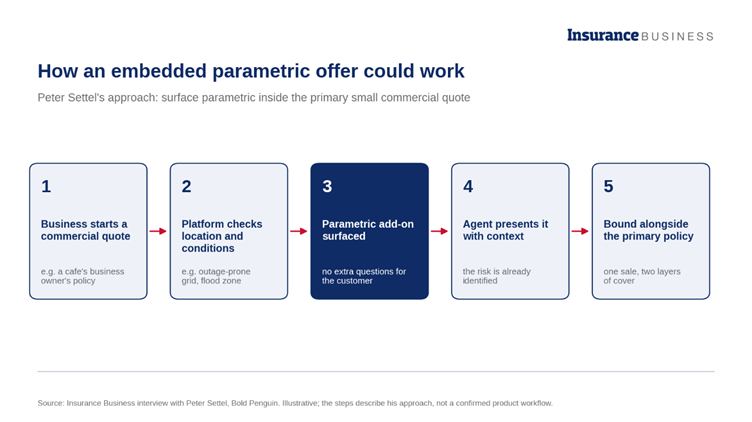
Settel's answer is to stop treating it as a separate sale. Instead, the parametric option rides along with the primary commercial quote. The platform uses what it already knows about the business, such as its location and the conditions it faces, to decide whether a parametric add-on makes sense, and surfaces the offer without asking the customer any extra questions.
“When you downscale a complex product like parametric for the small commercial market, it’s important to have positioning accuracy because there isn’t a broad awareness yet,” he said.
“But if you can use technology and distribution to position it where it makes the most sense, now the agent or whoever is thinking about it has context, and it’ll make it easier for them to think about that.”
Read next: Parametric insurance: everything risk managers need to know
Bold Penguin has started down that road. In December 2025 it added Adaptive Insurance's GridProtect, a parametric policy that pays out when verified data shows a power outage, to its placement desk, making Adaptive the first parametric carrier on its platform. Outage losses are a classic gap, because standard business interruption cover usually requires physical damage before it pays, as IB's look at how Adaptive is targeting the power outage gap explains.
Others are building similar plumbing. In February, Liberty Mutual and Floodbase launched an instant quoting tool for parametric flood that lets brokers price cover in minutes and plug it into automated quoting, with small and mid-sized commercial accounts as the target. Specialty players have pushed into narrower niches too, from tiered rain cover for event organizers to hurricane and earthquake triggers.
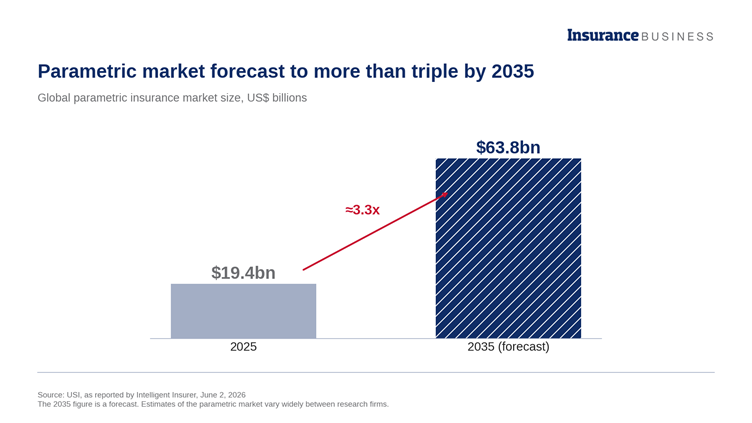
The broader market is growing fast from a small base. US broker USI expects the parametric market to grow from about $19.4 billion in 2025 to roughly $63.8 billion by 2035. The need is plain among smaller firms: 77% of US small businesses are underinsured, according to Hiscox's 2025 survey of 2,000 owners.
Read next: Chaucer launches parametric coverage for hurricanes, earthquakes
Settel sees parametric eventually sitting inside the core program rather than beside it. He describes a hybrid protection stack in which primary carriers recognize the value of parametric alongside traditional products.
That could mean bundling several products together, offsetting overlapping coverage, or giving credits to customers who carry both. None of those arrangements is standard in small commercial yet; they are Settel's view of where the market could go.
The model has a catch agents will need to explain. Parametric policies pay when a trigger is hit, not when a loss is proven, so a client can suffer real damage and get nothing if the trigger isn't met, or receive a payout that doesn't match the loss. That mismatch, known as basis risk, is why parametric is usually pitched as a complement to indemnity cover, not a replacement.
Bold Penguin is applying the same embedded logic elsewhere. This week it announced a global partnership with bolttechto bring commercial and personal lines into one offering for agents, insurers and embedded partners.
For Settel, the case for parametric is about timing as much as product.
“You have to be in the water before the wave crests in order to ride it,” he said. “I think parametric is a good bet to take.”