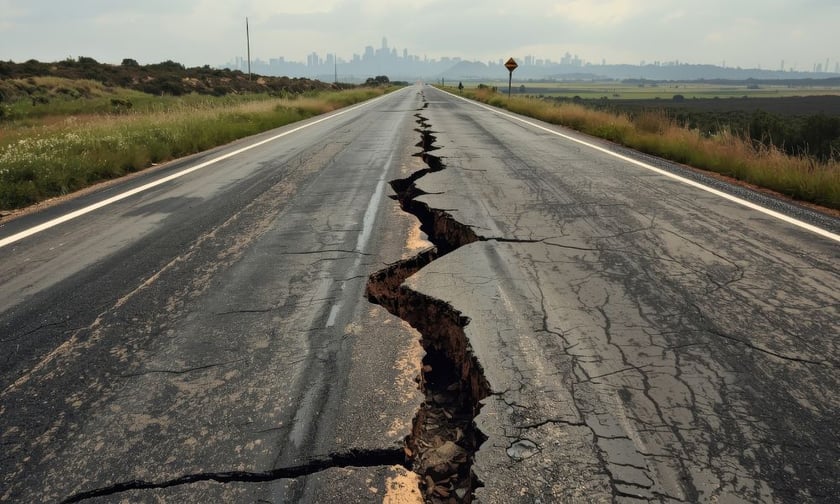
Insurance catastrophe models may be underestimating earthquake losses because they fail to account for a class of seismic events that has been linked to most insured earthquake losses over the past decade, according to new research from MS Amlin.
The study found that so-called supershear earthquakes accounted for 66% of insured earthquake losses since 2016, equivalent to $13.2 billion, despite being absent from seismic hazard assessments, building design standards and insurance catastrophe models.
Published in the Journal of Catastrophe Risk and Resilience, the research warns that the gap could affect pricing, capital allocation, and risk management decisions, particularly in major earthquake zones such as California.
Supershear earthquakes occur when a fault rupture travels faster than normal, creating a shockwave comparable to a sonic boom. According to the study, the phenomenon can produce stronger ground shaking, a "double punch" effect from successive seismic waves and unusual torsional forces that place additional stress on buildings.
MS Amlin reported supershear events were once considered rare but are being identified more frequently as seismic monitoring technology improves. The research found that around 36% of major strike-slip earthquakes worldwide since 2010 involved supershear rupture.
"There are still lots of things we don’t know about supershear earthquakes, but the evidence now suggests they are more common - and potentially far more damaging - than previously understood," said Luke Wedmore, senior research analyst at MS Amlin and co-author of the study.
"The sonic boom produced by these ruptures can cause more intense and widespread damage – yet the impact is significantly underestimated in models used for capital and pricing decisions for earthquake risks."
Researchers cited the magnitude 7.7 Myanmar earthquake in 2025, identified as a supershear event, as an example. The quake produced a surface rupture stretching 475km, around 230km longer than expected estimates, increasing the area exposed to damaging ground shaking.
The findings carry particular significance for California, the world's largest earthquake insurance market. Researchers noted that the San Andreas Fault is capable of generating supershear ruptures and that the 1906 San Francisco earthquake has since been classified as a supershear event.
The warning comes as California's insurance sector continues to adjust to growing catastrophe-related challenges. Market participants have increasingly relied on excess and surplus lines carriers to address difficult-to-place property risks. This shows broader concerns about catastrophe exposure and the availability of coverage in high-risk areas.
Wedmore said there is "a significant chance" that earthquake risk in California is being underestimated because of the higher shaking intensities associated with supershear events. He added that California may be experiencing its longest major earthquake drought in 1,000 years.
MS Amlin's modeling found that losses on representative insurance and reinsurance portfolios increased by 5% to 10% at a 200-year return period when supershear effects were included. At a 500-year return period, losses increased by between 30% and 60%.
The findings also emerge as insurers seek additional protection against major seismic events. Earlier this year, earthquake specialist Palomar expanded its reinsurance program to approximately $3.92 billion in limit. This shows the industry's continued focus on catastrophe capacity and large-loss preparedness.
The study urged insurers and catastrophe model vendors to incorporate supershear risk into future modeling frameworks. It also called for greater collaboration among scientists, engineers, risk professionals and the re/insurance industry to develop practical guidance and improve the assessment of earthquake exposure.