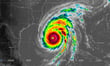
Hurricane Isaias strengthened into a Category 3 storm on Friday morning with sustained winds of 120 mph, the National Hurricane Center said in a special update at 8:20 a.m. ET. The storm was about 240 miles south of Pensacola, Florida, moving north-northeast at 15 mph. Landfall is expected late Friday or early Saturday on the Alabama or northwest Florida coast.
Forecasters expect Isaias to lose some strength before it reaches land. Fox Weather said it will likely come ashore as a Category 2 hurricane somewhere between Gulf Shores, Alabama, and Pensacola. Bloomberg put the population in its path at more than 3 million.
The NHC is forecasting storm surge of up to 9 feet and has told people in the warning areas to act now to protect lives and property. Storm surge and tropical storm warnings reach as far west as Louisiana. Florida Gov. Ron DeSantis declared a state of emergency in 27 counties, and the state lifted tolls on bridges in Okaloosa and Santa Rosa counties to help evacuees leave.
Read next: After months of calm, Isaias puts hurricane coverage back under scrutiny

Offshore producers had halted about 1.28 million barrels a day of oil output by Thursday, close to 63% of the Gulf total, according to the Marine Minerals Administration. The previous day’s report put the figure at about 25%. Roughly 57% of Gulf natural gas production was also offline.
Operators have evacuated 121 production platforms, about a third of those in the Gulf, Maritime Executive reported. The Coast Guard in Mobile told commercial ships to get ready to leave port. US oil prices rose as much as 5.6% on Thursday, adding to pressure from the conflict in the Middle East.
The storm’s eastward track has helped limit the offshore damage risk. Gary Cunningham of Tradition Energy said Isaias had grown stronger than forecasters first expected, but its shift east reduced the threat to Gulf production and LNG export terminals, according to Bloomberg. The track also keeps the storm away from the large refining cluster in southern Louisiana. Offshore wells that are shut in as a precaution usually come back within days unless equipment is damaged.
Refineries near the coast are more exposed. Bloomberg estimates that nearly 500,000 barrels a day of refining capacity sits in or near the forecast track. Most of it is at Chevron’s 356,000-barrel-a-day refinery in Pascagoula, Mississippi. Vertex’s plant in Saraland, Alabama, is also close to the track.
Chevron spokesperson Ross Allen told CNBC that Pascagoula was still operating. In a Friday note, Andy Lipow of Lipow Oil Associates identified power outages and flooding as the main risks to both refineries.

Gulf Coast refineries account for about 9.88 million barrels a day of the country’s 18.2 million barrels of operable capacity, according to the EIA. They were running at roughly 95% of capacity before the storm, so there is little spare capacity in the region to cover an outage.
Lipow told CNBC that US diesel supplies are at their lowest level for this point in the year since the EIA started collecting the data in 1982. He said that makes any lost refinery output harder for the market to absorb.

The US average on-highway diesel price was $6.199 a gallon on Oct. 5, $2.488 higher than a year earlier, according to the US Energy Information Administration. AAA’s daily national average hit a record $6.53 on Sept. 22. Bloomberg reported that gasoline and diesel stocks are both well below normal for the season, and that even a modest drop in output could send prices higher.
Trucking, logistics and farming clients would see fuel bills rise if a Gulf refinery stays down for long. Diesel also runs the backup generators that many businesses will rely on if the grid goes down this weekend.
Read next: Average business interruption claim now 70% larger than property damage – Allianz
Isaias is forecast to cross Alabama after landfall and move into the Tennessee and Ohio valleys. Tyler Roys, a meteorologist at AccuWeather, said parts of those regions could get 8 to 12 inches of rain. Up to 8 inches could fall in the Carolinas, including areas that flooded during Hurricane Helene in 2024. Parts of west Georgia are under tropical storm watches.
Many properties in those inland areas sit outside FEMA’s high-risk flood zones and have no flood insurance.
Read next: Flood insurance is vanishing where the water is rising fastest
BMS Group estimated insured losses of $3 billion to $5 billion, based on current forecasts, catastrophe model output and comparisons with Hurricane Sally in 2020. Gallagher Re put losses in the low to mid-single-digit billions, based on the exposure along the track and past Category 1 and 2 landfalls on that part of the coast. It said Isaias is unlikely to materially change January 1 reinsurance renewals.
A Category 2 landfall would likely keep losses within that range, though a loss of that size could still eat into deductibles on aggregate catastrophe bonds. Estimates would rise if Isaias makes landfall stronger than forecast or if a refinery floods.
Whether an energy-related loss is covered will turn largely on whether there was physical damage. A plant or terminal that closes as a precaution and reopens intact usually has no claim under a standard commercial property policy. A facility that takes on water does, and the disputes there tend to center on how long the restoration period runs and how much a percentage-based named-storm deductible takes out of the payout.
Customers of a damaged refinery would have to rely on contingent business interruption cover, such as a manufacturer or fleet operator that can’t get fuel or feedstock. Many policies limit that cover to named suppliers or carry sublimits that clients may not know about. Brokers reviewing losses with clients will need to check waiting periods, physical-damage requirements, utility service interruption provisions and contingent BI extensions.
Duke Energy Florida said its crews will restore power as soon as conditions are safe. It has also said that flooded homes and businesses can’t be reconnected until a licensed electrician inspects them, which could extend business income and additional living expense claims.
Adrian Hall, CEO US at Swiss Re Corporate Solutions, said the hurricane shows how vulnerable energy infrastructure is more generally.
“Reliable energy supply depends on grids, energy networks and critical infrastructure that can withstand disruption and recover quickly when it occurs,” Hall said. “With significant capital flowing into energy infrastructure, understanding physical risks is increasingly important to keeping those investments resilient, financeable and insurable.”
The Swiss Re Institute expects worldwide investment in energy infrastructure to reach $3.4 trillion in 2026. About $2.2 trillion of that is going to renewables, nuclear power, grids, storage, low-emission fuels, efficiency and electrification. For insurers, that spending means more premium, along with more interconnected assets clustered in places where one storm can damage many of them.
“With so much new energy infrastructure being built, resilience needs to be considered from the outset, not added after the fact,” Hall said. He said brokers, clients, carriers and engineers should work together while projects are still being designed, looking at redundancy, backup power, reliance on utilities and suppliers, and how fast operations could be restored after a disaster.
Read next: Energy casualty underwriters want brokers to look harder at the contracts
Updated Oct. 9, 2026, 11 a.m. ET: Isaias is now a Category 3 hurricane. This update adds the NHC’s latest surge forecast, new Gulf shut-in figures, the status of Chevron’s Pascagoula refinery, diesel inventory data and early insured loss estimates.