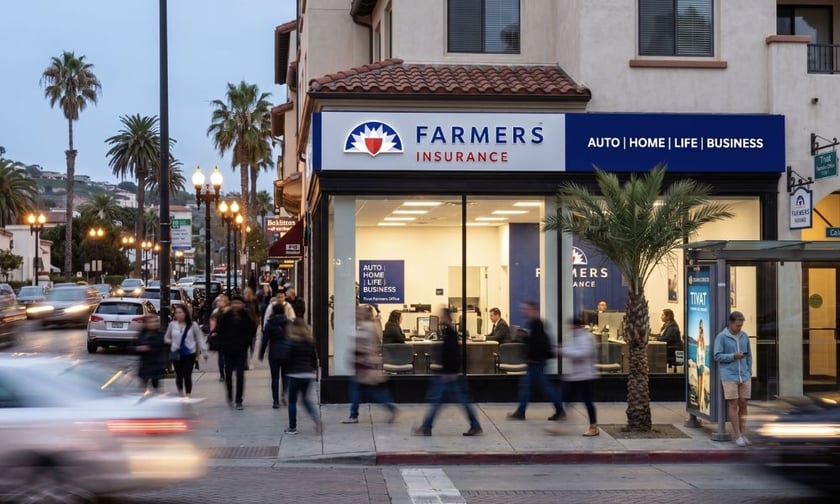
Los Angeles County has announced a civil investigation into Farmers Insurance Company, alleging the carrier failed to properly compensate policyholders whose homes were damaged in last year's Eaton and Palisades fires. County lawyers laid out the allegations in a letter sent to Farmers on September 9, warning the insurer to halt any unlawful practices immediately.
The county's Office of County Counsel said the inquiry will test whether Farmers breached California's Unfair Competition Law through delayed payments, denied claims, and underpayment of survivors whose homes were left standing but contaminated by smoke, ash, and toxic debris.
"Eaton Fire survivors did everything right, responsibly paying their premiums year after year, but when disaster hit, Farmers left them with a contaminated home and refused to pay for testing and cleanup," County Supervisor Kathryn Barger, whose district includes Altadena, said in a statement. "My constituents shouldn't have to walk back into homes with lead and asbestos because an insurance company won't pay for the test that would prove it's there."
Farmers pushed back on the county's characterization of its claims practices. "As always, we operate in accordance with applicable laws and regulations," the insurer said in a statement. "We do not believe the inquiry accurately characterizes our actions or practices and will cooperate through the appropriate process." The company added that each claim "is reviewed individually, taking into account the specific circumstances of the loss and the coverage provided under the policy."
According to the county, the complaints surfaced during a recent meeting with Eaton fire survivors, where Farmers policyholders said the insurer was slow to authorize, or outright resisted, testing by qualified industrial hygienists, leaving homeowners to pay for it themselves. That testing reportedly turned up unsafe levels of lead, asbestos, chromium, and other contaminants in homes that survived the flames. Residents also told the county that Farmers declined to fund adequate remediation or cover ongoing living expenses while homes sat uninhabitable.
"After paying millions of dollars in premiums, policyholders deserve the benefits and support they paid for," said Supervisor Lindsey Horvath, whose district covers Pacific Palisades. "Families whose homes survived the Palisades and Eaton fires but remain damaged or contaminated should not be forced to choose between returning to an unsafe home and financial devastation."
Farmers now joins State Farm as the second major insurer facing formal county action over its handling of the January 2025 wildfires, which razed more than 16,000 structures across Altadena and the Pacific Palisades. The county sued State Farm General Insurance Company on August 31, alleging the carrier engaged in illegal and deceptive business practices that kept survivors from receiving benefits they were owed under their policies. State Farm has denied the allegations.
That lawsuit followed a separate, and larger, enforcement action from the California Department of Insurance, which in May sought record penalties and a possible license suspension against State Farm after a Market Conduct Examination found 398 violations of state law across a sample of just 220 claims. Regulators said the pattern — including adjusters reassigned mid-claim and smoke-damage claims denied without explanation — potentially affected thousands of the roughly 11,300 State Farm policyholders who filed residential claims after the fires.
It isn't yet clear whether Farmers faces a comparable state-level Market Conduct Examination; the county's letter is, so far, a civil inquiry rather than a Department of Insurance action.
Farmers had projected roughly $600 million in losses from the January 2025 fires in an early-2025 estimate, a figure likely to have shifted since, and separately, lifted a cap on new homeowners' policies in parts of California later in 2025 as part of the state's broader push to rebuild coverage capacity in wildfire-exposed areas.
The company has not disclosed how many Eaton and Palisades fire claims it received, making it difficult to size the dispute against State Farm's roughly 11,300 residential claims.
Statewide, insurers had paid out more than $23.7 billion on wildfire-related claims as of early March 2026, according to Department of Insurance figures, out of roughly 41,800 claims filed following the two fires, a number that has almost certainly grown since. For brokers and agents with Southern California books of business, the widening scrutiny of claims handling now spanning two of the state's largest homeowners carriers, signals that regulators and local government are both willing to escalate beyond fines to litigation and public pressure when disaster-related complaints pile up.
The Farmers probe lands as Sacramento moves on two bills sponsored by Commissioner Lara that would rewrite the rules this dispute turns on. AB 1795, the Smoke Damage Recovery Act, would set the state's first enforceable, science-based standards for testing and remediating smoke-damaged homes solving precisely the kind of dispute Farmers policyholders are describing to the county.
A companion measure, SB 876, the Disaster Recovery Reform Act, would double penalties for claims-handling violations during declared emergencies and let the commissioner order restitution directly to policyholders, while also targeting the multiple-adjuster reassignments that have featured heavily in the State Farm case. Both bills passed the Assembly earlier this year and remain in play in Sacramento; if enacted, they would give regulators sharper tools the next time a carrier's smoke and contamination claims draw this kind of complaint.
Farmers said it remains focused on "handling claims with care, consistency, and attention to each customer's unique situation." The county's investigation is ongoing, and no findings of wrongdoing have been made public.