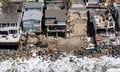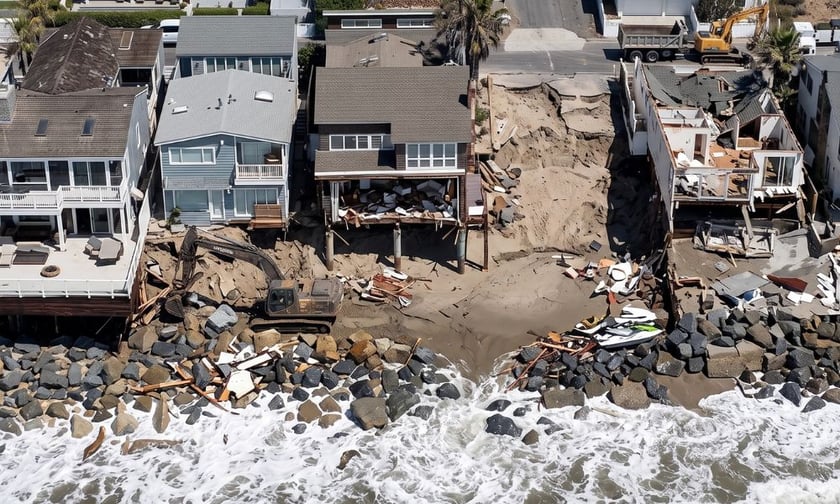
A weekend of pounding surf on the Southern California coast has given carriers and brokers an early look at what a record-strength El Niño winter could bring: real damage to real homes, and a stark reminder that many coastal policyholders assume they're covered for water damage – most simply aren't.
Swells thrown off by Hurricane Marie, combined with unusually high tides, tore through beach communities from Long Beach to San Diego over the Labor Day weekend. The historic boardwalk on the Long Beach Peninsula was destroyed in sections, at least two dozen homes were placed under evacuation orders, and a driveway at an oceanfront Malibu property collapsed into a sinkhole, forcing 31 nearby homes to evacuate under a local emergency declaration, according to local reports.
In Dana Point, city officials red-tagged seven storm-damaged homes as unsafe and yellow-tagged two more. Further south in San Clemente, high tides shut down a long-troubled stretch of coastal rail line again.
University of California climate scientist Daniel Swain said the storm was a preview of what's to come. "Unfortunately this is just a preview," he said, adding that coastal flooding "will get worse this fall and especially this winter." U.S. Geological Survey research geologist Jonathan Warrick made a similar point to the LA Times: "We are seeing the effects of El Niño already."
A large share of this kind of damage isn't covered by a standard policy, and many homeowners don't find that out until a claim is denied. Wind-driven wave damage, storm surge and flooding are excluded from standard homeowners policies and from the California FAIR Plan, the state's insurer of last resort, unless a policyholder has separately bought a difference-in-conditions (DIC) policy layered on top, according to the California Department of Insurance. Flood protection has to come instead from the National Flood Insurance Program (NFIP) or a private flood policy, and that coverage remains rare in California even as exposure grows.
Just 1.4% of California homes carry flood insurance of any kind, even though the state's 10 highest-loss counties account for nearly two-thirds of all NFIP claims paid since 1978, according to a Neptune Flood analysis.
California holds roughly 12% of the US population but only about 4% of NFIP policies nationwide according to AM Best. Even the coverage that does exist often falls short: the NFIP's $250,000 residential building cap sits well below the state's median home value, leaving many flood policyholders underinsured on top of everything else.
There's also a deadline brokers should have on their radar. NFIP's authority to write new policies and borrow against its Treasury credit line expires on September 30, 2026, unless Congress reauthorizes it, something lawmakers have repeatedly done only at the last minute in recent years. NFIP-backed clients renewing or binding near that date should be told now, not later.
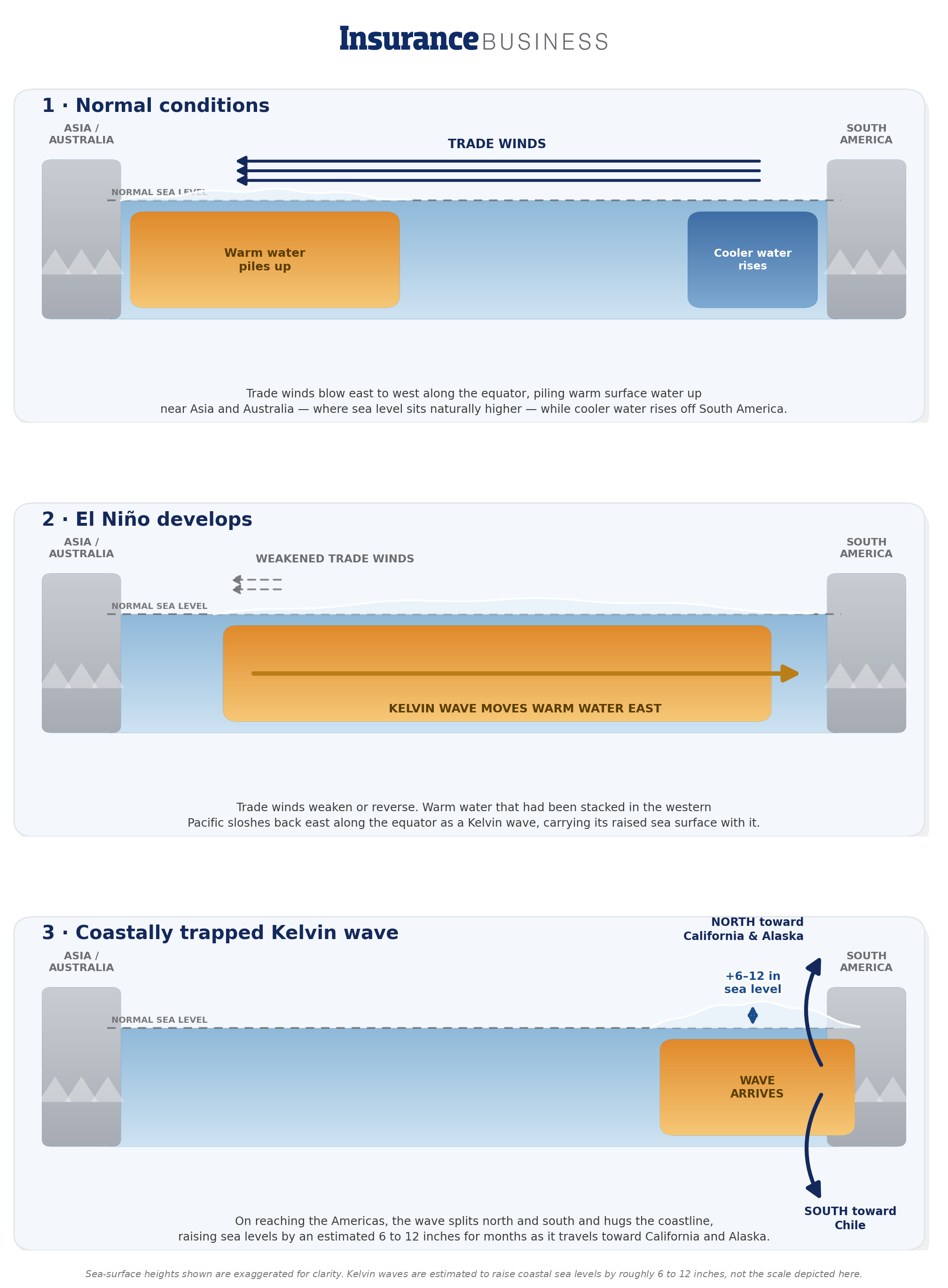
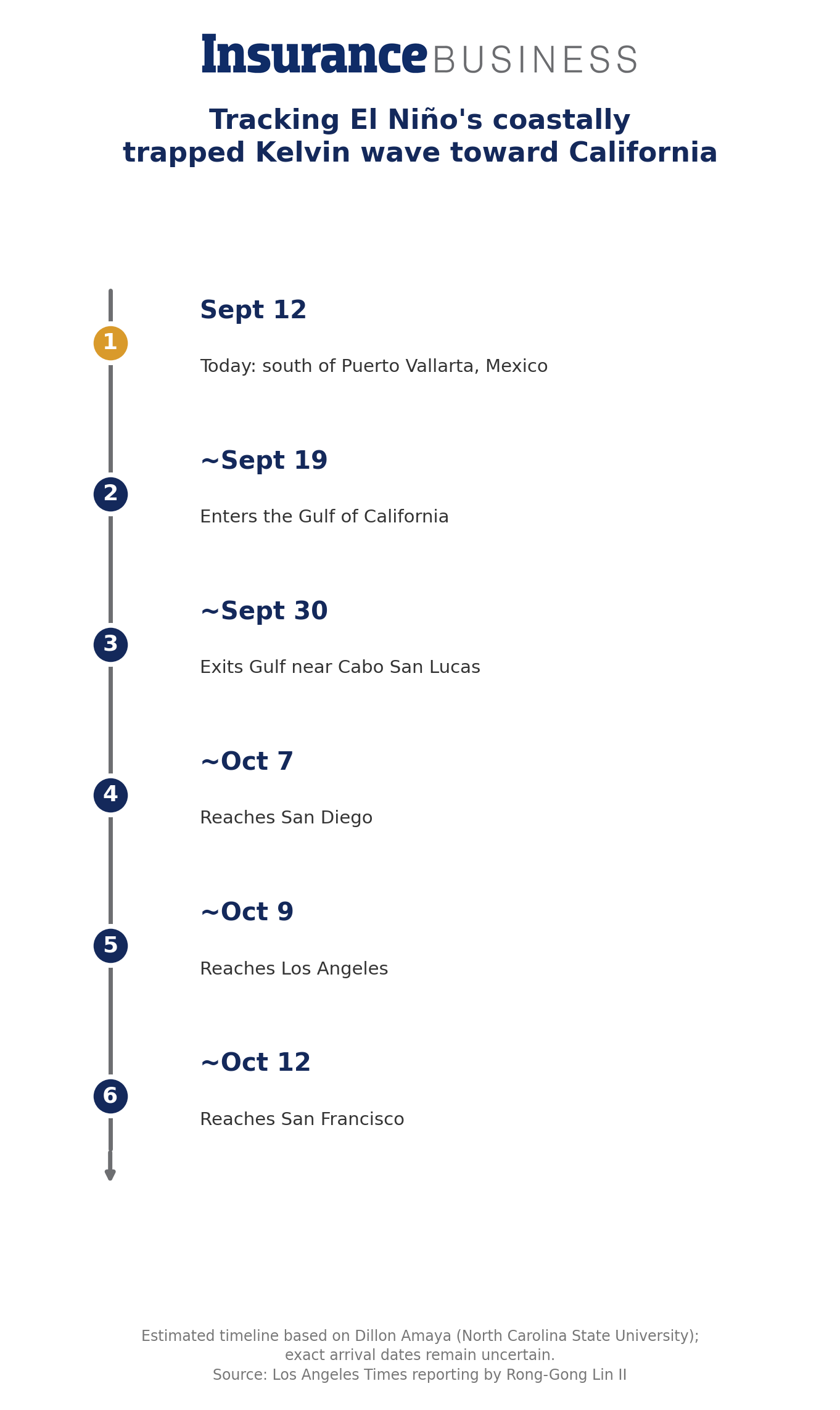
The weekend's storm damage may not even be the season's biggest test. A coastally trapped Kelvin wave, a slow-moving surge of unusually warm water tied to El Niño, is working its way up Mexico's Pacific coast and is expected to reach Southern California in early October.
Dillon Amaya, an oceanographer at North Carolina State University, said the wave alone could raise sea levels along the coast by 6 to 12 inches for months at a time, on top of roughly a foot of sea level rise the state has already seen from climate change and a separate, ongoing marine heat wave.
Stacked on top of already-elevated tides, that kind of sustained sea-level increase is exactly what makes El Niño years hard to price. The relationship between the El Niño-Southern Oscillation cycle and insured losses is "even weaker than the correlation with storm activity," catastrophe modeler Karen Clark & Company said in a white paper.
In other words, a quiet Atlantic hurricane season, which El Niño typically produces, doesn't mean a quiet season for California's coast. Federal forecasters put the odds of this El Niño becoming "very strong" through the final three months of 2026 at 98%, with a 75% chance it ends up stronger than any event since record-keeping began in 1950 according to National Oceanic and Atmospheric Administration data.
This storm hit at a difficult moment for California's property insurance market. Years of wildfire losses have pushed admitted carriers to tighten underwriting and non-renew policies across large parts of the state, sending homeowners toward the FAIR Plan and a surging surplus lines market that topped 300,000 homeowners policies for the first time in 2025, according to Insurance Business.
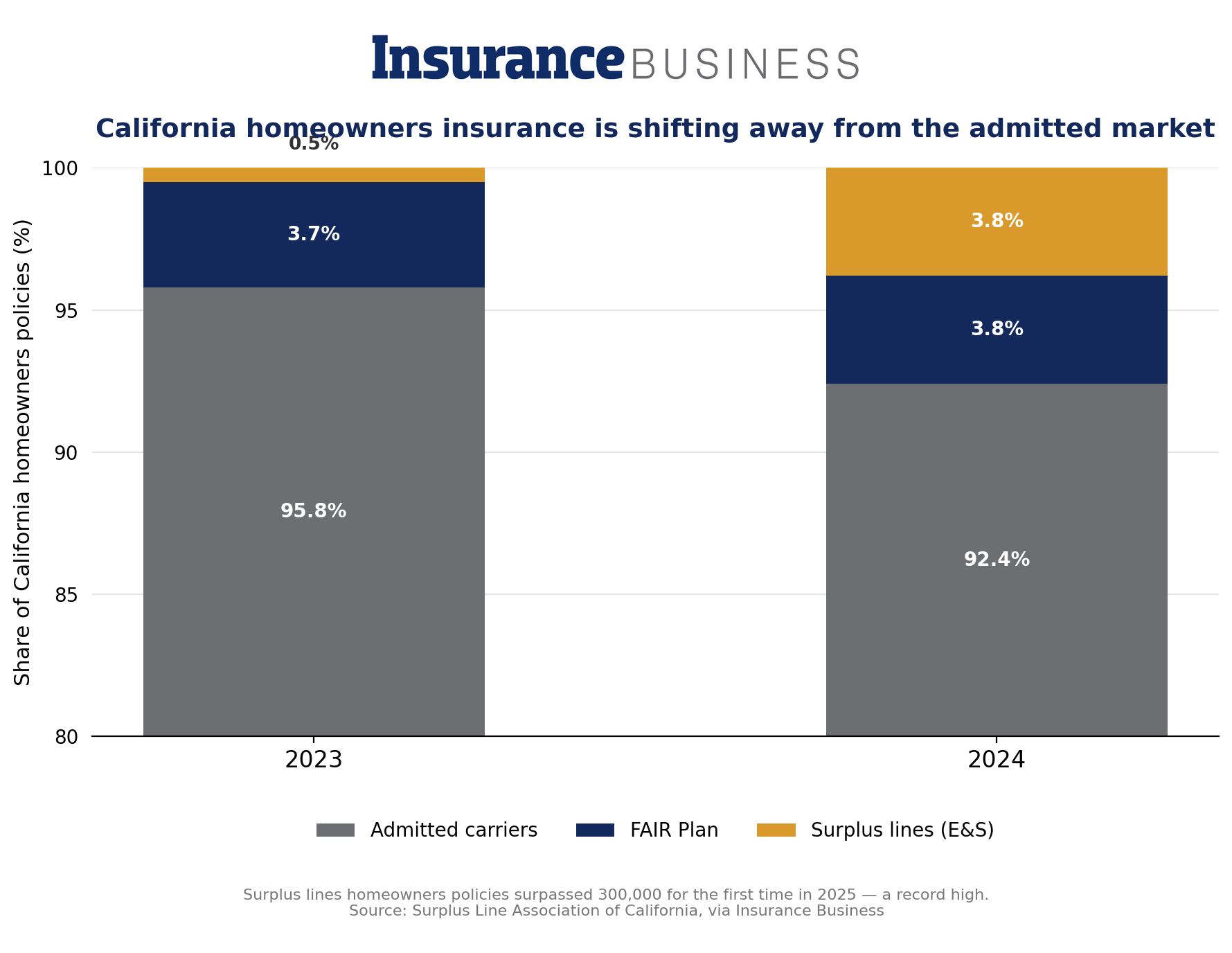
The FAIR Plan has been raising rates to keep pace, with one recent filing seeking a 29.1% increase while a wildfire liability dispute involving the state's major utilities remains unresolved. Farmers, Mercury and CSAA have each pledged to expand writing in high-hazard areas as part of the state's Sustainable Insurance Strategy, a push regulators hope will ease pressure on the residual market, Insurance Business has reported.
Meanwhile, private flood take-up is moving the wrong way. Nationwide private flood premiums fell from $803 million in 2023 to $730 million in 2024, even as El Niño conditions were firming up, according to Insurance Information Institute data.
That gap between rising coastal exposure and falling flood take-up may be the single most useful number brokers can raise with clients this fall, before the next swell hits rather than after.
For agents working coastal Southern California books, the weekend's damage is a good reason to check three things with clients before the Kelvin wave and winter storm season arrive: whether a DIC policy sits behind any FAIR Plan placement, whether flood coverage exists at all, and whether NFIP-backed clients know about the program's looming reauthorization deadline.
Long Beach officials say they're reinforcing sand berms and seawalls and checking storm drains. Orange County is rehabbing pump stations, and coastal communities up and down the state are stockpiling sandbags. Those mitigation efforts may factor into underwriting conversations of their own in the months ahead.