The Florida Surplus Lines Service Office has spent much of 2026 writing checks to universities. This week it wrote its biggest yet.
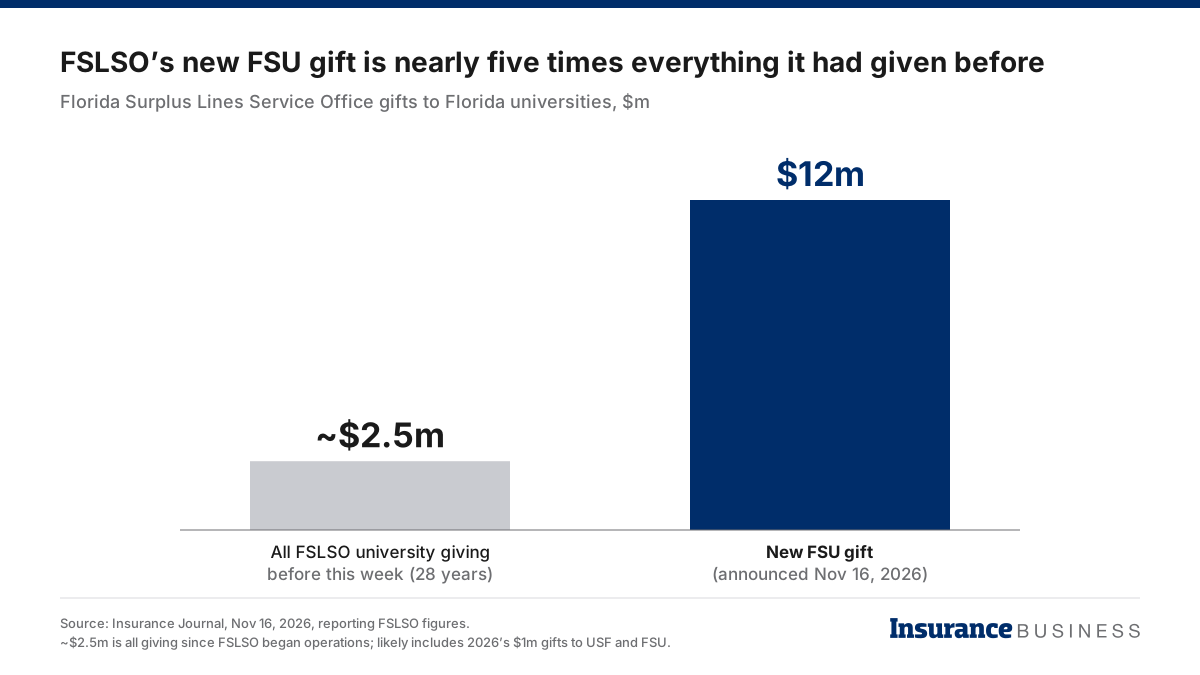
On November 16, the FSLSO announced a $12 million gift to Florida State University's risk management and insurance program. The endowment will create the Florida Surplus Lines Center for Insurance Excellence at FSU's Herbert Wertheim College of Business. It dwarfs everything the stamping office had given before: about $2.5 million to Florida universities across its 28 years.
The gift follows two $1 million endowments earlier this year, to the University of South Florida in July and to FSU in August, bringing the office's 2026 commitments to at least $14 million.
Jose Pagan, the FSLSO's director of regulatory affairs, spoke exclusively to IBA before the $12 million announcement. He joined the office in January after more than 15 years as an insurance defense and coverage lawyer in Tallahassee, including as a partner at Quintairos, Prieto, Wood & Boyer, followed by a stint as vice president of claims at Certus Claims Administration.
The industry, he said, faces a workforce challenge as retirements mount - and with them the potential loss of "not only personnel but also institutional knowledge."
The earlier endowments, along with support for a new risk management and insurance program at the University of Central Florida, show the office's commitment to education and workforce development in the state, he said. But he was clear that writing checks isn't enough. "Recruiting new talent is important, but mentoring, training, and retaining those professionals is also just as critical," he said.
The money is aimed squarely at bolstering the E&S talent pipeline. USF's gift to The Baldwin Group School of Risk Management and Insurance focuses on excess and surplus lines and funds internships, mentorships and experiential learning. FSU's August gift created a surplus lines directorship held by Professor Charles Nyce, who will now lead the new center. Nyce told Insurance Journal the center plans to combine regulator data with E&S data to build a fuller picture of Florida's homeowners market.
Read next: Insurance Business unveils America's top specialist wholesale brokers for 2026
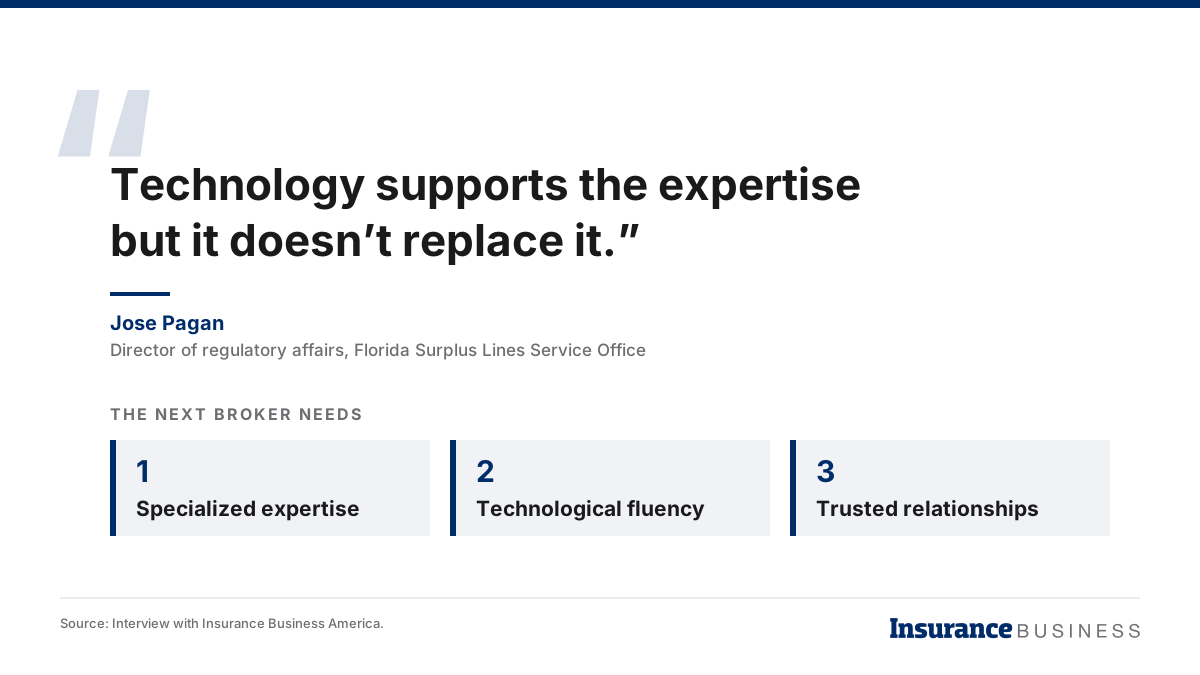
Asked what the next generation of wholesale brokers needs, Pagan listed three skills: specialized expertise, technological fluency, and the ability to build trusted relationships.
"Technology supports the expertise but it doesn't replace it," he said. AI will create efficiencies, but professional judgment and personal relationships remain essential in the E&S market.
Read next: CRC adds CAT specialist amid wholesale hiring wave
Pagan explained where he believes AI is already paying off: faster submission processing, cleaner data reaching carriers, more efficient placement, and lower administrative costs. Downstream, he said, that is producing better risk evaluation, sharper exposure modeling and more informed underwriting.
But he also sees hype. Adoption is still developing and measurable returns remain inconsistent, he said. "AI is not really a substitute for specialized expertise." E&S runs on relationships, professional judgment and the ability to structure solutions for very complex risks - and those, in his view, stay human.
The returns may depend on how deeply firms commit to the new technology. AM Best found that distributors using AI across submission intake, pre-underwriting and quote-to-bind outperformed those using it as a one-off fix, according to IB's analysis of AM Best's 2026 surplus lines report.
Read next: Florida's surplus lines market is booming as prices fall
For an office whose day job is processing filings and collecting fees, the FSLSO is making an unusually large bet on people. If Pagan is right that technology can only support expertise, the $14 million is a wager on where that expertise will come from.