The excess and surplus lines market has always sold the same three things, in Mike Kerner's (pictured) view: speed, flexibility and coverage tailored to the risk. What changes is how much those things matter.
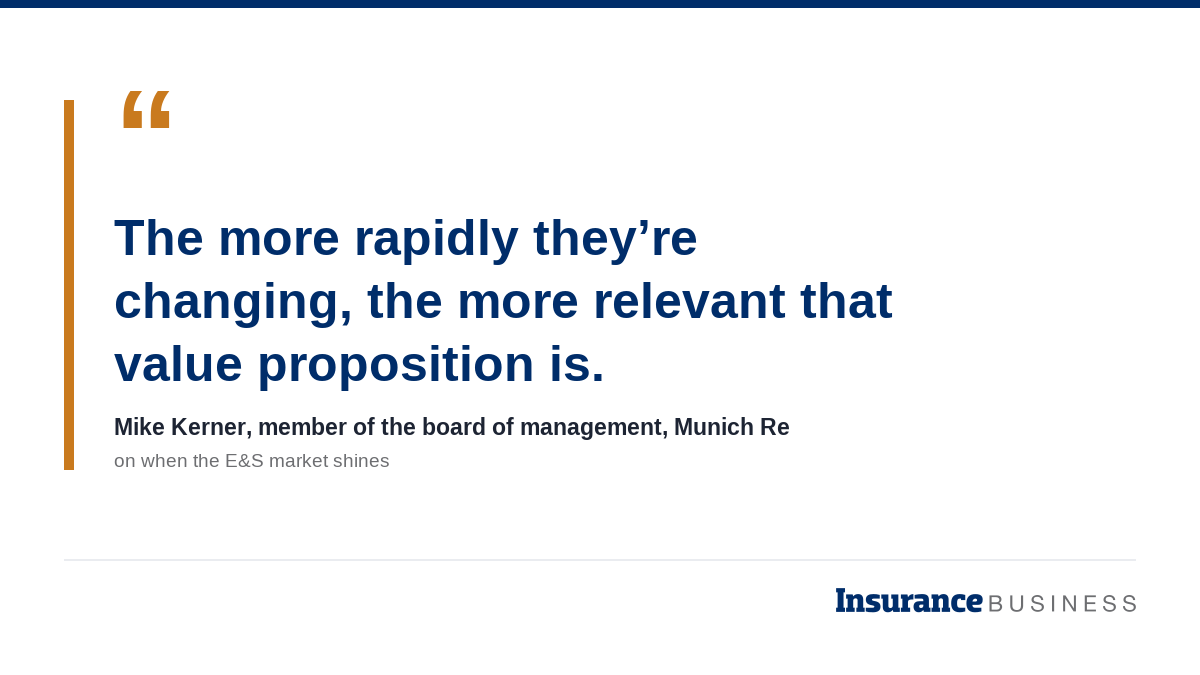
"When those needs are particularly relevant, that's when the E&S market really shines," said Kerner, the member of Munich Re's board of management responsible for Global Specialty Insurance. "Usually that happens when things are changing, and the more rapidly they're changing, the more relevant that value proposition is."
Kerner, who is also president and chief executive of Munich-American Holding Corporation, joined Munich Re's board in 2023 after running its Munich Re Specialty Insurance unit in New York. Before that he held senior roles at Everest Re and Zurich.
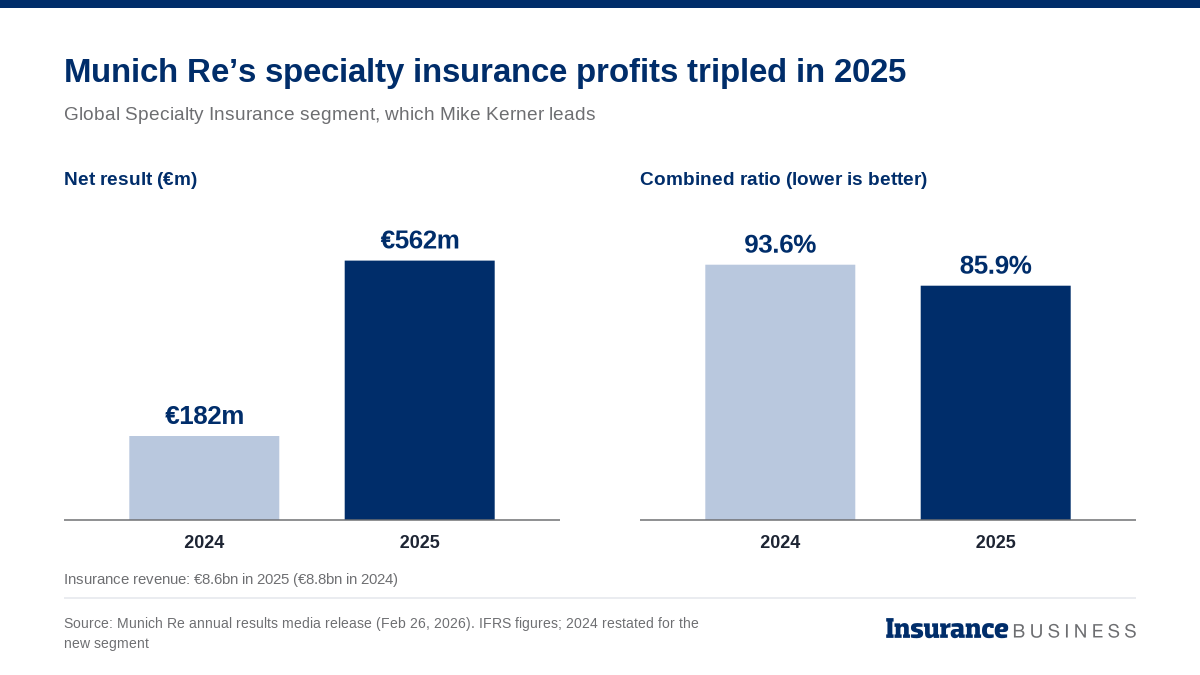
His division is a sizable business in its own right. Munich Re began reporting Global Specialty Insurance as a separate segment in 2025. That year it generated €8.6 billion of insurance revenue and a net result of €562 million, up from €182 million, as its combined ratio improved to 85.9% from 93.6%, according to Munich Re's annual results.
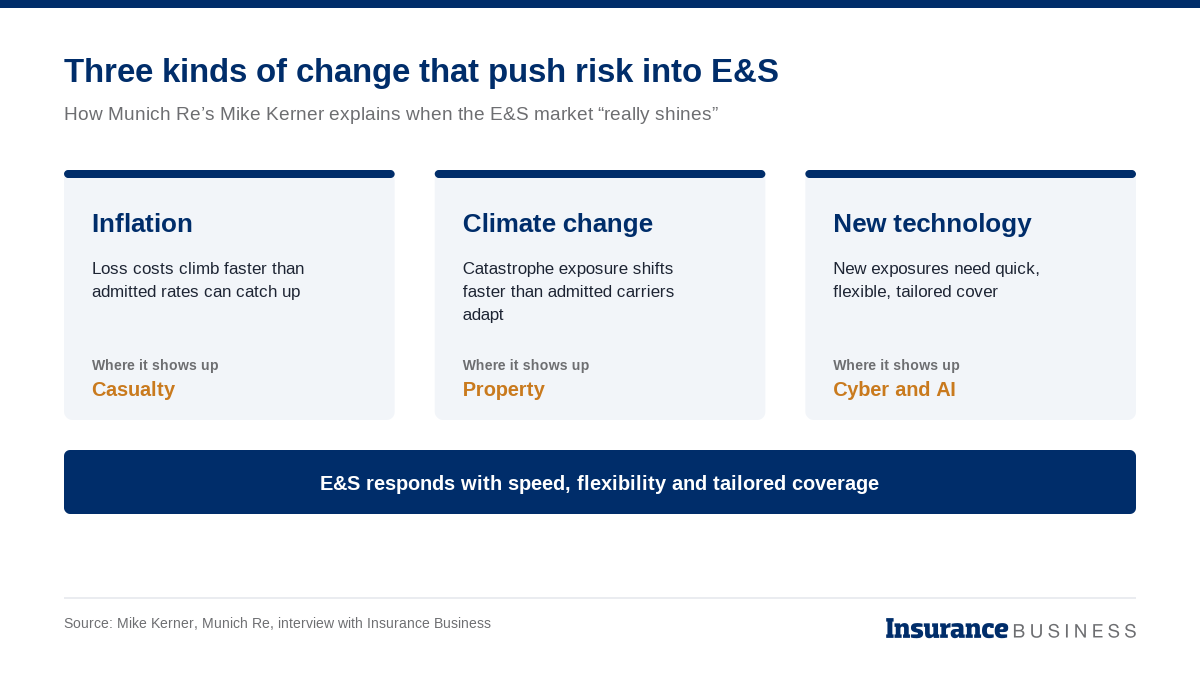
Kerner told Insurance Business that three kinds of change favor E&S.
The first is inflation. When loss costs climb quickly, he said, the admitted market "takes a bit of time to catch up," and E&S steps in. The second is climate change. As catastrophe exposure shifts, E&S can respond faster than admitted carriers can adapt. The third is new technology and new exposures. "The innovation normally comes from the E&S market, where you can act quickly, where you can be flexible," he said, citing both cyber and AI.
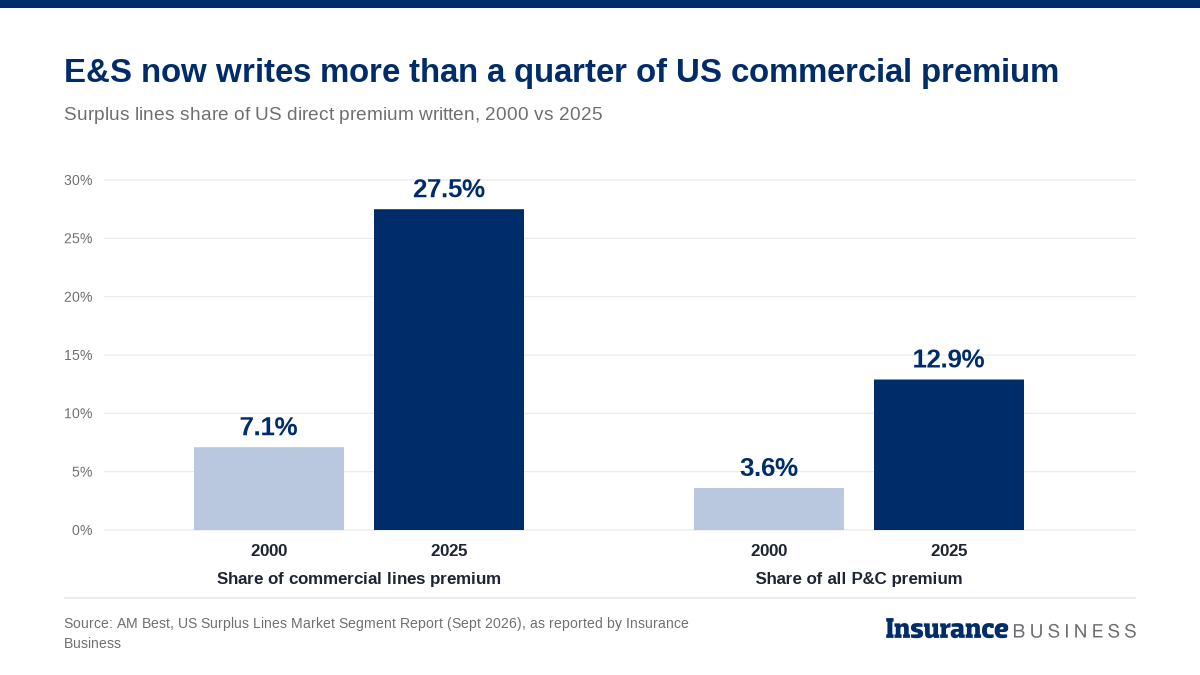
Those forces have reshaped the market over a generation. Surplus lines carriers wrote 27.5% of US commercial lines premium in 2025, up from 7.1% in 2000, according to AM Best.
Read next: Liability keeps buyers on edge as commercial market softens
Casualty has historically driven E&S, Kerner said, and he expects that to continue, because the litigation environment remains hot. Climate change has pulled a lot of property into the market too. Even after a couple of relatively light years for hurricanes, he said, there is still plenty of property exposure that needs a flexible E&S solution.
He also expects specialty lines to keep growing, cyber above all. Cyber exposure keeps evolving as AI tools develop, he said, and as exposures to AI itself emerge, E&S will be where the solutions are built.
Munich Re has been writing AI cover for longer than most. Its Insure AI unit has insured the performance of AI models since 2018 through a product called aiSure, which covers losses when AI systems make errors, including hallucinations in generative AI, for both AI vendors and companies deploying AI. This year it partnered with specialist insurer Mosaic to bring aiSure cover to more AI developers.
Surplus lines carriers already write nearly two-thirds of US cyber premium, according to AM Best. Munich Re is putting money behind the same view. In August it agreed to buy cyber insurer At-Bay for $575 million. At-Bay wrote $278 million of gross premium in 2025 and will sit under HSB, part of Kerner's specialty business, once the deal closes, which is expected in the first quarter of 2027. Kerner said at the time that he expects it to become a strong earnings growth driver.
Read next: Your clients think cyber covers their AI risk. Most of the time, it doesn't
The best MGAs, says Kerner, bring focus on their products and services, distribution expertise, nimbleness and entrepreneurialism. What works best, though, he believes, is an MGA that partners well with a carrier, so that the carrier's strengths come to the table too: "the stability of capacity, the expertise the carriers bring to the equation."
That is what brokers should look for, he said: MGAs that work well with their carriers to build a proposition with real value for the customer, "something that's going to stand the test of time."
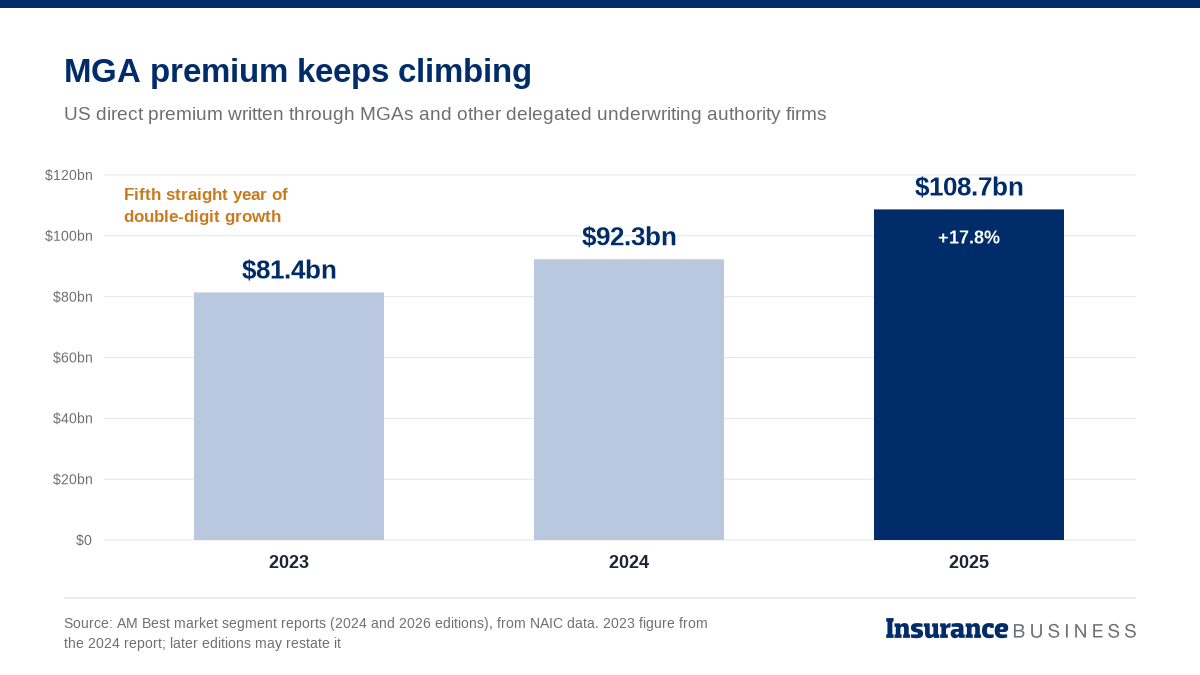
Kerner’s distinction could matter as the sector grows. MGAs wrote $108.7 billion of US premium in 2025, about 10% of the market, and AM Best and Conning have both warned that more of the reinsurance backing that capacity now comes from unrated or offshore markets.
Read next: Conning: fronting sector's easy growth phase is ending