In the excess and surplus lines market, "freedom of rate and form" has almost become a slogan, but Erich Bublitz (pictured) thinks the industry is putting the emphasis in the wrong place.
"Nobody goes out and buys insurance because we have freedom of rate and form," said Bublitz, executive vice president and head of E&S at AmTrust. What that freedom actually buys, he told Insurance Business, is the ability to be responsive: "responsive to new risks that are coming out, responsive to the needs of the specific insured, responsive to a changing economy." That, he said, is much harder for the admitted market.
Bublitz, who has led AmTrust's E&S division since 2022 after senior underwriting and operations roles at W.R. Berkley's Admiral Insurance Group, also believes, like others we interviewed at WSIA’s Annual Marketplace, that the gap between the two markets is growing. "I think it's absolutely widening," he said.
AmTrust has been expanding in E&S under his leadership. In September 2025, it added property, environmental and builders risk lines to the division, folded its primary, excess and environmental casualty products into a single brokerage casualty group, and set up E&S Premier, a new unit for complex casualty.
Artificial intelligence is a case in point of the types of risk that E&S can excel in. Few people yet understand what the risks of AI are or how to insure them, Bublitz said, and the way the industry will work that out is by writing it in E&S. The admitted market, in his view, will follow once E&S has shown how. As the economy, AI and data keep changing, he said, that will only widen the gap.
AM Best data also backs up his view of how the market is working. In its September report on the surplus lines market, the rating agency said admitted insurers have concentrated on tightening AI exclusions in general liability policies, leaving surplus lines as the main route to affirmative, specialized AI coverage.
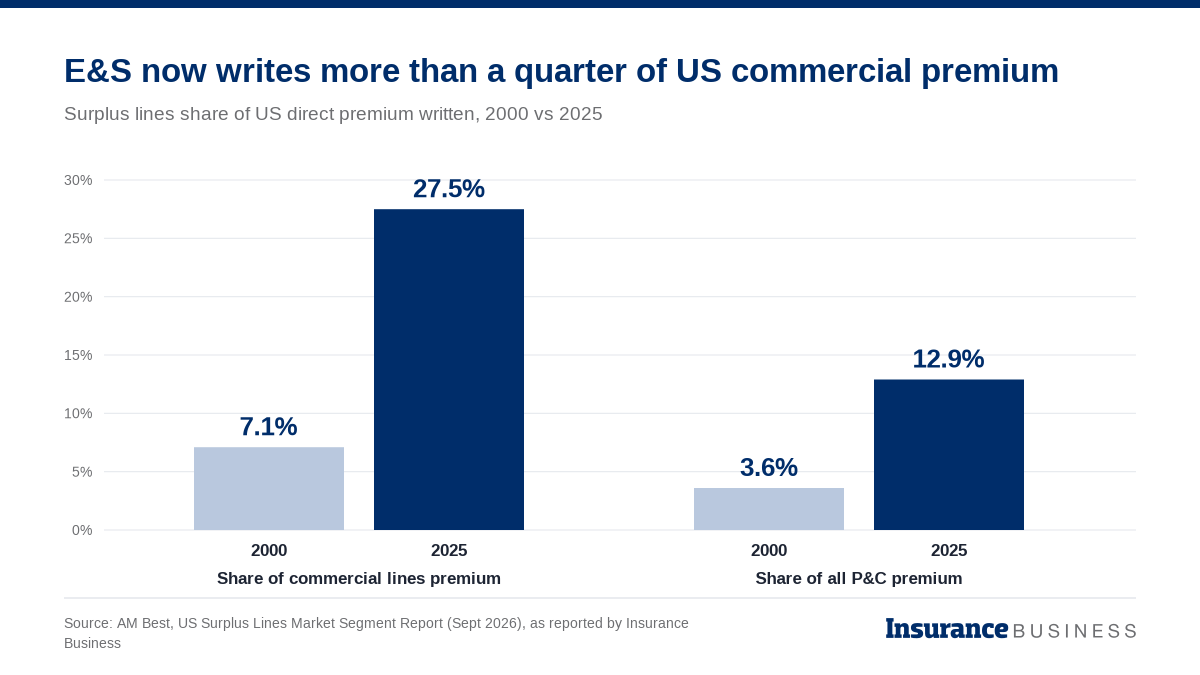
The broader widening he describes has been under way for decades. Surplus lines carriers wrote 27.5% of US commercial lines premium in 2025, up from 7.1% in 2000, according to AM Best.
Read next: Your clients think cyber covers their AI risk. Most of the time, it doesn't
The business moving into E&S fastest, Bublitz said, is the most specialized. He singled out human and social services, where sexual abuse and molestation claims have become a major problem for the industry. Because of changes in the law, claims can now arrive decades after the alleged abuse, which he called unsustainable for the standard market. Those accounts are moving into E&S, he said, where carriers have been able to keep the exposure under control.
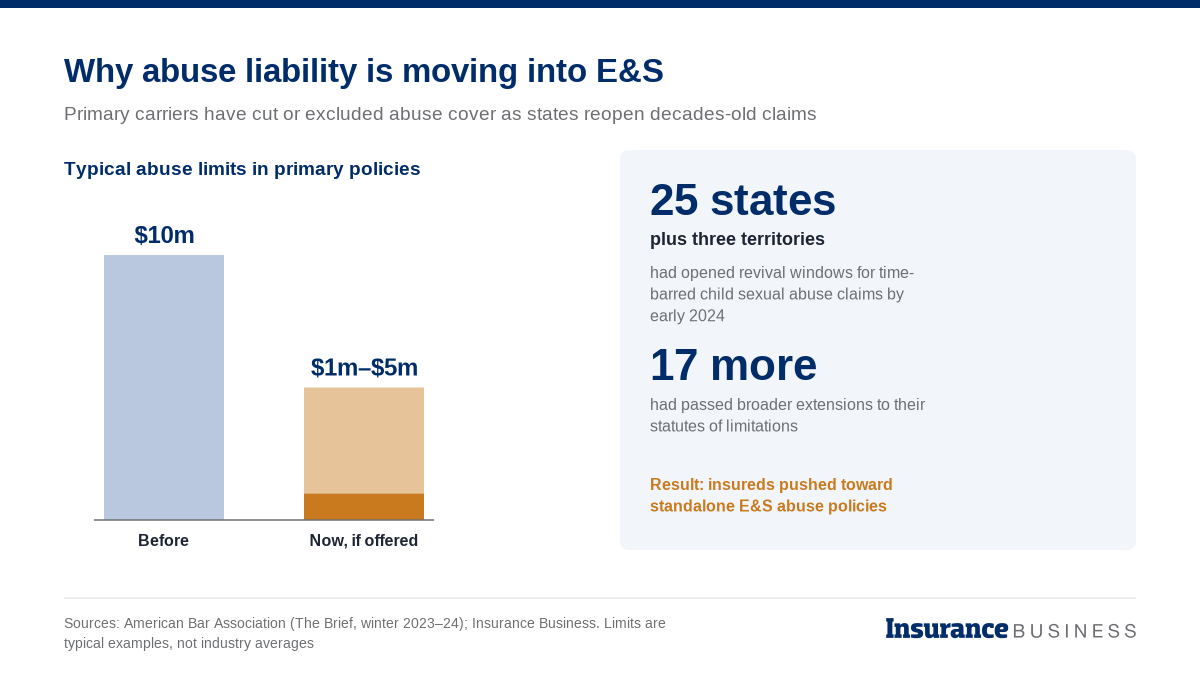
State law changes are a big part of the reason. By early 2024, 25 states and three territories had opened revival windows allowing previously time-barred child sexual abuse claims, and 17 more had passed broader extensions of their statutes of limitations, according to the American Bar Association. Primary carriers have responded by sublimiting or excluding abuse cover, often cutting limits from $10 million to $1 million or $5 million, and pushing insureds toward standalone E&S policies.
And this is a pretty fluid state of affairs, as the count has kept rising. Wholesaler Amwins now puts the number of states that have extended or removed filing deadlines for abuse claims at more than 30, leaving insureds with fewer options, higher premiums and greater reliance on E&S.
That exposure control comes from the same freedom of form Bublitz described at the start of the interview. E&S carriers can write standalone abuse policies with their own limits, aggregates and reporting windows, (terms that are now being tested in court as revived claims arrive).
Environmental liability, another long-tail line, is moving in too, Bublitz said, and it is one AmTrust has invested in directly: its environmental group is among the products now housed in the new brokerage casualty unit. "The more specialized it is, the more it's flowing," he said. Very little, in his view, is leaving.
Read next: Liability keeps buyers on edge as commercial market softens
Bublitz also has strong thoughts on what the next generation of wholesale brokers needs to be. The broker's job, he said, should be two-way communication: carrying the insured's risk information through to the carrier, and carrying back to the insured what the carrier can and can't insure, and why.
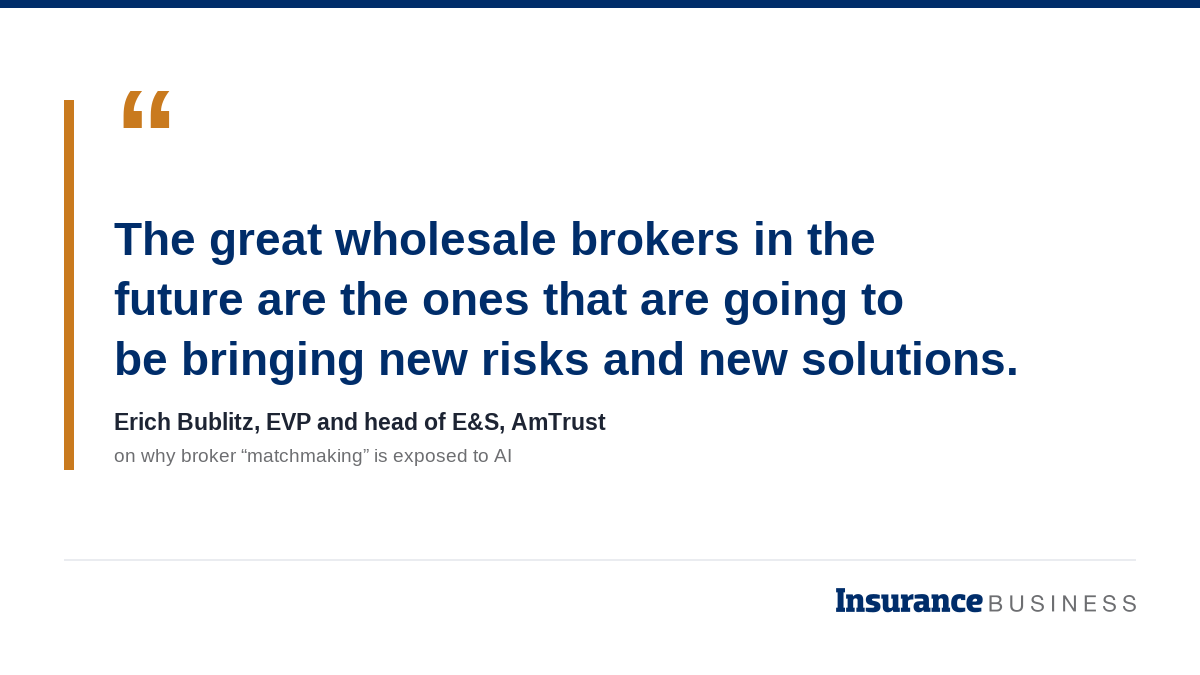
The broker who thinks of the job as matchmaking, knowing which carrier writes which type of risk, is in trouble. "That's an area that I think is badly exposed to AI," he said. "The great wholesale brokers in the future are the ones that are going to be bringing new risks and new solutions, and being hugely communicative between the carriers and the insureds."
[Insert graphic: ib-quote-card-bublitz.svg]
On whether the industry is developing that talent, he was positive. "We absolutely are making great investments in the industry and new people," he said, pointing to the number of young people at the conference. The task now, he said, is to keep evolving how they are trained to work with capacity providers.
Read next: Why AI adoption will split wholesale brokers into winners and losers
As retail brokers specialize, Bublitz expects wholesalers to keep their edge. They see the market at a broader level than even large retailers, he said, often with deeper expertise, and they have long-term relationships with carriers. That history builds trust, which makes AmTrust more willing to write business from retailers it doesn't know.
Retail specialization, in his view, has "really just opened up more avenues for wholesale to be valuable."
Read next: Bring in wholesale broker before admitted market says no, RPS president tells retailers