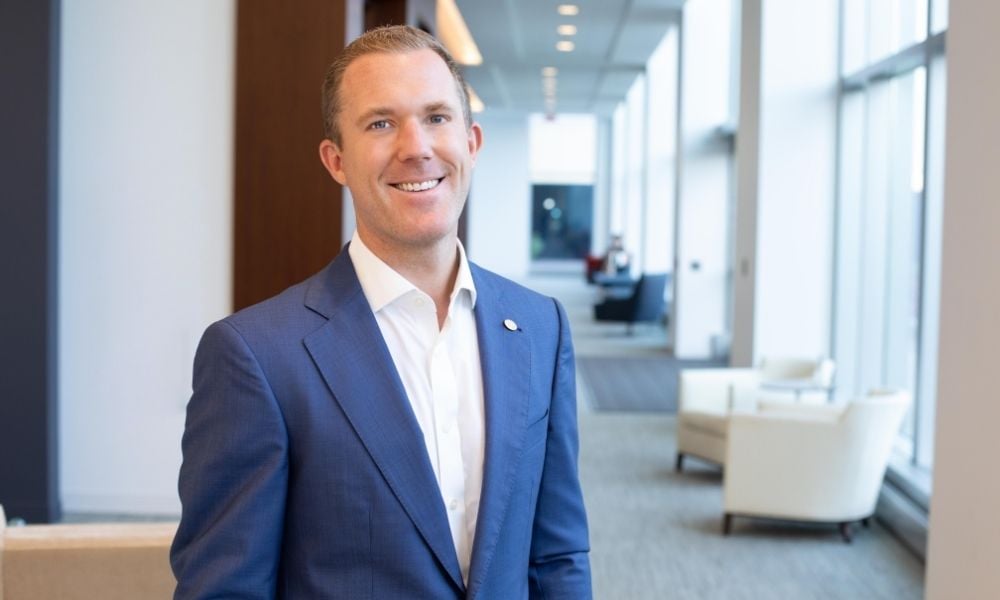
Ask Adam Mazan (pictured) what the next generation of wholesale brokers should look like and he answers in four words: technology-enabled, judgment-led.
Mazan, who was named president of Risk Placement Services (RPS) in 2024, spoke with IBA at the WSIA Annual Marketplace in San Diego in October. His view of where the channel is heading comes as two forces press on wholesalers at once: AI tools that can automate much of a broker's working day, and a run of large brokerage deals that is handing big retailers more specialty muscle of their own.
As AI and other tools spread, Mazan said, they will strip out many of the processes and keystrokes that fill a broker's day. But brokers are "still going to need to understand the why behind the data points," he said – and use that understanding to bring better judgment and more creative solutions to the point of sale.
The technology shift is already sorting out the market. AM Best found that distributors deploying AI across submission intake, pre-underwriting evaluation and quote-to-bind outperformed those treating it as a single-task fix, and that the early movers are pulling further ahead.
Read next: CRC adds CAT specialist amid wholesale hiring wave
If judgment is the job, it has to be grown somewhere. Mazan's own path is a case study in that growth path. He joined RPS as a summer intern, came on full time as a broker after graduating from the University of Wisconsin–Madison, and worked through regional leadership roles in California before taking the top operating job. He’s not the only senior manager who followed that trajectory - RPS CEO Kevin Doyle also started as an intern.
In a 2023 profile of his rise through RPS, Mazan said his Southern California operation had taken on five interns that year, two of whom had already accepted full-time offers, and that 10 or 11 former interns were working across its Orange County and Los Angeles offices. In RPS's 2025 IBA 5-Star Wholesale Brokers and MGAs profile, he stressed the importance of "recruiting, retaining and developing the best talent in the industry."
Read next: Insurance Business unveils America's top specialist wholesale brokers for 2026
The bigger strategic question for wholesalers is what happens as their retail clients specialize – and as the largest of them build internal wholesale desks through acquisitions. Aon's planned $17 billion purchase of USI Insurance Services is the latest example; Aon has pointed to USI's excess and surplus lines business as one of the deal's attractions.
Mazan's explains that in our industry, practice makes perfect. A specialist retail broker might work 20 or 30 deals a year, he said; a wholesale broker works 30 or 40 a month. Retail specialists go a mile deep in their industry, and wholesalers do too – but with a much broader view of what is happening across the market and what is possible. That breadth, he argued, only becomes more valuable as retail clients narrow their focus.
IBA readers largely agree. In an IBA LinkedIn poll, only 7% expected brokerage consolidation to significantly reduce reliance on wholesalers; 43% said it would do so somewhat, 20% said only for simpler risks, and 28% said it would not really reduce it.
Peter McMurtie, insurance practice leader at consulting firm West Monroe, expects most large brokers to keep building in-house wholesale operations, but not to go it alone. "The key is they're still going to need to partner with and work with those other large wholesalers," he told IBA, adding that established wholesalers should hold on to the most complex risks and niche markets.
Read next: Why wholesale brokers are being squeezed as retail consolidation accelerates
If Mazan is right, technology will level much of the processing work across the channel. What it won't level is the judgment a broker builds by seeing deal after deal – and that, he suggests, is where the wholesaler's future lies.