
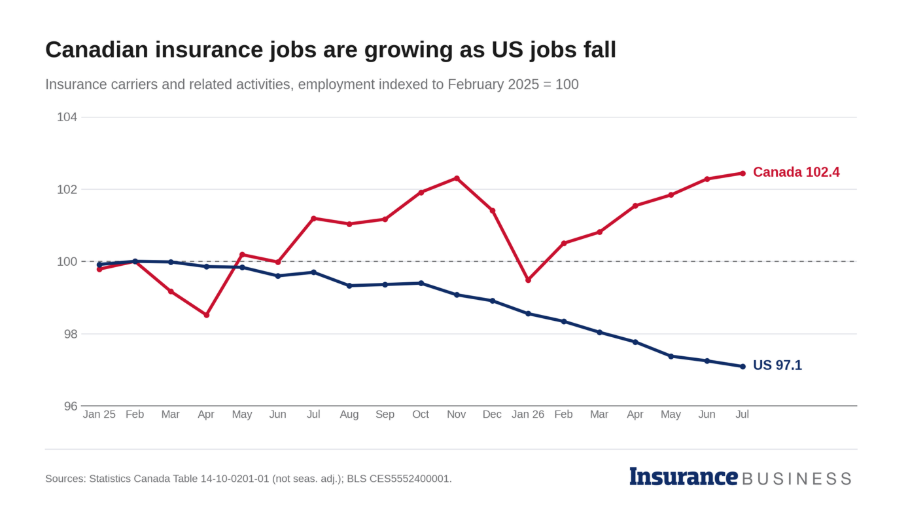
Canada's insurance industry is still adding jobs while its US counterpart cuts them. But the US decline has deepened this year, and several large Canadian insurers depend heavily on the American market.
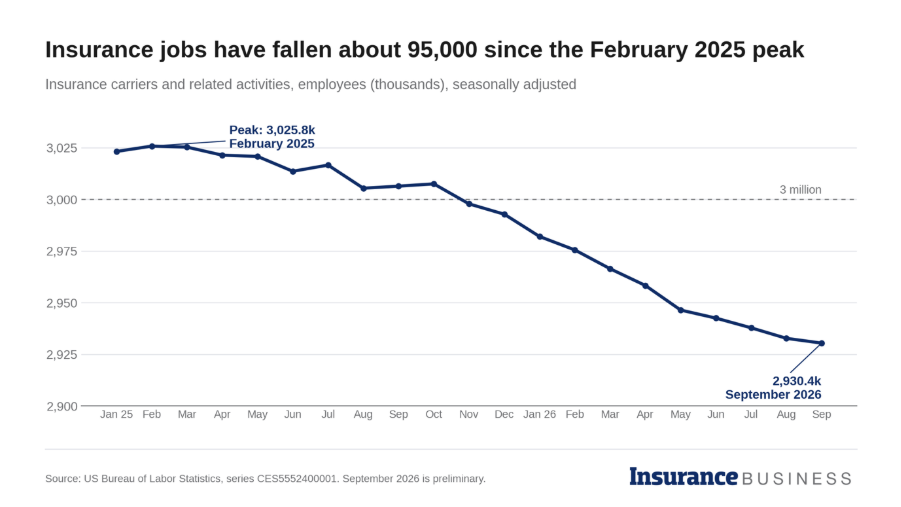
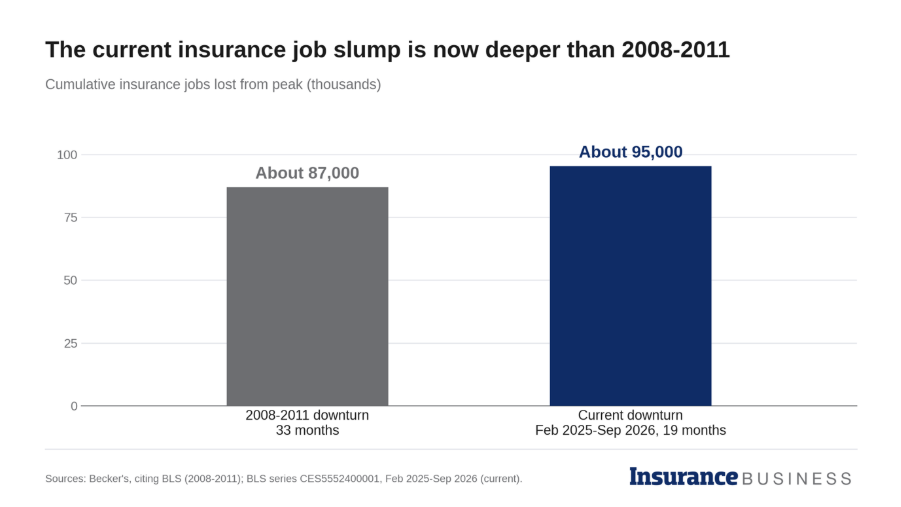
US insurance carriers and related businesses cut another 2,300 jobs in September, their 11th straight monthly decline, according to figures released Friday by the US Bureau of Labor Statistics. The US industry now employs about 2.93 million people, roughly 95,000 fewer than at its February 2025 peak. That is more jobs than it lost between July 2008 and early 2011, although the current decline is smaller as a share of the workforce, at 3.2% compared with 3.6% then.
Canada is moving the other way. Insurance carriers and related businesses employed about 282,000 people in July, up 3,400, or 1.2%, from a year earlier, according to Statistics Canada's Survey of Employment, Payrolls and Hours. Over the same 12 months, US insurance employment fell 2.6%.
The Canadian growth is coming from carriers. Employment at insurance carriers rose 4.5% from July 2025 to about 178,800, while agencies, brokerages and other insurance-related businesses fell 3.9% to about 103,100, a loss of roughly 4,200 jobs. Statistics Canada's figures are not seasonally adjusted, so the year-over-year comparisons are a more reliable guide than month-to-month moves in the chart.
Last month, Insurance Business asked whether Canada was following the US path and found the Canadian picture quieter and less settled. Since then, the US numbers have worsened, and second-quarter results from some of Canada's biggest insurers show how much of their business depends on the American market.
The insurance losses came in a soft month for the US economy. Employers added a net 29,000 jobs in September, and the BLS revised July and August down by a combined 60,000. July now shows a loss of 10,000 jobs. The US unemployment rate rose to 4.2%.
US insurers' own forecasts have also proved too optimistic. In the Q3 2026 Insurance Labor Market Study by The Jacobson Group and Aon, 13% of property and casualty respondents in July 2025 said they planned to reduce staff. A year later, 26% reported having done so. Among life and health companies, 10% planned cuts and 29% made them. Where companies do plan cuts, automation is now the most common reason given.
Read next: AI is cutting insurance jobs. The industry is just starting to say so
Canada's broader labour market weakened in August. Employment fell by 42,000 and the unemployment rate held at 6.4%, according to Statistics Canada's Labour Force Survey. Finance, insurance, real estate, rental and leasing were among the industries that lost jobs, Insurance Business reported at the time.
The Labour Force Survey does not break out insurance on its own. Statistics Canada's payroll survey does, but it runs about two months behind the US data, so the Canadian insurance figures above end in July.
Statistics Canada will publish September's Labour Force Survey on Oct. 9.
Three of Canada's biggest insurers each earn a meaningful share of their business in the US, according to their second-quarter results.
Manulife's US segment, which operates as John Hancock, generated C$301 million of the company's C$1.92 billion in core earnings in the quarter, about 16%. That figure excludes US wealth and asset management, which Manulife reports within its global wealth unit.
Sun Life's US business accounted for C$227 million of its C$1.12 billion in underlying net income, about 20%. That business includes employee benefits and medical stop-loss coverage sold to American employers, which ties it to US payrolls, as well as dental coverage. US sales rose 43% in the quarter to US$324 million.
Intact Financial's US specialty business, which insures mainly medium-sized companies, produced C$602 million of the group's C$6.57 billion in operating revenue in the quarter, about 9%.
Canadian insurers are also adopting the technology that US companies increasingly cite when cutting staff. Manulife said in its second-quarter results that it was named the top life insurer for AI maturity in the 2026 Evident AI Index for Insurance, and that it is accelerating AI across the business to, in chief executive Phil Witherington's words, "improve efficiency, and deliver tangible value." Sun Life reported launching a proprietary agentic AI platform and an AI-powered concierge for its advisors. Neither company's results release mentioned AI-related job cuts.
Read next: Canada's junior insurance talent emergency: it's not AI, it's WFH
Monetary policy is also diverging. The US Federal Reserve raised rates on Sept. 16 for the first time since 2023, lifting its target range to 3.75%–4%. Two weeks earlier, the Bank of Canada held its policy rate at 2.25%, its seventh consecutive hold, as economists expected it to wait and see how new tariffs between Canada and the US affect growth and inflation.
The gap could matter for investment income. Higher US rates generally lift yields on new US investments for insurers with American operations, though the effect on Canadian results depends on each company's portfolio mix and currency hedging. The Bank of Canada's next decision is Oct. 28.
Until now, Canada's insurance workforce story has been about shortages rather than cuts. SGI Canada chief operating officer Andrew Voroney has described the industry as still feeling a post-pandemic talent cliff, with fewer experienced professionals available. "It creates a pressure sandwich," he told Insurance Business.
The payroll data suggests that may be starting to change in one part of the market. Brokerage employment is down 3.9% from a year earlier even as carriers hire. The figures do not show why, and a broader shift would show up first in entry-level and administrative roles if automation is the cause.
Read next: Insurance talent shortages, broker pressure reshape insurer strategy, says SGI Canada COO
Three releases over the next five weeks will show whether the two markets are moving together: Statistics Canada's September jobs data on Oct. 9, the Bank of Canada's rate decision on Oct. 28, and the BLS October jobs report on Nov. 6.