
South of the border, a shrinking finance and insurance workforce has reopened the debate over how much of the damage AI is doing versus how much comes down to interest rates. Canada's August jobs data, released last week by Statistics Canada, raises the same question here. The short answer: something similar shows up in the headline number, but the shape of the underlying data looks quite different once you check it month by month.
Canada lost 42,000 jobs overall in August, a surprise given the run of solid hiring from April through July, according to the Labour Force Survey. Within that, the category StatCan calls "finance, insurance, real estate, rental and leasing" fell by 9,600 jobs (‑0.6%) from July to August, and is down 15,100 (‑1.0%) from a year earlier, according to Table 2 of the release.
Our monthly Labour Force Survey doesn't split insurance out from finance, real estate, rental and leasing the way the US Bureau of Labor Statistics splits "finance and insurance" from the broader "financial activities" category. A reader can't tell from this release alone how much of the August drop came from insurance specifically versus mortgage lending, real estate brokerages or property management. That's a real limitation to flag before drawing conclusions about insurance jobs in particular.
Statistics Canada's own August highlights didn't flag finance, insurance, real estate, rental and leasing as one of the month's statistically significant movers. The sectors called out were business and support services, public administration, natural resources and utilities, each posting larger declines, with manufacturing the lone gainer.
The finance and insurance figure is real, but it reads as a quieter story here than in the US release, where insurance carriers alone accounted for a clearly identified, larger share of the national decline.
Checking the last five months of official releases changes the picture further. Employment in this category moved from about 1,477,500 in April to 1,470,200 in May, 1,474,100 in June, 1,492,100 in July and 1,482,500 in August. Over the same five months, the equivalent US category fell in four of five months, a steadier slide of roughly half a percentage point. Canada's series bounced around and ended the period slightly above where it started in April, with the July gain of 18,000 largely reversing in August rather than compounding a longer downtrend.
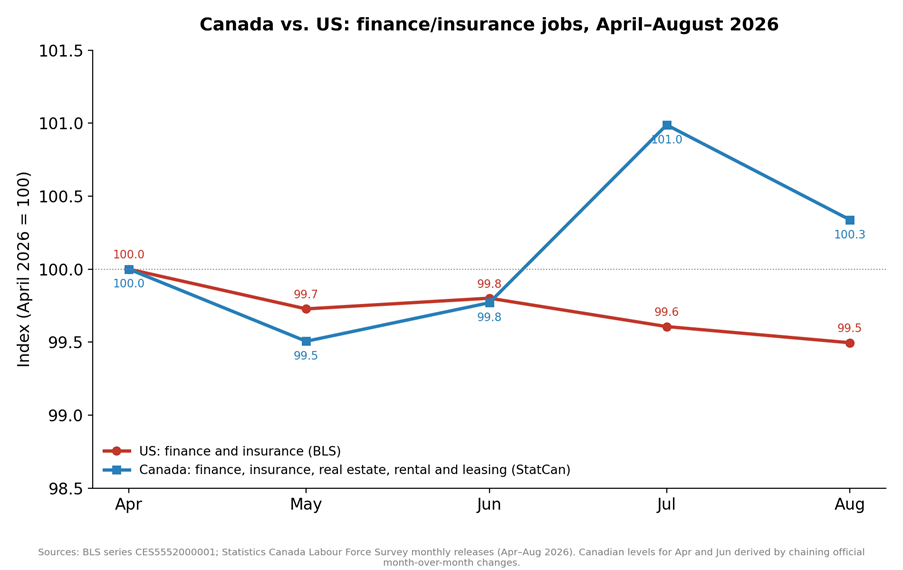
A single-month drop against a backdrop of volatility reads differently than a single-month drop inside a sustained, multi-month decline. Judged only on the August figure, Canada looks like it's tracking the US story. Judged on the full run of monthly data, Canada's finance and insurance jobs picture looks closer to flat with noise than to a steady erosion.
There's also a structural difference in how the two countries' August reports read. In the US, the headline number beat expectations by a wide margin even as finance and insurance shed jobs, making the sector look like an outlier in an otherwise strong report.
In Canada, total employment fell by 42,000 against expectations of modest growth, and finance, insurance, real estate, rental and leasing was one of several soft spots in a broadly weaker report, alongside a US-Canada tariff dispute that Statistics Canada flagged as weighing on export-dependent industries.
A category losing jobs during a month of broad softness, with trade uncertainty front and centre, tells a different story than the same category losing jobs while the rest of the economy accelerates. It reads less as a distinct insurance story and more as one symptom of a slower Canadian labour market generally. This isn't the first time Statistics Canada's finance and insurance numbers have drawn attention this year either.
In the US, Julie Hill's argument that margin pressure from high interest rates explains some of the job losses runs into trouble once you check the recent path of the Fed funds rate: it's been falling, not rising, even as job losses accelerated in 2026. Canada's rate history follows a nearly identical arc. The Bank of Canada raised its overnight rate from near zero in 2022 to a peak of 5.00% by mid-2023, then began cutting in June 2024, bringing the rate down step by step to 2.25%, where it has held since the start of 2026, including at its September 2 decision.
Canadian finance, insurance, real estate, rental and leasing jobs fell in August at a point when the Bank of Canada's rate has been at its lowest level in years, not its highest. The complication that undercuts a simple "high rates caused the layoffs" story in the US applies here too: if margin pressure from expensive borrowing were the main driver, the losses would track the 2022–2023 hiking cycle more closely than the current, much easier rate environment.
What's genuinely different is the tone. In the US interview that sparked this debate, insurance economists and a former insurance-industry chief economist described real anxiety about AI replacing claims and research roles. Canadian insurers speaking publicly this year have leaned toward a more measured framing.
At InsuranceFest 2026 in July, Doug Alexander, chief technology officer at Upland Specialty Insurance, said the carrier has already automated tedious document work, but stressed that its position is to ensure "human expertise is augmented with AI, but not replace it." Other panelists at the same event argued the industry's more interesting near-term test isn't job cuts, but whether AI can help carriers write more profitable new business.
Adoption data backs up the calmer tone. Statistics Canada found that 10.9% of Canadian insurance companies had begun implementing AI technologies such as chatbots and virtual assistants by 2024, a modest, steady-adoption figure rather than a sign of wholesale automation, based on numbers cited by BrokerLink. None of that rules out job losses as adoption deepens, but it doesn't match the more urgent tone of the US conversation either.
Partly. The headline pattern repeats: a finance-and-insurance-adjacent category shed jobs in August, in a rate environment that's easing rather than tightening, which weakens the simple rate-driven explanation on both sides of the border. But the Canadian data can't isolate insurance from real estate and lending the way the US data can, Statistics Canada didn't treat the move as significant, the five-month trend looks like volatility rather than decline, and the loss shows up inside a broadly softer, tariff-affected jobs report rather than as an outlier against otherwise strong hiring.
Add a Canadian insurance industry that's talking about AI augmentation rather than AI anxiety, at least in public, and the Canadian version of this story reads as a much quieter, less settled echo of the US one.