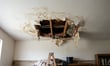
What happened: A New Brunswick appeals court revived punitive damages claims after an insurer took more than four years to pay a homeowner water-damage claim it never disputed.
Who's involved: Promutuel de l'Estuaire (insurer), homeowners (appellants)
What's at stake: Punitive damages and a higher interest rate on the $21,471.19 indemnity, plus the trial the lower court tried to prevent
Why it matters: The court ruled an insurer seeking to throw out a claim must explain its own payment delays - it cannot shift that burden to the policyholder
Where it stands: Appeal allowed in part; punitive damages and interest claims sent back for trial
Promutuel de l'Estuaire never disputed the claim. It acknowledged coverage from day one. And yet, from the moment a windstorm drove water through a New Brunswick couple's roof in December 2019, it took more than four years for the insurer to pay them anything at all.
The New Brunswick Court of Appeal has now ruled that timeline raises real questions about whether the insurer acted in bad faith - questions a lower court was wrong to shut down without a trial.
The dispute began with a straightforward loss. Wind damaged the homeowners' roof on December 10, 2019, and water poured into the home. The couple reported the claim. Promutuel sent a contractor, Winmar, to inspect and patch the roof as an emergency measure.
Winmar's January 2020 report put repair costs at $7,634.53 plus HST - about $7,779.71 after the $1,000 deductible. But according to the homeowner, Winmar never came back to finish the job. Four more rounds of water ingress followed the temporary fix. He told Promutuel. The insurer reportedly advised him to file a fresh claim. He refused - he saw the leaks as part of the original loss and did not want his premiums to go up.
Six months in, Promutuel sent a second firm, Claim Restore, to take another look. In the email setting up that inspection, Promutuel itself acknowledged that Winmar had not returned to complete the work and that damage in the attic appeared to have gone uninspected. Claim Restore assessed the replacement cost at $32,481.45 including HST, before deducting the $1,000 policy deductible.
Promutuel rejected that estimate too. Still no payment.
By December 2020, the homeowners sued, claiming $32,481.45 plus interest and punitive damages. They alleged Promutuel had breached its obligations by refusing to pay a claim it had never contested.
It was not until June 2023 - three and a half years after the loss - that the parties went through a formal loss appraisal under provincial insurance law. An independent umpire valued the December 2019 damage at $20,282.78 in repairs. But the umpire also found that the homeowners' own appraiser had mixed two separate losses into one estimate and declined to assess what he called a second loss from May 2020.
Then came another wait. Promutuel did not pay the umpire's assessed amount until April 9, 2024 - nearly ten months after the umpire's decision. The payment, $21,471.19, included interest at 2.5% dating back to December 2019.
With that cheque finally in the mail, Promutuel asked the court to throw the entire case out without a trial, arguing the homeowners had been fully compensated and nothing remained to fight about.
The motion judge dismissed all remaining claims, including for punitive damages. He found no evidence of bad faith, noting the homeowners had not explained why it took more than three years to request the formal appraisal.
The Court of Appeal, in a decision rendered October 29, 2026, took issue with that reasoning. As the party asking to shut the case down, Promutuel bore the burden of showing there was nothing left worth trying. Once the homeowners put the timeline of delays into evidence, the court held, it was up to Promutuel to show those delays could not reasonably point to bad faith.
No such explanation was offered. The appeal court noted the lower court's reasons did not even address the ten-month gap between the umpire's decision and payment - a delay the homeowners had specifically flagged as evidence of potentially abusive conduct.
Drawing on established Canadian authority, the court observed that bad-faith claims against insurers are seldom suited to being thrown out before trial. These claims typically depend on what a judge can piece together from the timeline, the contradictions, and the explanations the insurer gives under cross-examination - not the kind of evidence that can be tested on paper alone.
The appeal court was equally direct on a second argument Promutuel had raised: that the remaining dispute was too small to justify a full hearing. The court rejected that, warning that allowing an insurer to sit on payments it acknowledges owing, then argue the leftover amount is too modest to bother with, would turn cost-efficiency rules into a way of dodging legitimate claims.
The appeal was allowed in part. The lower court's dismissal of the punitive damages claim and the interest rate dispute was set aside and sent back for trial. The homeowners were awarded $2,500 in costs.
For claims departments, the practical takeaway is in the timeline: when an amount is undisputed and coverage is acknowledged, the clock is running. A four-year gap between loss and first payment - with no coverage dispute to explain it - is the kind of record that opens the door to a bad-faith trial, not a quick dismissal.