
Sir Gareth Southgate waded into the working-from-home debate this week, telling reporters during a trip to the Netherlands with the government's "Neets tsar" Alan Milburn that home working denies young people the informal mentoring he had throughout his football career, and that rising employment costs are making bosses reluctant to hire under-25s.
The former England manager, who has spent his post-football career campaigning on issues affecting young men, argued that firms in sectors like hospitality and retail see taking on junior staff as too risky given the additional costs involved.
It's a familiar political framing: young workers are missing out because offices have emptied out. But the data on who is actually avoiding the office tells a different story - and it's one that should sound uncomfortably familiar to anyone working in UK insurance.
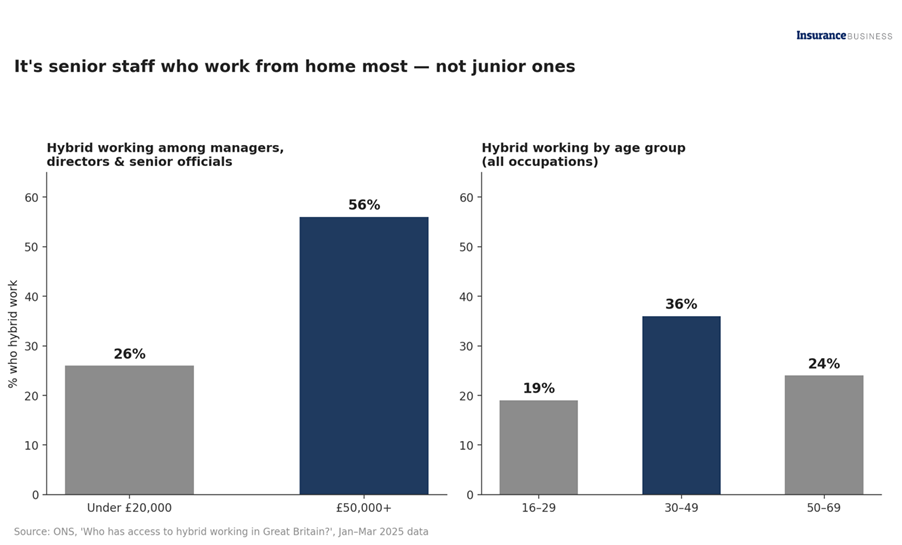
According to the Office for National Statistics, it is managers, directors and senior officials who are by far the most likely group to work hybrid, not new starters. In the most recent ONS data on hybrid working, 56% of managers, directors and senior officials earning £50,000 or more hybrid-worked between January and March 2025, compared with 26% of people in the same occupational group earning under £20,000. Across the workforce as a whole, only 19% of 16 to 29-year-olds hybrid work, against 36% of 30 to 49-year-olds.
In other words, it's the senior end of the workforce, the people who are supposed to be doing the mentoring, who are least likely to be at their desk.
And this lack of mentors in the office could be affecting our industry too. Talent attraction and retention jumped from seventh to first place on the list of UK insurers' biggest business challenges in the space of a year, according to Gallagher Bassett's Carrier Perspective 2026 report, with almost a quarter of UK insurers naming it their single biggest concern.
That piece points to a working paper from researchers at Warwick, the LSE and Oxford's Ellison Institute, which argues that the collapse in junior hiring since 2022 has tracked the spread of hybrid working at least as closely as it has the rise of AI, the explanation most commonly reached for. If that holds up, insurance's junior hiring problem and Southgate's "no mentors" argument are describing the same mechanism, just from different ends of the telescope.
Insurance's demographic problem long predates this year's WFH debate. Chartered Insurance Institute research has found that only around 4% of young people see insurance as an appealing career, and the CII has separately warned that roughly a quarter of the workforce is due to retire within a decade. London Market Group data has shown the number of professionals over 50 in the market now roughly matches the number under 30 - the "dumbbell" demographic that leaves a thin middle layer to pass on institutional knowledge.
Some insurers are treating this as a mentoring problem rather than an office-attendance one. Aviva's Rising Stars broker development programme has just taken its largest ever cohort, pairing each junior participant with a senior broker mentor for a year.
The MGA sector is experimenting with similar practices. The Managing General Agents' Association's Next Gen Mentoring Scheme is now in its third cohort, built explicitly around the idea that structured mentoring, rather than blanket return-to-office mandates, is what actually closes the experience gap for new entrants.
Southgate's other point - that rising employment costs discourage firms from hiring young people - is also something the group risk and protection market has been watching closely since April 2025, when the main rate of employer National Insurance contributions rose from 13.8% to 15% and the threshold at which it kicks in fell from £9,100 to £5,000 a year, under the National Insurance Contributions (Secondary Class 1 Contributions) Act 2025.
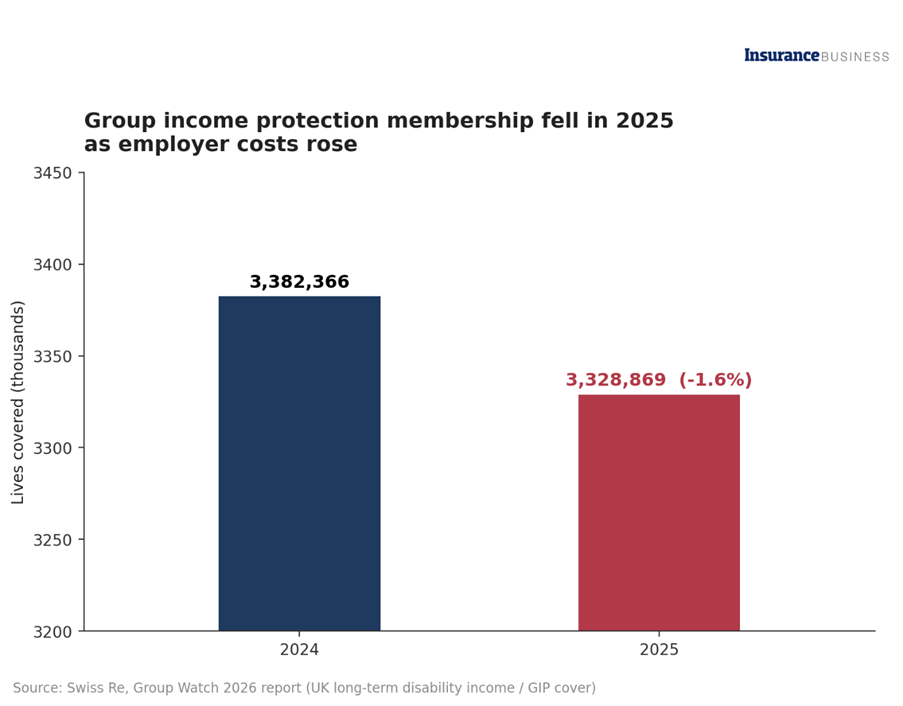
Swiss Re's Group Watch 2026 report found the number of people covered by group income protection actually fell 1.6% over the year, with employers moving away from cover running to retirement in favour of shorter, cheaper benefit periods, even as overall group risk membership grew on the back of cheaper group life and critical illness products.
Swiss Re's UK head of group risk, Keith Williams, described the effect of the NIC rise on the market as "undeniable," saying employers had pivoted from using benefits to attract talent towards using them purely for cost control.
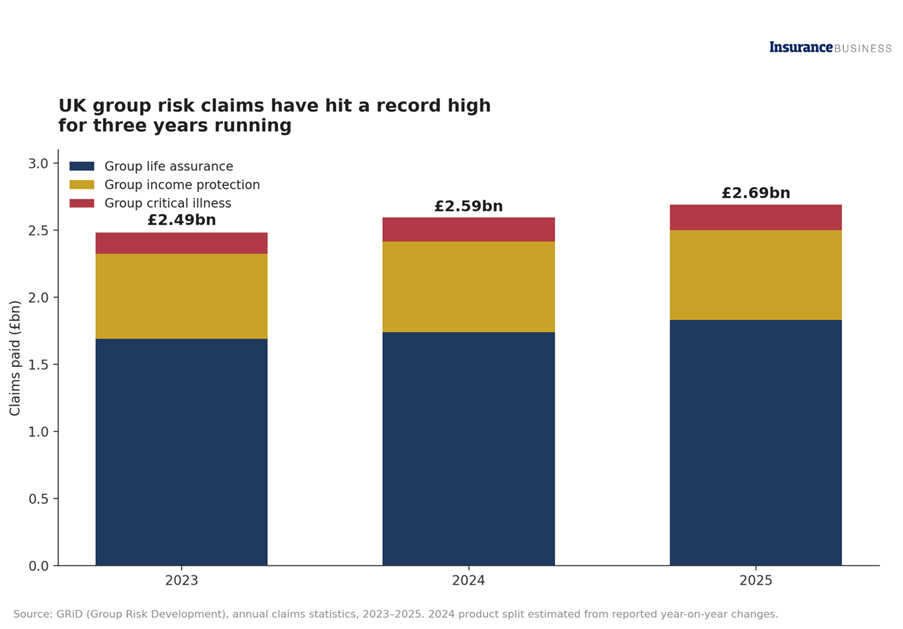
That squeeze is landing at an awkward moment for demand. GRiD, the group risk industry body, reported that UK group risk products paid out a record £2.69bn in 2025, and that almost half of all early health and wellbeing interventions funded by insurers that year - 48% - were for mental illness, the single largest category.
Separate research by Mental Health First Aid England published earlier this year found that under-25s are nearly eight times more likely than older colleagues to say their mental health has suffered because they don't feel able to speak up at work, with nearly a third having considered quitting over it.
So insurers and brokers are watching two trends converge on the same age group: youth unemployment climbing towards levels last seen over a decade ago - 981,000 16 to 24-year-olds, or 13.0% of the age group, were NEET (not in education, employment or training) in the quarter to June 2026, according to the ONS - and the group protection products designed to support young employees becoming a harder sell to cost-conscious employers just as demand for the mental health support they fund is rising.
Milburn's review, expected to recommend how the government tackles worklessness among under-25s, is due to report to the prime minister this autumn - after chancellor John Healey delivers his first Budget on 28 October, confirmed by the Treasury in July. The British Chambers of Commerce has already called on the government to use the Budget to fund a cut to employer NICs for under-25s by scrapping the pensions triple lock, though there is no indication yet that ministers will take up that specific trade-off.
For insurance, the WFH argument itself is something of a sideshow. The more useful question the Southgate intervention raises is whether employers, including insurers themselves, are relying on office attendance to solve a problem that structured mentoring and well-designed benefits are actually built to fix, and whether rising employment costs will keep pushing those same employers toward the cheapest version of workplace protection rather than the most effective one.