Car insurance in Nevada got more expensive again this year, just as the state's roads became safer.
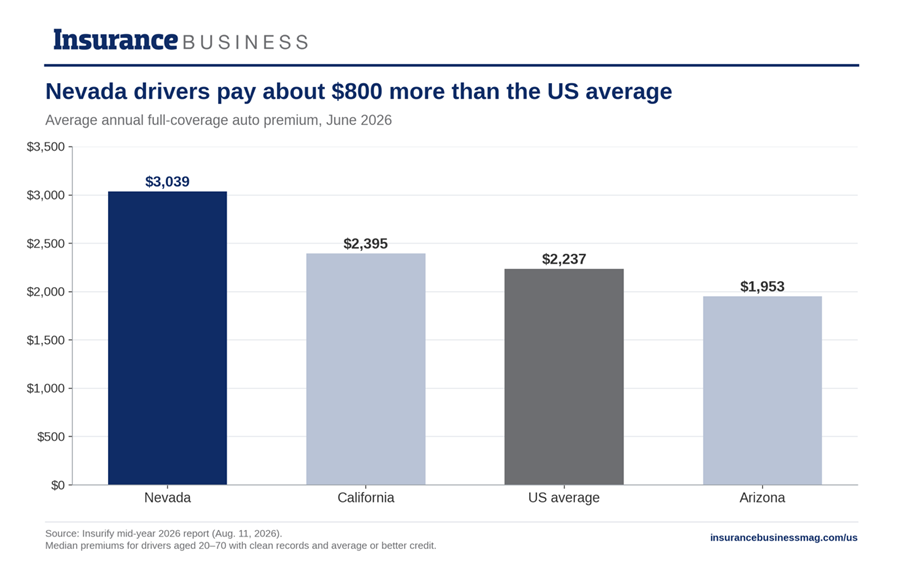
The average full-coverage policy in Nevada cost $3,039 a year in June, up 4% since the start of 2026, according to Insurify's mid-year rate report. That is about $800 more than the national average of $2,237 and roughly $1,100 more than in neighboring Arizona. Insurify expects Nevada to end the year near $3,090. That would make it one of five states on track for increases of about 6% or more in 2026, at a time when premiums nationally are close to flat.
The rise comes after a difficult stretch for carriers. In 2024, Nevada auto insurers had the third-highest loss-to-premium ratio of any state, according to reports based on NAIC data. State Farm, the state's second-largest auto writer, paid $89 in claims for every $100 of premium, against a national average of $66.
Carriers have been filing to recover that ground. State Farm put through a 2.7% auto increase in January, American Family raised rates 12%, and Allstate followed with a 3.5% increase.
Ned Gaines, the state's insurance commissioner, says the underlying problem is on the road. "People, they just really need to drive better," he told the Las Vegas Sun. He pointed to speeding, distraction and a lack of defensive driving as the main reasons Nevada's rates run high.
Read next: Nineteen states set for auto insurance increases – report
Crash numbers in Las Vegas are high. Metro Police counted 18,109 crashes in their jurisdiction in 2025, or about 50 a day, the Sun reported. Gaines said Nevada crashes also tend to be more serious than average, especially late at night in a region where the casinos, bars and resort corridors stay open around the clock. Impaired driving is a persistent problem as a result.
Most Nevadans live in or around Las Vegas and Reno. That makes Nevada the second most urbanized state in the country after California, and dense traffic means more collisions per mile. Nevada reported about 20% more fatal crashes than the average state in 2025, according to Insurify's analysis of federal data.
The state's legal minimums are low by current standards: $25,000 per person and $50,000 per accident for bodily injury, and $20,000 for property damage. A serious crash can use up those limits quickly, leaving the injured driver's own uninsured or underinsured motorist coverage to pay the rest.
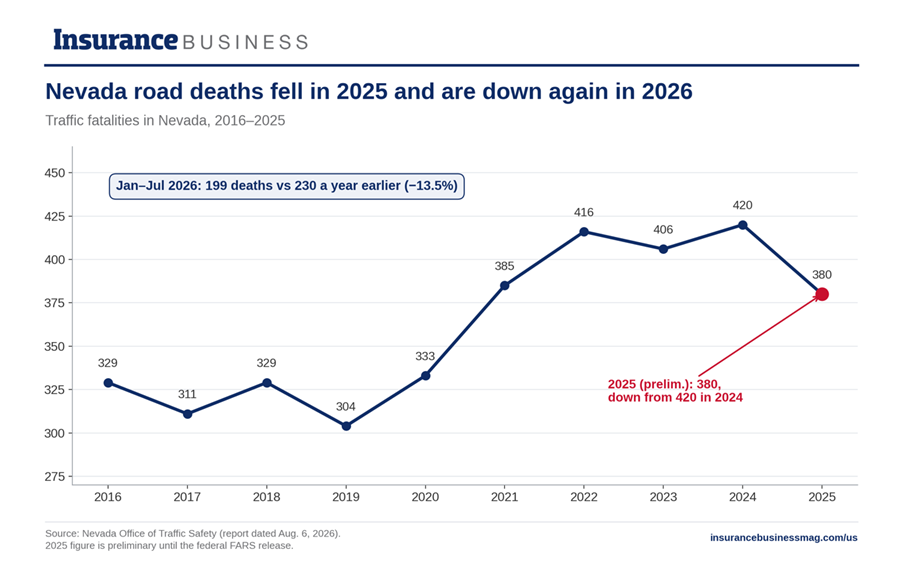
Road safety has improved. Nevada recorded 380 traffic deaths in 2025, down from 420 the year before, according to preliminary figures from the state Office of Traffic Safety. The decline has continued this year. From January through July, 199 people died on Nevada roads, compared with 230 in the same period of 2025.
Fatal crashes are a small share of claims, though. Premiums depend more on the cost of the far larger number of injury and property damage claims, and those costs keep rising. CCC Intelligent Solutions' 2026 Crash Course report found that 23.1% of auto claims ended in a total loss in 2025, a record. Paid bodily injury severity rose 10.3% from a year earlier.
Newer cars carry cameras and sensors that need recalibrating after even minor damage. Parts for them can be hard to find, and shops don't have enough trained technicians.
Gaines told the Sun that body work that once took about a week now often takes three to four. Carriers pay for rental cars and sometimes storage fees while a car sits in the shop.
Read next: US auto insurance shopping cools from 'hot' to 'warm' in Q1 2026: report
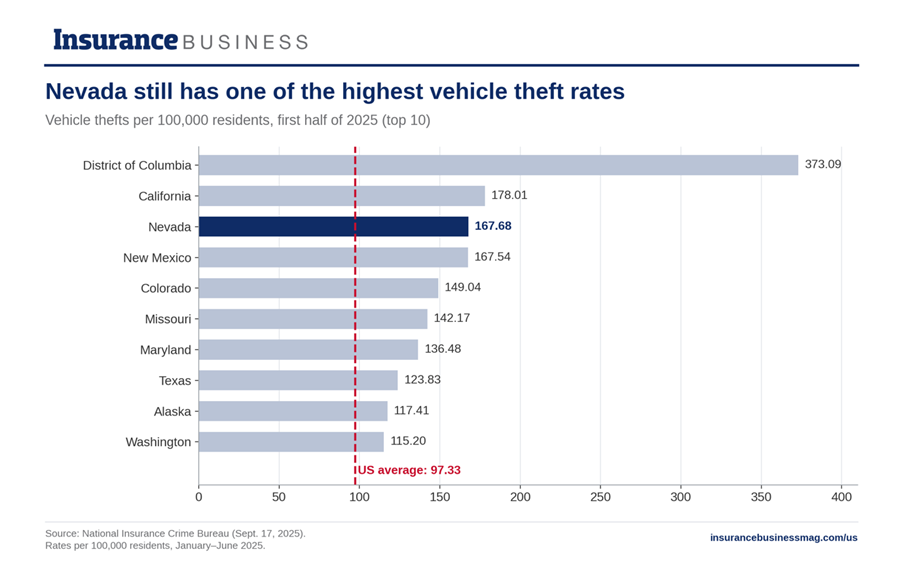
Vehicle theft has dropped across the country. The National Insurance Crime Bureau counted 659,880 stolen vehicles in 2025, the lowest total in decades. Even so, theft methods are changing, and thieves are increasingly using keyless-entry exploits and relay attacks. Nevada remains one of the worst states for theft. In the first half of 2025, it had 167.68 thefts per 100,000 residents, well above the national rate of 97.33. Only Washington, DC, and California were higher.
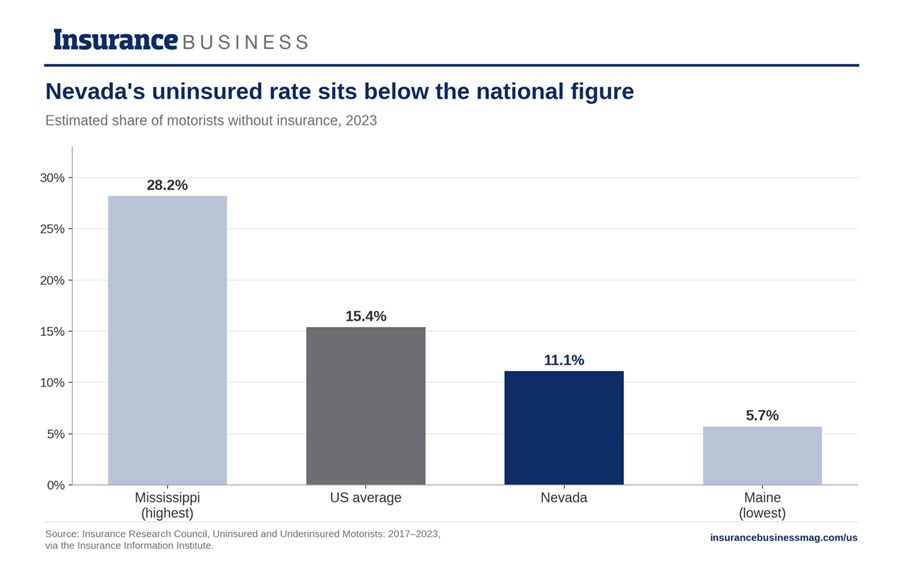
Nevada does better than most states on uninsured drivers. The DMV can suspend a vehicle's registration as soon as its liability coverage lapses. An estimated 11.1% of Nevada motorists were uninsured in 2023, below the national rate of 15.4% estimated by the Insurance Research Council. Gaines told the Sun that uninsured drivers are not the main reason Nevada's rates are high, but he said he recently met with a carrier struggling with a large volume of uninsured motorist claims.
Agents have reason to watch this closely. A national survey this year found that one in three drivers had gone without coverage at some point in the past year, often after a renewal increase. In a market where rates are going up again, clients who cut coverage to the 25/50/20 minimum or let a policy lapse create E&O risk for their agents as well as a lost account.
Read next: Rising number of uninsured drivers increases auto insurance costs, report warns
In February, Christa Rapoport of the National Council of Insurance Legislators gave the Legislature's Joint Interim Standing Committee on Commerce and Labor several suggestions, according to the Sun.
One was a subsidized liability program similar to California's Low Cost Auto program for income-eligible drivers with good records. She also recommended better lighting and other safety work in high-crash corridors, and a simpler rate-filing process at the Division of Insurance to make it easier for new carriers to enter the state. She argued that more competition would help keep prices down.
Gaines said the Legislature may be able to help. He still considers the number of crashes the single biggest factor in what Nevadans pay.
Read next: US car thefts see largest drop in years