For several years, most privacy claims reaching underwriters have been about software that nobody sees, such as a tracking pixel on a quote page, a chatbot that logs what customers type, or a cookie banner that allegedly didn't work. The latest high-profile case is about a device people wear on their faces.
More than 70 named plaintiffs have filed a consolidated class action complaint in federal court in San Francisco. It names Meta Platforms and Luxottica of America, the US arm of EssilorLuxottica, which produces Meta's Ray-Ban and Oakley smart glasses. The case, In re Meta AI Glasses Litigation, is assigned to US District Judge Edward M. Chen. The plaintiffs allege that the glasses recorded users and the people around them in private settings and sent the footage to overseas contractors, who reviewed and labeled it to train Meta's AI systems.
The claims have not been tested in court, and they are graphic. The complaint describes glasses left on a bathroom counter that switched on by accident and recorded a woman undressing. It also describes a father who asked his glasses about a rash on his daughter's skin, unaware that video of the girl would be reviewed by a stranger abroad.
According to the filing, contractors reported seeing people showering, having sex and changing diapers, and hearing them discuss medical and financial matters. The filing also says the face blurring meant to protect bystanders did not work reliably. One California plaintiff, Steven Beltran, says his glasses switch on by mistake about twice a day.
Much of the case rests on reporting published in February by the Swedish newspapers Svenska Dagbladet and Göteborgs-Posten. That reporting drew in part on interviews with workers at Sama, a Kenyan outsourcing company that did data-annotation work for Meta. Sama is no longer a defendant. Court records show the plaintiffs voluntarily dismissed their claims against Samasource Impact Sourcing with prejudice in August.
Meta denies the allegations. The company has said that reviewing data from its AI assistant is common across the industry and that it filters that data to remove identifying details. It has also said the glasses show a light when recording and blur faces and license plates.
For insurers, the way the complaint is built matters more than its most lurid details.
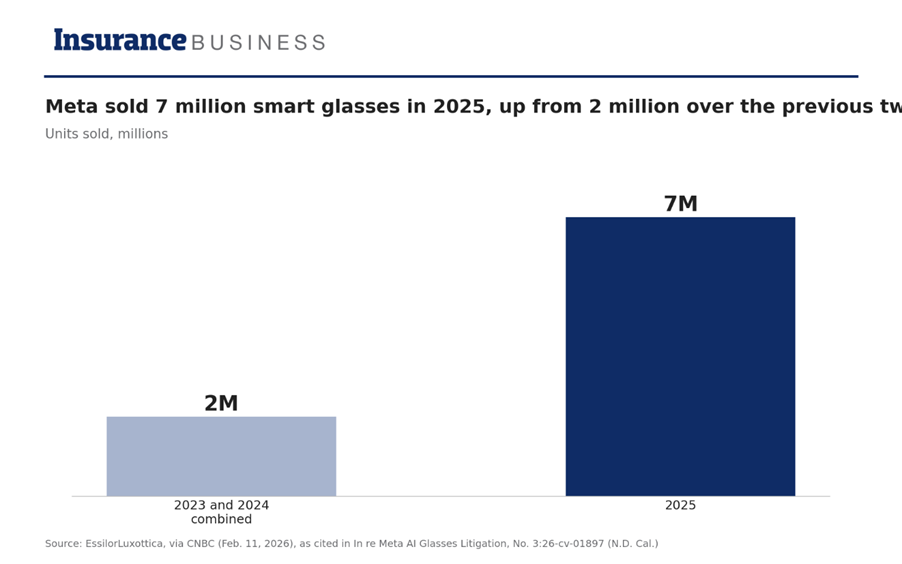
The complaint pleads 55 counts across three proposed classes: people who bought the glasses, people who used them and people who were recorded by them. Some counts are standard in privacy litigation. These include the federal Wiretap Act, the Computer Fraud and Abuse Act, state eavesdropping laws in California, Georgia and Maine, intrusion upon seclusion and the right of publicity.
Others would look familiar in a products case, including strict liability for design defect, failure to warn, negligence, and breach of express and implied warranty. The plaintiffs argue, in effect, that a camera designed to look like ordinary sunglasses, with only a faint recording light, is defective.
The bystander class includes 14 minors suing through their parents or guardians. None of the 14 bought the glasses or agreed to Meta's terms of service. That could make those claims harder to push into arbitration, which has been one of the main ways companies have kept consumer privacy suits out of court.
Read next: Wrongful data collection exclusions are spreading – what brokers need to check in cyber policies
Privacy and product claims usually fall under different policies, and that is why the mix matters. Privacy suits have moved steadily into cyber insurance. Roughly 70% of the wrongful collection claims reported to Coalition since 2023 have been tied to the California Invasion of Privacy Act, a wiretap law passed in 1967. Most of those matters are small. Jeremy Gittler, global head of claims at Resilience, describes the trend as "high volume, low severity." The Meta case is the opposite kind of claim: a proposed nationwide class, a defendant with deep pockets, and a physical product at its center.
The design defect and failure-to-warn counts point instead toward general liability and products coverage. Carriers have been adding new generative AI exclusions in exactly those lines. ISO endorsement CG 40 47, available since January, removes CGL coverage for bodily injury, property damage and personal and advertising injury arising from generative AI. A related form, CG 35 08, applies to products and completed operations coverage. A review of state filings found 2,369 generative AI exclusion records in 49 states by mid-2026.
Read next: ISO's generative AI exclusion is already on thousands of CGL policies
The facial recognition question
The complaint also targets a feature that does not yet exist. It alleges that Meta has placed dormant facial recognition components in the companion app that glasses owners must install. It asks the court to bar any biometric analysis unless Meta discloses it publicly and obtains opt-in consent from both users and bystanders. In April, the ACLU and 75 other organizations called on Meta to drop any plan to add facial recognition to the glasses. Meta has said it has not released such a feature and is not building a universal face database.
Insurers have dealt with facial recognition claims before. Meta shut down Facebook's facial recognition system in 2021, after agreeing to a $650 million settlement with Illinois users under the state's Biometric Information Privacy Act. BIPA suits then spread to employers and retailers of every size, and many of the early coverage disputes went the policyholder's way.
In West Bend Mutual v. Krishna Schaumburg Tan, the Illinois Supreme Court ruled in 2021 that a general liability insurer had a duty to defend a BIPA suit. Carriers responded with biometric exclusions, which are now more common, especially in employment practices liability and cyber policies.
Read next: Chatbots spark new front in cyber litigation
The plaintiffs' damages theory is also unusual. They argue that first-person video is one of the scarcest inputs in AI development and that a market already sets its price. Citing 2024 Reuters reporting, the complaint lists rates of $1 to $2 per image, $2 to $4 per short video and $5 to $7 for images involving nudity. The plaintiffs say those figures show what Meta would have paid if it had asked for the footage.
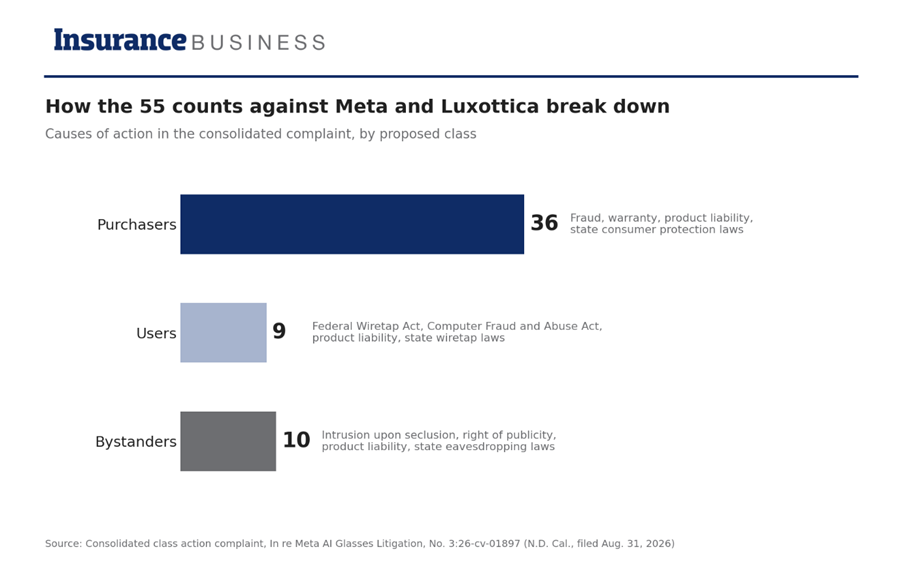
Volume is what could make those small sums add up. Meta and EssilorLuxottica sold about 2 million glasses in 2023 and 2024 combined, and about 7 million in 2025. The plaintiffs also want all footage collected without consent destroyed. They argue that once recordings have been used to train a model, they can't be pulled back out the way a leaked password can be changed. How the court treats that request could affect AI litigation well beyond this case.
Brokers may see this as a problem for Big Tech alone, but the exposure is wider. Smart glasses are appearing in clinics, warehouses, gyms, hotels and offices. They are often worn by employees or customers at businesses that have no policy on them.
If an employee's glasses record a patient, guest or co-worker, even by accident, the employer could face the same wiretap and privacy theories the Meta plaintiffs are pursuing. And its coverage may already be narrowed by wrongful collection and AI exclusions. Underwriters have begun asking clients how they deploy tracking tools and manage consent, and wearable cameras may be next on that list.
"Smart glasses make it less obvious when images, video or audio are being captured," said Paul Nash, EPL and safeguard focus group leader for US and UK executive risk at Beazley in an interview with our sister website, HRD America.
Read next: Wrongful collection claims escalate as CIPA drives new wave of cyber lawsuits
Meta, meanwhile, is expanding its line. At its Connect event on Sept. 23, the company introduced third-generation Ray-Ban Meta glasses starting at $449. It also unveiled its first pair without a camera, priced at $349 and shipping Oct. 13. Coverage of the keynote noted that Meta said little about the privacy complaints that have followed the product for the past year.
The case is at an early stage. Whatever the outcome for Meta, it raises a question insurers will have to answer for many other clients: who pays when a pair of glasses records something it shouldn't.