A new 50-state analysis finds the gap between the best- and worst-managed state Medicaid programs is wider than most benefits advisers might expect. The differences run through the same variables that shape how much room employers have to structure competitive health benefits.
The Medicaid Report Card, published by the Heartland Institute, a Chicago-based free-market think tank, scores every state across 16 metrics. The four areas are: program design and enrollment, fiscal sustainability, program integrity and administrative oversight, and market structure and provider environment. Kansas leads with 74 out of 100 points. California ranks last with 22.
The report was authored by Jack McPherrin, senior policy analyst and research fellow at Heartland. It draws on data from the Kaiser Family Foundation (KFF), the US Census Bureau, the Medicaid and CHIP Payment and Access Commission (MACPAC), and the Centers for Medicare and Medicaid Services (CMS). The scorecard is built around a specific normative framework - that smaller, more targeted Medicaid programs represent stronger governance - and its findings should be read in that context.
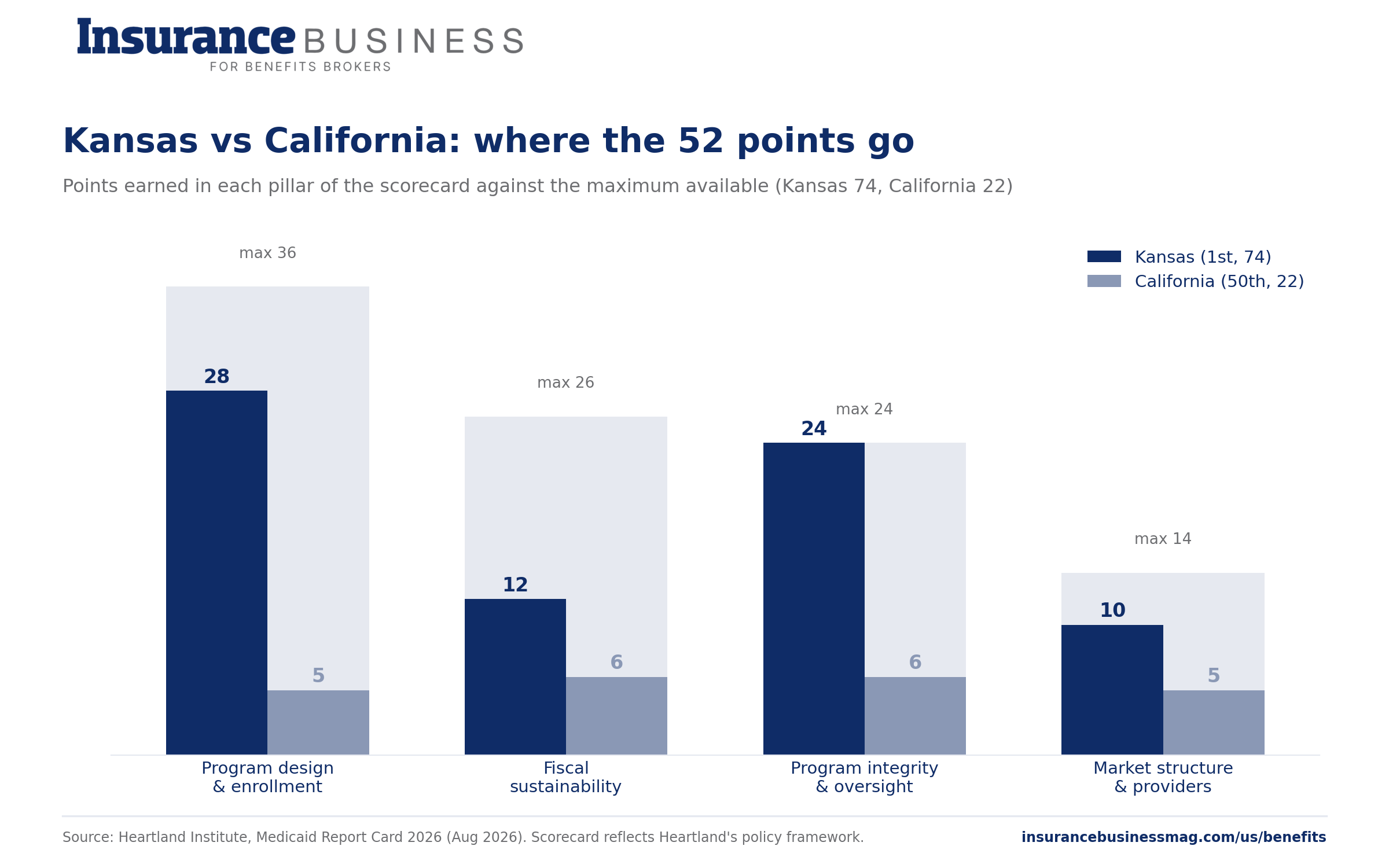
The clearest dividing line is fiscal performance. The top 10 states average 18 of 26 available fiscal points. The bottom 10 average just 7. Wyoming and Mississippi score the maximum 26 points. New York scores zero.
KFF's 2025 annual Medicaid budget survey found that nearly two-thirds of states considered a fiscal year 2026 budget shortfall either possible, likely, or almost certain. Total Medicaid spending grew 8.6 percent in fiscal year 2025. State Medicaid spending grew 12.2 percent in the same period. Rate increases, higher enrollee health needs, and rising pharmacy and long-term care costs drove those increases.
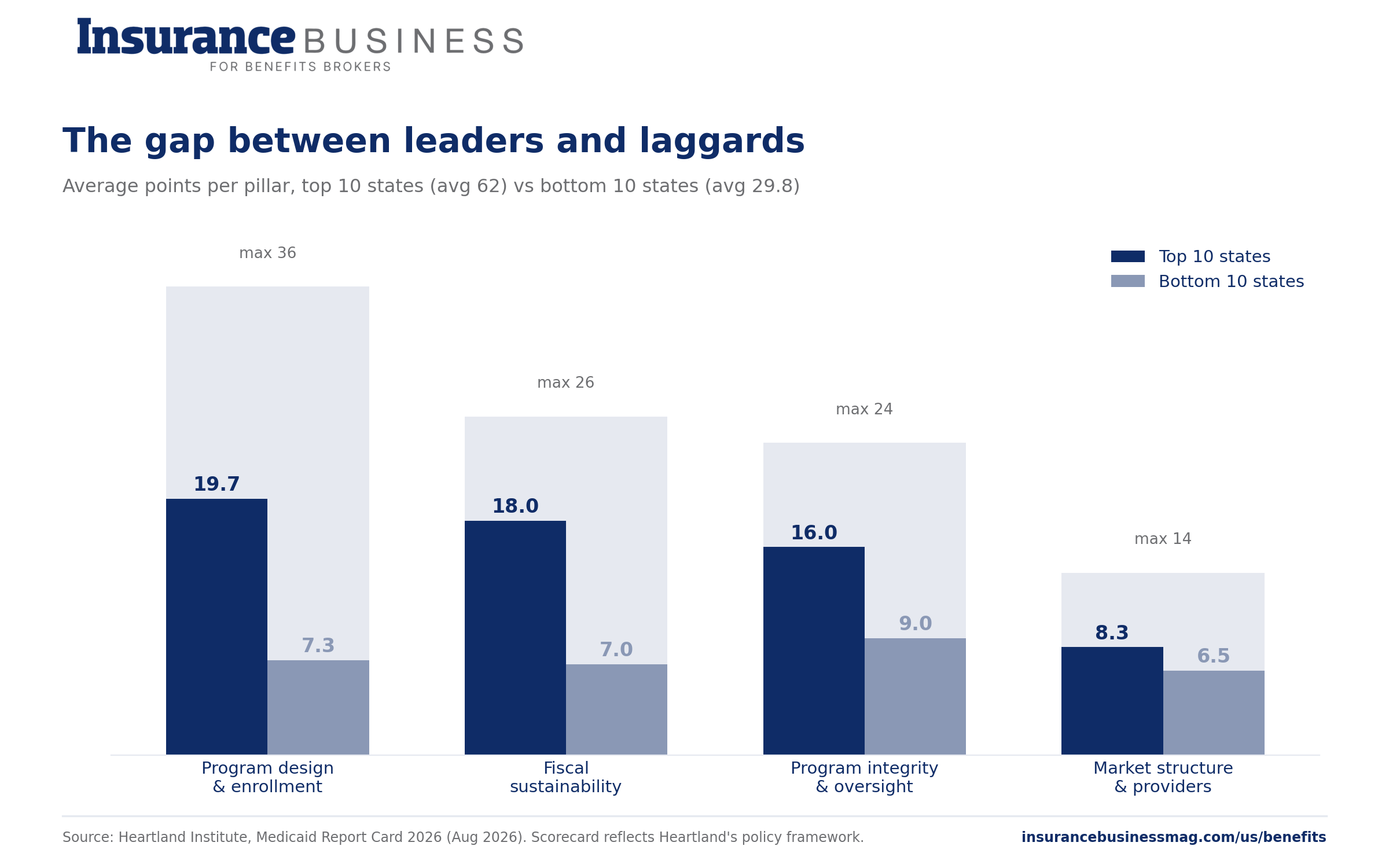
Program integrity is the second area where states diverge sharply. Kansas earns all 24 available points for program integrity and administrative oversight. Arkansas, Missouri, South Dakota, Texas, Minnesota, Pennsylvania, and Washington also score well. Elevated improper-payment rates and weak fraud enforcement pull scores down significantly in many lower-ranked states.
Program integrity determines how administratively functional a state's Medicaid program is, and by extension how predictable the interaction between Medicaid eligibility and employer-sponsored plan enrollment will be. When low-income workers in high-improper-payment states lose coverage through administrative failures rather than genuine eligibility changes, mid-year enrollment disruptions follow.
Those disruptions are harder to anticipate than structured eligibility transitions, and harder to build into plan design advice. Self-funded employers already face meaningful cost exposure from billing disputes that go uncontested by plan administrators. Unplanned mid-year enrollment shifts compound that exposure.
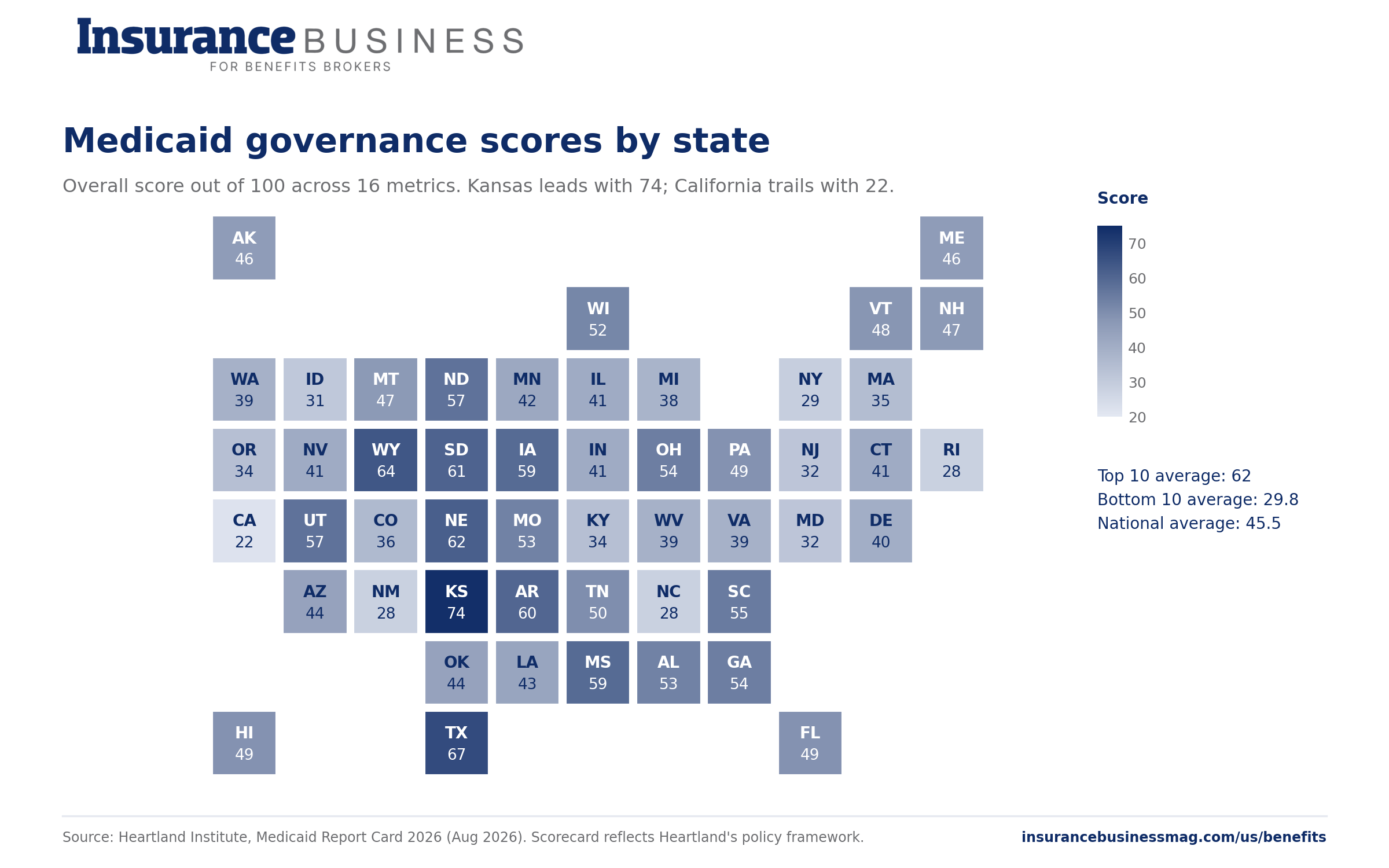
The most politically visible finding is that non-expansion states substantially outperform expansion states on average. The 10 states that had not adopted the Affordable Care Act's (ACA) Medicaid expansion at the time of the analysis average 57.7 points. Expansion states average 42.4. All 10 non-expansion states rank in the top 18. Every state in the bottom 10 has expanded.
But expansion status does not explain the full picture. Six expansion states, Nebraska, South Dakota, Arkansas, Iowa, North Dakota, and Utah, still crack the top 10. They do so on the strength of fiscal discipline, program integrity, and provider-market policy. Strong provider-market performance alone is not enough if fiscal and integrity problems are significant.
"The states that rise to the top generally do several things well at once, while the states at the bottom tend to accumulate problems across several areas," McPherrin said.
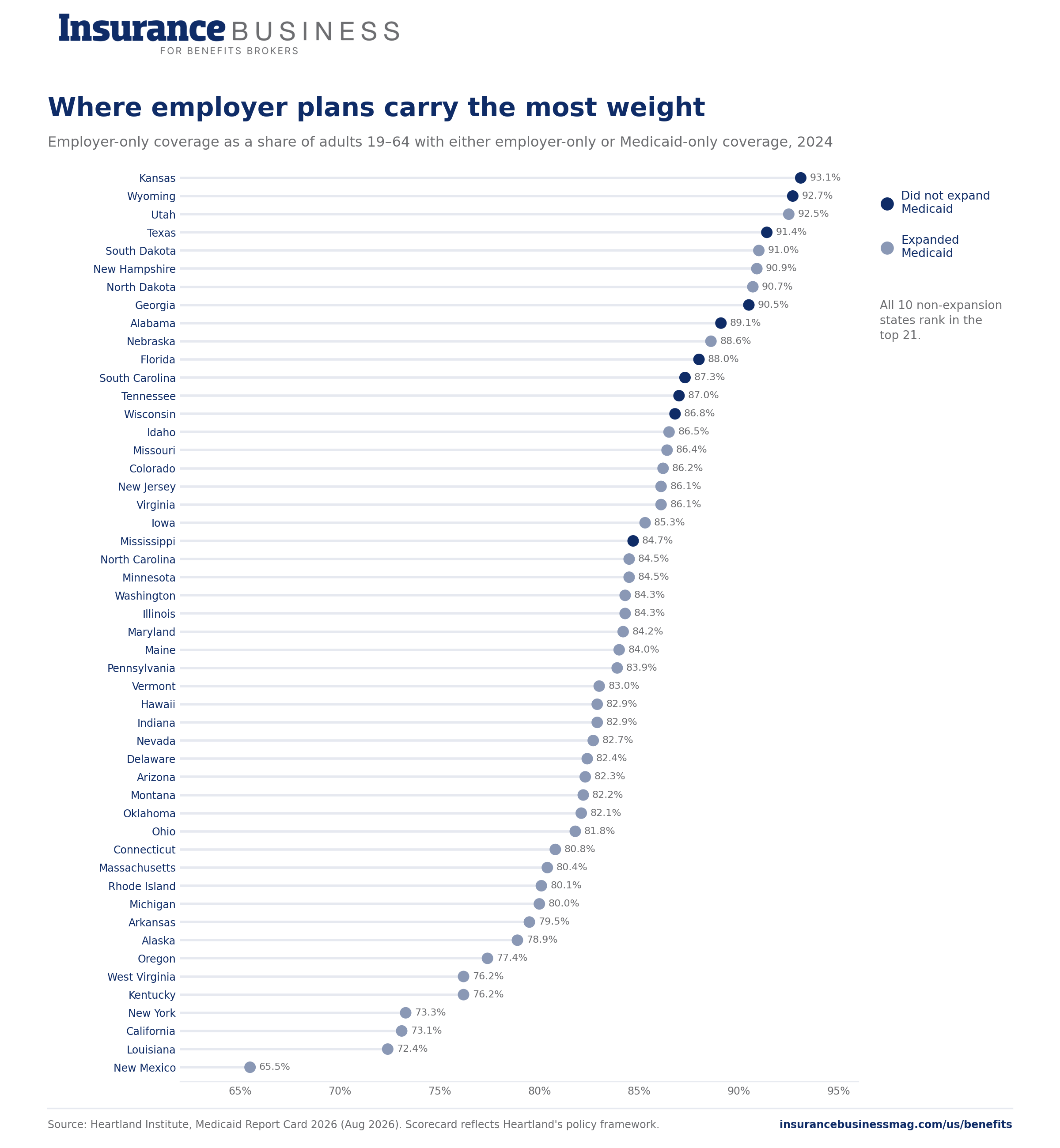
The 2025 federal budget reconciliation law, known as the One Big Beautiful Bill Act (OBBBA), sharpens the governance differences the scorecard documents. The Congressional Budget Office estimated the law would cut federal Medicaid spending by approximately $930 billion over the next decade, alongside new work requirements for expansion-state enrollees. More frequent eligibility reviews are also included. Most provisions take effect in fiscal year 2027.
Medicaid enrollment dropped 7.6 percent nationally in fiscal year 2025 as pandemic-era continuous coverage protections unwound, according to KFF. Further changes are coming as work requirements and tighter eligibility reviews take hold. In sectors such as retail, food service, and healthcare support, where employees sit relative to Medicaid eligibility thresholds is an active benefits design question.
The Medicaid governance divide sits alongside a broader patchwork of state-level obligations that multi-state employers are already managing. The growing compliance burden on multi-state employers managing paid leave across 13 states illustrates how state-by-state variation creates ongoing advisory complexity. The Medicaid governance divide the Heartland report maps follows the same pattern. Understanding which states are administratively prepared for the coming enrollment changes, and which are not, is the 50-state baseline the report provides for the first time.