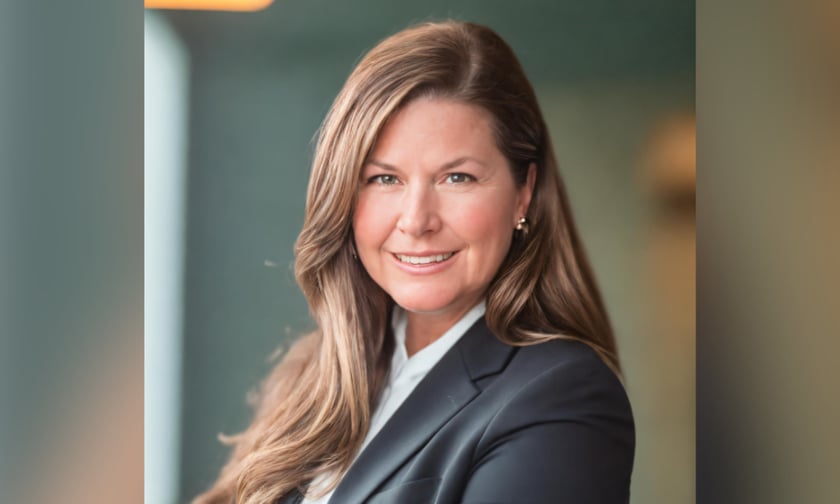
Aluminum mill shapes are up roughly 33% year over year and steel mill products have climbed more than 20%, according to the Associated General Contractors of America, driving up the replacement cost of the cranes, concrete pumpers and forklifts that contractors rely on daily. For Heather Frain (pictured), senior vice president and head of inland marine at Amwins Program Underwriters, that volatility is reshaping how her team prices and services contractor's equipment risk, even as AI reshapes how her team gets through the paperwork behind it.
"When people hear inland marine, they automatically think of boats and hulls," Frain said. "What we're actually doing on the inland marine side is contractors' equipment. These are the businesses that build America."
Frain said the clearest AI gains so far have come from the earliest and most repetitive parts of underwriting: prequalifying submissions and converting equipment schedules, often received as ACORD-form PDFs, into usable rating data.
"There are certain accounts we can entertain, crane accounts, concrete pumpers, and certain accounts we can't, like a logging company," she said. "AI can flag that immediately." On equipment schedules specifically, she said the change has been dramatic: "I could have a list of 100 different pieces of equipment, and within about two minutes, it's organized and ready to upload." Amwins built the tool internally to keep the underlying data proprietary, she said, and it has also cut down on a common source of error. "It eliminates the risk of retyping errors, typos on VIN numbers, on values. That's one of the biggest sources of human mistakes, and we're now taking that out of the equation."
Amwins Program Underwriters recently launched an inland marine equipment program with Sentry covering physical damage on contractors' equipment, rigger's liability and motor truck cargo, part of a broader push detailed in Insurance Business's coverage of Amwins' 2026 outlook on how AI is reshaping market conditions. Frain said building a multi-line program like that leaned less on AI than a single-coverage product would have.
"If you were writing just contractor's equipment with one coverage line, AI would play a much bigger role in standing it up quickly," she said. "But because we had multiple lines with complex data points that all needed to tie together, the build still required a very human touch." Once the program was live, she said, AI's role shifted toward speeding quotes and processing endorsements on already-complex accounts.
Beyond intake, Frain said Amwins is starting to use the equipment data it now captures cleanly, tracking year, make, model, VIN and location, to refine pricing against loss experience rather than relying on flat, equipment-type rates, a shift consistent with broader industry findings that carriers still lack confidence to fully act on the AI underwriting tools they've adopted.
"You could have two identical pieces of equipment in different locations, utilized differently, with different maintenance procedures," she said. "We can start to slice and dice that for rate utilization... look at all the accounts I've written, aggregate them, and come up with a better rate based not just on the equipment, but on all these other parameters." She described that ambition as a work in progress that depends on accumulating enough tracked data over time, rather than a capability already built.
Tariff-driven cost increases have made accurate equipment valuation harder, a pressure point Frain said her team manages primarily through agents rather than AI, a dynamic also playing out across the wider inland marine market as Insurance Business reports carriers opening the door to higher limits as equipment values surge. Amwins offers replacement cost coverage on equipment five years old or newer and actual cash value beyond that, with the policy capped at the scheduled limit regardless of a later valuation dispute.
"Equipment prices have skyrocketed, and insureds often think they're giving their agent the correct value, when in reality they're underinsured," she said. To address it, Amwins and Sentry added an inflation guard endorsement for equipment, similar to those used on property and homeowners' policies. "I've been in this business since the mid-'90s, and this is the first time I've ever seen such a dramatic increase in the value of used equipment," Frain said.
"If I can get into a faster vehicle, I'm going to do it. I'm just going to keep watching the road."
Frain was direct about how she still expects underwriters, not models, to carry the weight of a decision, particularly in niche programs like cranes and concrete pumpers. "AI doesn't automatically know the real history of an account," she said. "When you've been doing this as long as I have, a name comes up and you know exactly what happened back in the '90s or early 2000s. You know those accounts like old friends. AI can analyze the loss runs, but it's not going to know what's behind the curtain."
“My biggest takeaway is that the human touch is still needed, but lean into whatever can take away the busywork so you can focus on the actual underwriting of an account,” she said. “In niche, specialized programs like cranes or concrete pumpers, there’s a level of experience that has to come into play.”