Ottawa didn't hold a press conference for this one.
Just before the long weekend, Environment and Climate Change Canada quietly posted the second edition of Canada's Changing Climate Report — a nearly 1,500-page assessment built by more than 100 scientists over three years. There was no minister on stage this time, no technical briefing for reporters. But for anyone pricing catastrophe risk in this country, the numbers inside are hard to file away and forget.
The report, known as CCCR2026, is the federal government's most authoritative statement yet on how Canada's physical climate has already changed – and how much further it has to go. It doesn't try to quantify the cost of any of that. It doesn't need to. Insurers have been doing that math for years, and the report simply confirms the trend line they've been underwriting against.
Canada's annual average temperature rose by 2.0°C between 1948 and 2023 – nearly double the global rate over the same stretch. The North fared worse again, warming by 2.6°C, with the Canadian Arctic specifically warming at roughly three times the global average since 1970. Almost none of that is attributable to chance: the report's authors say the collective pattern of change across the country's land, oceans and atmosphere has no plausible explanation other than human-caused warming.
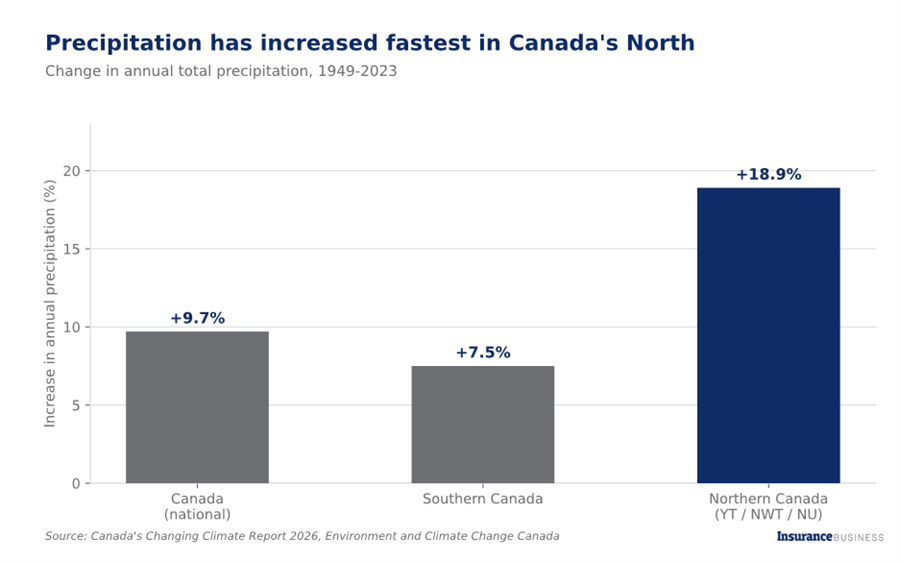
Rainfall and snowfall have moved with it. National precipitation is up 9.7% since 1949, with the sharpest increase – nearly 19% – recorded across Yukon, the Northwest Territories and Nunavut. That water isn't necessarily arriving gently; the same warming is driving heavier one-day and five-day rainfall extremes, more atmospheric river activity on the west coast, and – during the growing season – longer and more intense drought stretches across the Prairies and central Canada.
Read next: Canadian insurers under pressure as climate risks drive surge in claims
Here's the part that should matter most to anyone building a five- or ten-year cat model: near-term warming in Canada is now treated as essentially unavoidable. The report projects roughly another 0.9°C of national warming between 2021 and 2040, regardless of what happens with global emissions policy between now and then, because the greenhouse gases already in the atmosphere guarantee it. By that same window, Canada is expected to be running about 2.7°C above pre-industrial levels – nearly double the 1.5°C ceiling the Paris Agreement was built around.
What happens after 2040 is where the paths genuinely diverge, and the report lays out three of them side by side. Under a trajectory roughly consistent with current global policy, Canada warms to about 5.0°C above pre-industrial levels by the 2080s and 90s, glaciers in the west lose more than three-quarters of their mass, and the intensity of the heaviest rainstorms climbs by a median of roughly 40%.
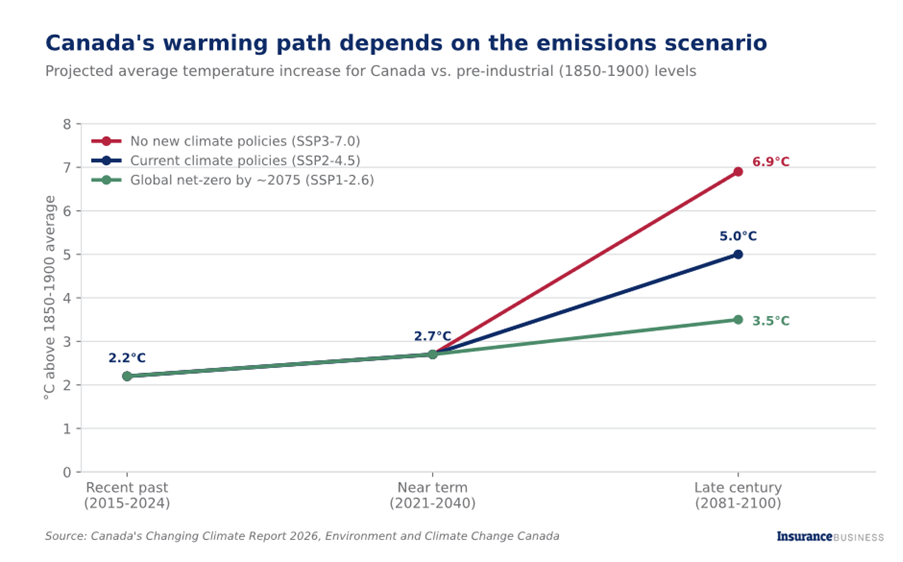
Under a scenario where climate policy stalls or reverses, that figure jumps to 6.9°C. Even in an optimistic case where the world reaches net-zero emissions in the 2070s, Canada still ends the century around 3.5°C warmer – because sea-level rise, glacier melt and permafrost thaw don't stop just because the thermometer does. The report calls the changes already under way "effectively irreversible."
"We do still have some agency," Nathan Gillett, one of the report's lead authors and a research scientist with Environment and Climate Change Canada, told CBC News, pointing out that emissions choices from here will decide whether the country's climate eventually stabilises or keeps deteriorating through the century.
"The warming and associated changes in climate in Canada are effectively irreversible." – Canada's Changing Climate Report 2026
Neither the Insurance Bureau of Canada nor any of the major national carriers had issued a public statement on the report at the time of writing – it was only published late yesterday. But the industry's long-standing position on the underlying trend hasn't moved: IBC has spent several budget cycles pushing Ottawa for a national flood insurance backstop and updated flood mapping on the grounds that the risk itself, not just the cost of insuring it, is deteriorating.
For the property and casualty market specifically, three findings stand out. Fire seasons have already lengthened across most of the country and will keep doing so with every additional degree of warming – consistent with what insurers have watched play out on the ground, most recently with wildfire risk pushing well beyond its traditional western hotspots.
Read next: Canada's wildfires shifting east, expanding insurers' exposure
Flooding gets similar treatment. Heavier one-day and five-day rainfall extremes are already showing up in the observational record, and the report expects more frequent flash flooding as a direct result – a finding that lines up neatly with recent events like the back-to-back flash floods in Montreal and Edmonton, which reignited the debate around Canada's flood insurance gap.
Coastal exposure is shifting too. Global sea level has risen about 20 centimetres since 1900, with the pace accelerating over the past three decades as glaciers and ice sheets melt faster. Locally, the picture is patchier: land subsidence is pushing relative sea-level rise as high as 34 centimetres per century in parts of southern Atlantic Canada and the western Arctic, while land uplift is actually offsetting sea-level rise in sections of British Columbia and Hudson Bay. Where the land is sinking and sea ice is retreating, the report expects extreme high-water events – the kind that drive storm-surge claims – to happen more often.
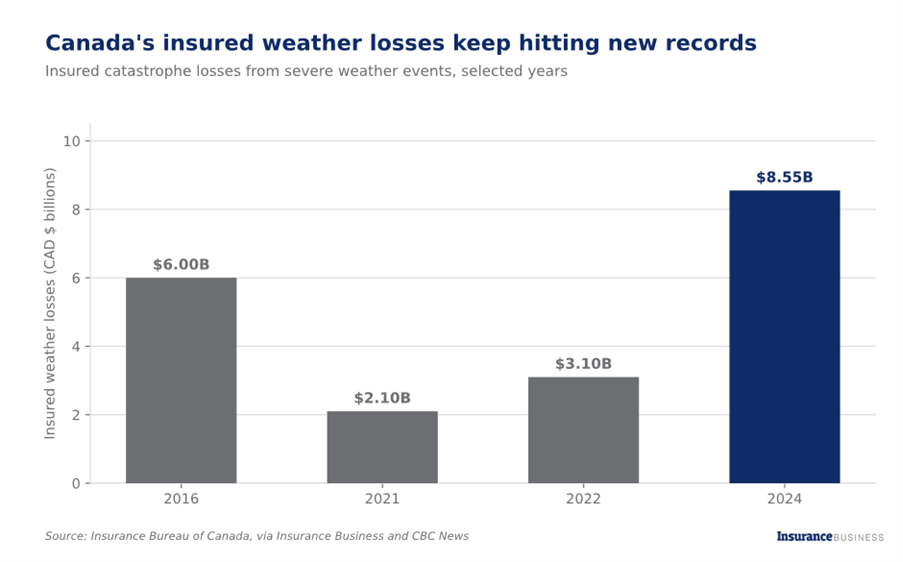
None of this will come as news to Canadian insurers, who have spent the past two years adjusting books of business around exactly these trends. Insurers paid out $8.55 billion in weather-related claims in 2024, according to the Insurance Bureau of Canada – more than $2 billion above the previous record, set after the 2016 Fort McMurray wildfires.
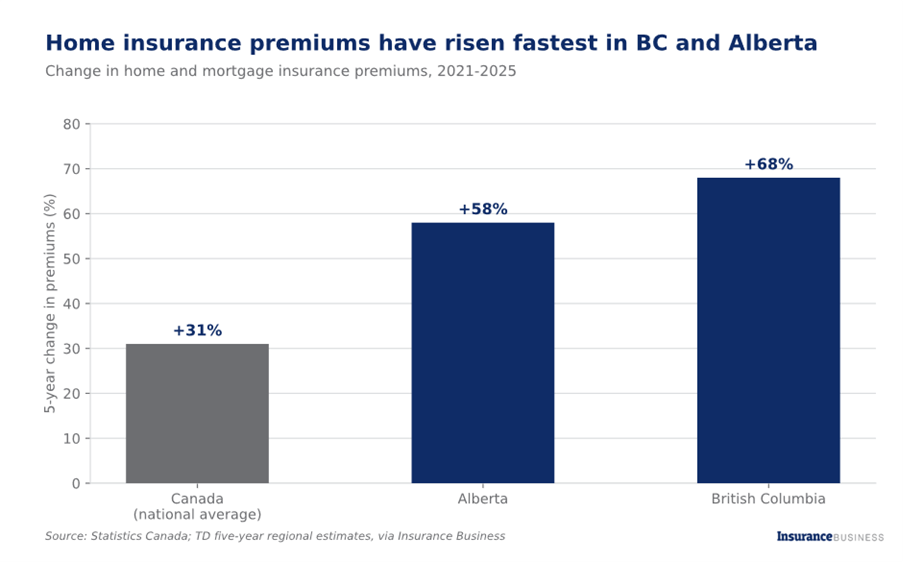
Homeowners have felt it too: premiums for home and mortgage insurance climbed roughly 31% between 2021 and 2025, according to Statistics Canada figures, with five-year increases running as high as 68% in British Columbia and 58% in Alberta in some carriers' books.
|
Region |
What the report flags |
What insurers are already seeing |
|---|---|---|
|
British Columbia |
Atmospheric rivers and extreme rainfall intensifying; some glacier melt offset by land uplift easing local sea-level rise |
Five-year premium rises as high as 68%, among the steepest in the country |
|
Prairies (AB, SK, MB) |
Longer, more intense summer droughts; wildfire area burned expanding east from traditional hotspots |
Alberta premiums up 58% over five years; wildfire claims spreading beyond BC's traditional risk zones |
|
Ontario & Quebec |
More one-day and five-day rainfall extremes; urban flash-flood risk |
Recent flash floods in Montreal have renewed pressure over the stalled national flood insurance programme |
|
Atlantic Canada |
Relative sea-level rise up to 34cm per century in the south, driven partly by land subsidence |
Coastal storm-surge exposure factoring more heavily into property renewals |
|
The North (YT, NWT, NU) |
Fastest warming (2.6°C since 1948) and largest precipitation increase (18.9% since 1949); permafrost thaw reshaping the landscape |
Thin insurance market and limited data make northern risk especially hard to price |
Underwriters and cat modellers have another reason to pay attention to the specific numbers here rather than just the general trend: the report separates average precipitation increases (a relatively modest 13% nationally by century's end under current policies) from the intensity of the heaviest rainfall events (up roughly 40% under the same scenario). That matters for anyone recalibrating flood and flash-flood loss models, since it's the tail risk – not the average – that drives claims volatility.
Read next: Canada's home insurance market tightens as climate losses bite
The flood protection gap the report's findings point toward is also nothing new. Around 1.5 million Canadian households remain unable to secure affordable overland flood coverage, and for the ones that can, premiums can run as high as $15,000 a year. A national flood insurance backstop was promised in the 2023 and 2024 federal budgets, but Budget 2025 came and went without a confirmed launch date, leaving discussions between Public Safety Canada, the Insurance Bureau of Canada and industry partners still ongoing.
Where the industry is moving on its own, it's mostly toward resilience rather than retreat. Some insurers are now building "build back better" provisions into standard property policies, funding upgrades like impact-resistant roofing or improved site drainage when a claim triggers a rebuild, rather than simply restoring what was lost. Others have joined coalitions like Climate Proof Canada to push jointly for stronger building codes and updated flood mapping.
Read next: As wildfire and flood losses climb, insurers push to make rebuilds more resilient
CCCR2026 doesn't tell the insurance sector anything it doesn't already feel in its loss ratios. What it does is put a federal government stamp – 1,500 pages of it – on the idea that this isn't a temporary run of bad weather. Even the best-case emissions path still leaves Canada considerably hotter and wetter than it is today. For an industry that prices risk for a living, that's about as clear a signal as it gets that risk is rising.
Read next: Insurers confront growing climate losses as capital pressures mount in Canada and beyond