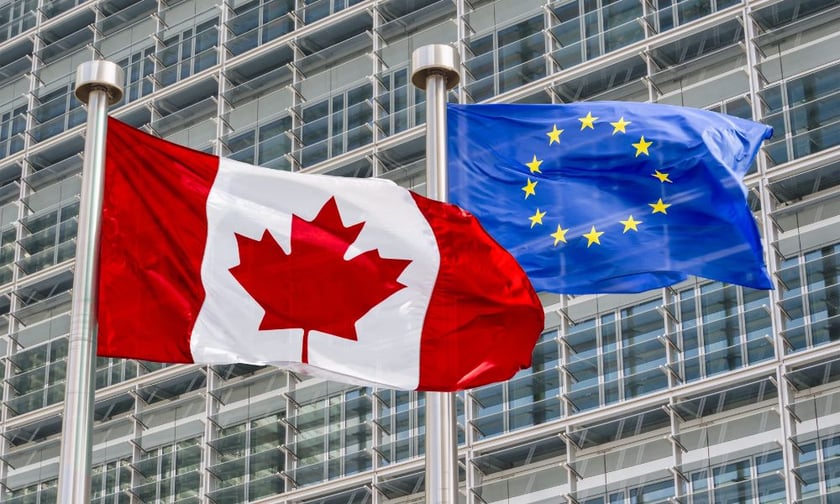
There was a hug in Strasbourg earlier today that will get more attention than it probably deserves, and a policy question underneath it that deserves more attention than it's likely to get.
The hug came when European Commission President Ursula von der Leyen, part way through her annual State of the Union address to the European Parliament, turned to Prime Minister Mark Carney and told the chamber she wanted to open the door for Canada to become the EU's first "associate member," a status that doesn't currently exist anywhere in the bloc's treaties. MEPs stood and applauded. Carney walked to the podium and embraced her.
The policy question is what, if anything, that actually means. For Canadian brokers and underwriters already navigating a tariff war, a scramble for new export markets and a fast-growing appetite for trade credit cover, it's worth working through what's real here and what isn't.
Von der Leyen's pitch was long on sentiment and short on detail. "I would like to work with you on opening the door for Canada to be the first associate member of the EU," she said, framing it as part of an urgent need to "reimagine" partnerships between two economies that, in her words, face pressure from both Washington and Beijing.
Nothing about that is settled. Associate membership isn't a status that exists in EU law today, and creating one would need the agreement of all 27 member states. That's a bloc that has historically been wary of flexible arrangements sitting somewhere between full membership and a standard trade deal. When Germany floated something similar for Ukraine back in May, as a stepping stone to full accession, the reception among other EU governments was lukewarm. One European diplomat, asked about von der Leyen's Canada proposal, put it bluntly: nobody is quite sure yet what it's supposed to mean in practice.
Carney, for his part, has been careful to frame his own ambitions more narrowly. He's described what he wants as a "unique alliance" with the EU, not membership of any kind, and has said more detailed talks will begin at a Canada-EU summit planned for Montreal in late October.
It's tempting to read today’s moment as the start of something new. For insurers, it's really the latest chapter in something already underway. Canada and the EU have had a trade agreement covering insurance and reinsurance since 2017, when the Comprehensive Economic and Trade Agreement (CETA) provisionally entered into force. Its financial services chapter commits both sides not to make life harder for cross-border insurers than it already is, though it stops well short of a genuine single market. Canadian provinces still regulate insurance separately from one another, let alone from Brussels.
Reinsurance is where the friction has actually shown up. European reinsurers doing business in Canada have long argued that domestic collateral requirements for unregistered foreign reinsurers act as a real barrier to entry, forcing them to tie up capital or secure local collateral in ways that CETA never resolved.
Whether a deeper political relationship translates into any movement on that front is an open question, the wording "associate membership" carries no specific commitments on financial services at all.
For the CETA framework itself, Global Affairs Canada's trade commissioner service lays out what the existing agreement does and doesn't cover for Canadian firms looking to do business in Europe.
Carney's outreach to Brussels comes as Canada's trade relationship with its largest partner has deteriorated sharply. Talks between Ottawa and Washington broke down last month, triggering a fresh round of tit-for-tat tariffs on both sides of the border. Roughly seven in ten Canadian export dollars still flow south, which is precisely the dependency Carney has pledged to shrink. He's committed to doubling non-US trade within a decade.
That pivot is already visible in the numbers this publication has been tracking. Export Development Canada has deployed billions of dollars in support for tariff-hit exporters, much of it through trade credit insurance and financing guarantees.
Allianz Trade's Canadian arm has reported inquiries climbing by roughly 10% as manufacturers and processors look for cover against buyers who might not pay. And still, by EDC's own reckoning, only about one in twenty Canadian exporters currently carries trade credit protection at all: a penetration gap that a genuine reorientation toward European buyers would only make more urgent to close.
Foreign Affairs Minister Anita Anand described the relationship with Brussels as having grown "increasingly close, especially over the past year and a half." It's language that fits a pattern brokers will recognise from their own client conversations, where businesses that spent years organised entirely around the US market are now being asked, sometimes for the first time, to think about Europe as more than an afterthought.
Two things stand in the way of this becoming more than a warm gesture in a European Parliament chamber.
The first is institutional. It took EU member states years to fully ratify the original CETA deal, and a handful still haven't finished the process nearly a decade on. A brand new membership category, invented from scratch, would need to clear that same bar twenty seven times over.
The second is sectoral. Mark Manger, a political economy professor at the University of Toronto, has pointed to two industries, telecommunications and dairy, that Canada has consistently protected at the cost of frustrating EU negotiators who want them opened up.
Neither is insurance, but the pattern is instructive. Canada's appetite for genuinely reciprocal market access has limits, and any push to deepen the relationship in financial services will run into the same provincial and sectoral resistance that has slowed harmonisation efforts even within Canada's own borders.
Set the "associate member" headline aside for a moment. The more useful signal for the insurance market is underneath it: Canada is trying, visibly and urgently, to rebalance an economy that has been overwhelmingly tied to a single trading partner.
That rebalancing act is already generating real underwriting activity, from rising trade credit demand to supply chain diversification away from US-dependent inputs, and renewed scrutiny of how exposed commercial clients are to a relationship that used to be taken for granted.
The Montreal summit in late October is the next concrete date to watch. It's likely to produce something narrower and more technical than a new membership tier, working level progress on trade, defence and digital cooperation, rather than a treaty change.
Whether reinsurance collateral rules or cross-border licensing ever make it onto that agenda remains to be seen. But for an industry that spends its time pricing exactly this kind of geopolitical uncertainty, the direction of travel matters more than the label attached to it.
What are your thoughts on what a closer EU-Canada relationship could mean for the insurance market? Share your views with [email protected]