Canada’s banking and insurance regulator has already identified the risk that a group of senior insurance executives raised earlier today.
Last September, OSFI and Quebec’s Autorité des marchés financiers published the results of their Standardized Climate Scenario Exercise. One finding concerned timing. Property insurance renews every year and can be repriced, restricted or withdrawn, while mortgages run for many years. A home that was insured when the loan was written can lose its cover partway through, and lenders may not realise.
Earlier today UK non-profit Inside Track published a memo that puts that mismatch at the centre of the industry’s climate strategy. The memo, Sounding the Alarm, is based on accounts from current and recently departed senior executives at UK and European insurers, reinsurers and brokers. It alleges that some firms have asked their catastrophe modellers and actuaries to lower forward-looking climate projections so the numbers don’t hold up new business.
According to the authors, insurers respond to rising physical risk by raising prices first, then narrowing cover, and finally pulling out of the worst-affected areas. Because policies renew annually, they can do this without much friction. The memo names coastal, mountain and flood-prone communities as the most exposed and includes North America among the regions where the effects will be felt.
The authors say insurers are acting rationally on short-term incentives rather than out of bad faith. Too many firms, they argue, are focused on how to “time the risk” instead of reducing it. They expect uninsured losses to grow, “for which someone else will have to pay the price.”
They also warn that a large-scale pullback in property cover could destabilize mortgage markets, comparing the risk to the sub-prime lending that preceded the 2008 financial crisis. Lord Stern, chair of the Grantham Research Institute on Climate Change and the Environment at the London School of Economics, backed that concern in a statement released with the memo. He noted that his review of the economics of climate change, published 20 years ago, concluded that inaction would cost far more than action.
More than 250 federally and Quebec-regulated institutions took part in the OSFI exercise, and the results show how little lenders know about the insurance status of the homes they finance.
Flood cover is optional in Canada, and OSFI estimates take-up at about 40%. Around 1.5 million households, or roughly one home in 10, can no longer buy it at all. Only 12% of deposit-taking institutions said they collect information on flood insurance for properties used as loan collateral. Mortgage insurers’ master policies generally exclude flood damage, so those losses can end up with the lender. Among lenders whose books are concentrated in particular regions, OSFI found some with as much as 43% of their high loan-to-value mortgages in high-risk flood zones.
OSFI also said that insurability is becoming an indicator of physical risk in its own right. In the regulator’s view, a home that can’t be insured may lose value, become harder to sell and eventually fail to qualify for a mortgage.
Results varied widely by city. Of the 11 urban regions in the exercise, Fredericton had the highest share of P&C insurers’ insured property value in high-risk flood areas, at 36%. Saguenay was next at 28%, then Winnipeg at 27%. Montreal, Calgary and Vancouver had larger exposures in dollar terms but lower shares, at 16%, 14% and 11%. Toronto was left out because its flooding comes mostly from heavy rain, which the exercise didn’t cover.
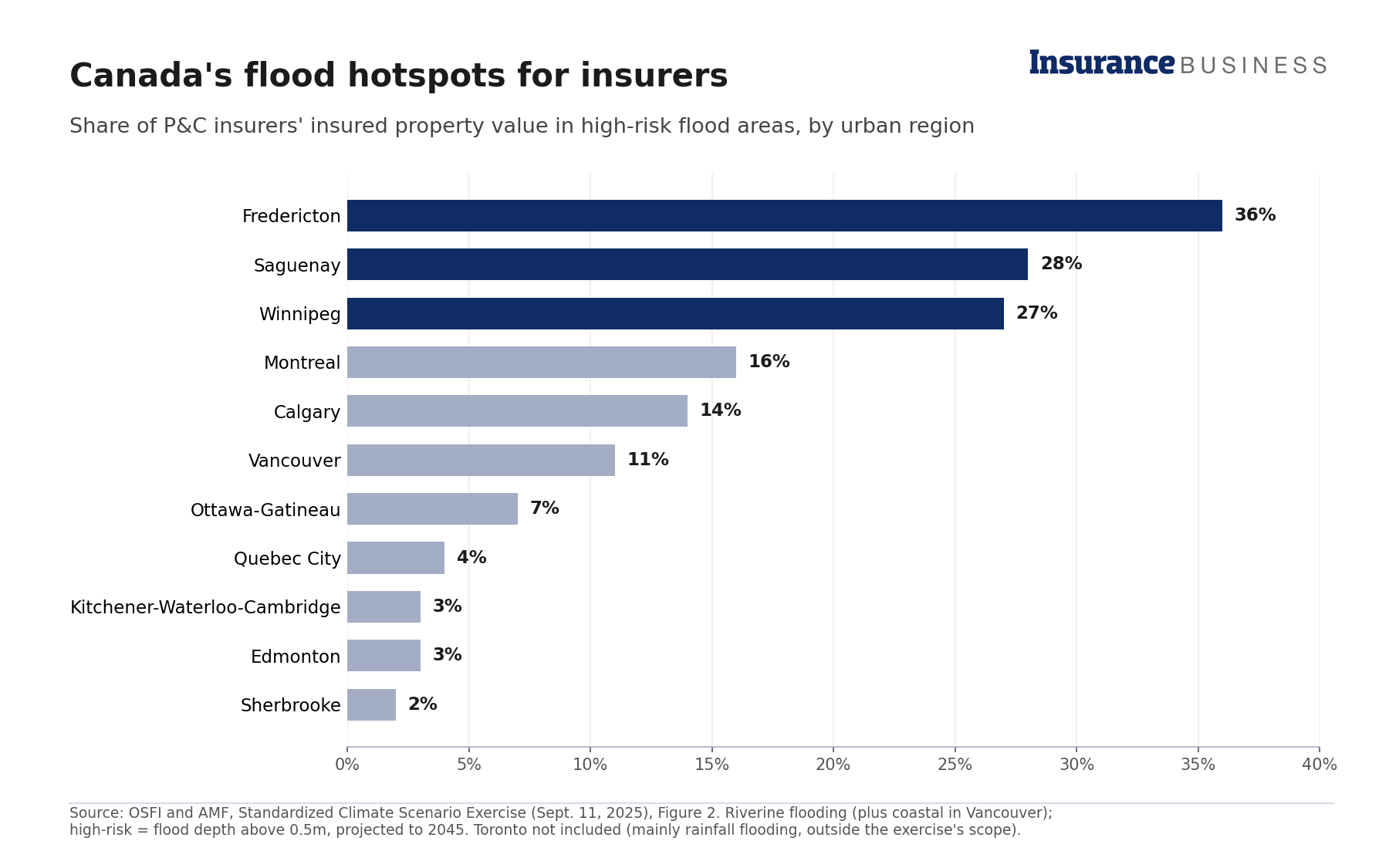
Some smaller insurers and lenders had more than half of their exposure in a region sitting in high-risk flood areas, OSFI found.
Read next: A flood program stuck in design, a market under strain: IBC on the race to stay insurable
Ottawa’s plan for a national flood insurance program was given $450 million and an April 2026 launch target. IBC says there is still no delivery date. The Canadian Climate Institute has estimated that more than 540,000 homes could be built in flood-prone areas by 2030 if nothing changes.
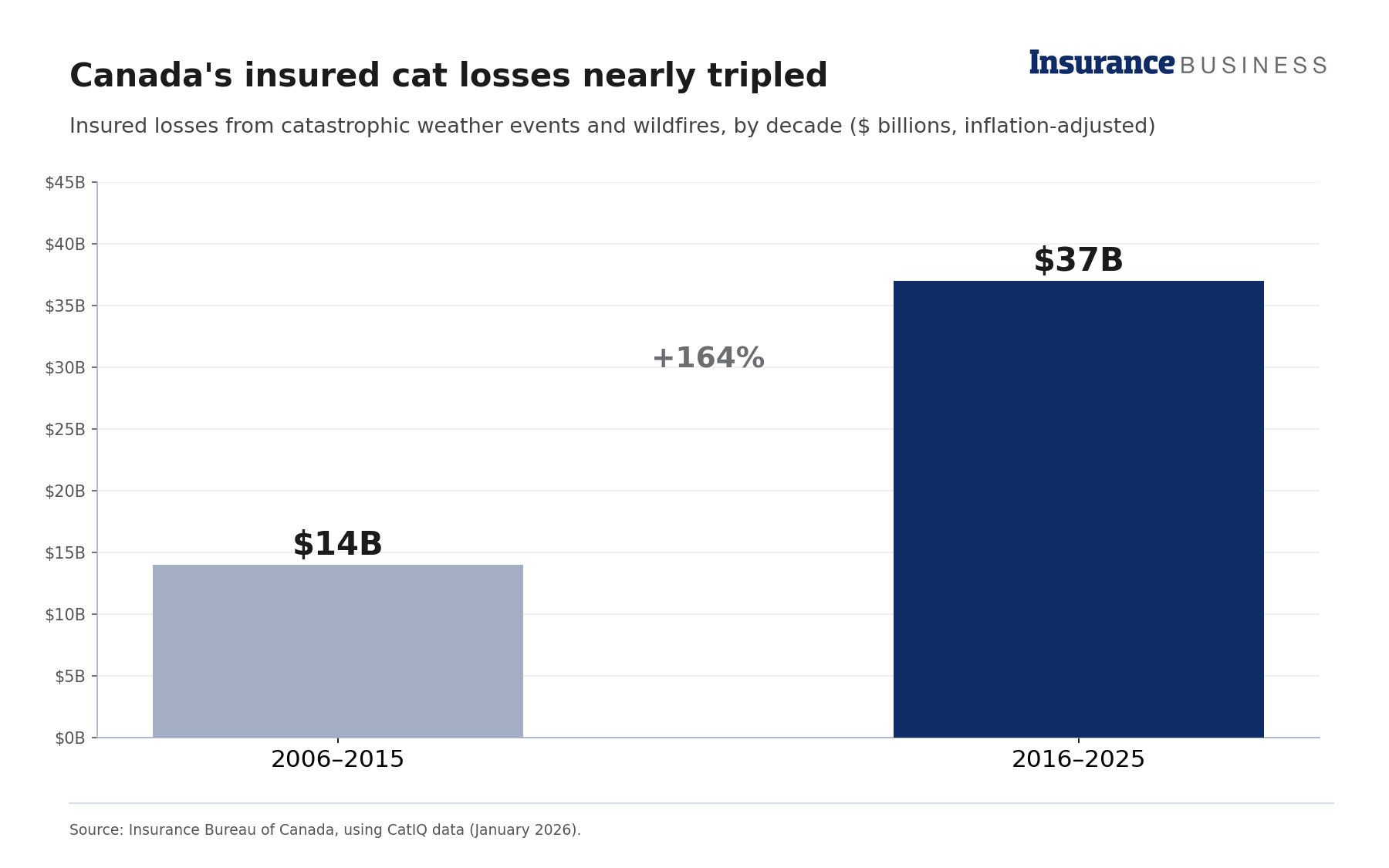
According to the Insurance Bureau of Canada, insured losses from catastrophic weather and wildfires reached $37 billion between 2016 and 2025, against $14 billion in the previous 10 years, adjusted for inflation. Insured wildfire losses rose more than 1,000% over the decade, to $8.1 billion.
Read next: Record cat losses put wildfire resilience back in the spotlight, IBC says
By early August this year, Canada had recorded 14 declared catastrophe events, close to the pace of 2023, when there were a record 26. Major publicly traded Canadian insurers still reported combined ratios below 95% for 2025 and for the first quarter of 2026. Statistics Canada data show premiums for home and mortgage insurance rose 31% between 2021 and 2025, about twice the rate of inflation over the same period. Morningstar DBRS has reported early signs that insurers are tightening coverage.
Read next: Canada’s fourth-worst wildfire season has barely dented P&C insurer results
The memo’s authors work in the UK and European market, and European groups have a substantial presence in Canada. Aviva Canada, one of the country’s leading P&C insurers, is owned by UK-based Aviva plc. AM Best data show that Munich Re and Swiss Re together wrote roughly a quarter of the premiums of the world’s 50 largest reinsurers in 2022.
Canadian insurers vary widely in how much they rely on reinsurance. OSFI found that about 70% of direct insurers reinsure less than 10% of their total insured value, while about 10% cede more than 90%. Reinsurance is also bought annually, and its price tends to rise quickly after heavy losses.
The memo says catastrophe modelling capability varies a great deal between firms. It describes some insurers relying on outdated models, a market dependent on a small number of vendor models, and firms that struggle to measure their total exposure.
OSFI’s exercise found similar gaps in data. P&C insurers were the most advanced participants, especially at mapping where their exposures sit, yet only 12% said they had adequate data for climate scenario analysis. The regulator also pointed out that Canada has no publicly available floodplain maps.
OSFI says its next round of work will assess whether institutions can measure and properly price catastrophe and climate risk, and that physical risk will become part of its regular reviews of capital models. That will put insurers’ modelling assumptions under closer supervisory scrutiny.
The report ends with an admission about the industry’s readiness, saying insurers are “neither prepared ourselves nor moving to prepare our customers of today.”
Read next: Canada’s home insurance market tightens as climate losses bite