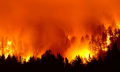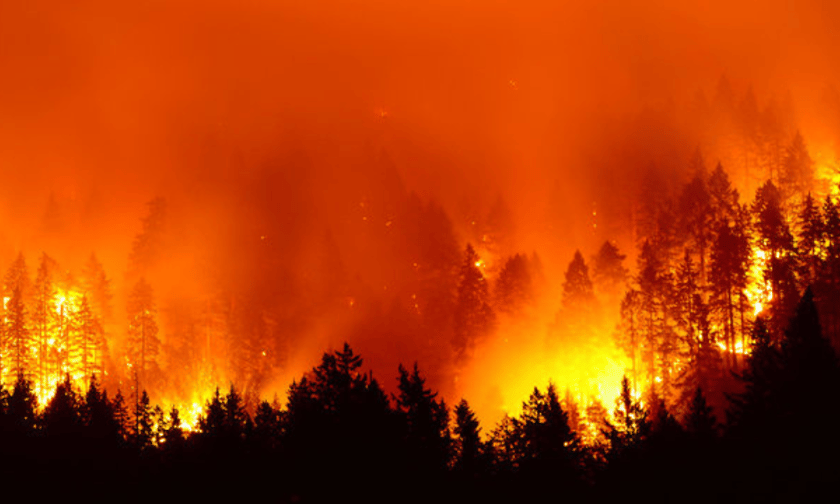
Smoke from wildfires burning across Canada has pushed air quality to dangerous levels for millions of people across the US Midwest and Northeast this week.
According to media reports, air quality alerts were in place across at least 17 to 18 states, from Montana and Minnesota to Massachusetts, New Jersey and Washington, D.C. Parts of Michigan reached "hazardous," the most extreme AQI category, on Thursday, while New York City recorded "very unhealthy" readings above 200 and Milwaukee recorded its worst air quality on record at an AQI of 644.
Environment Canada said the hazy conditions driving the smoke south are expected to persist into Friday morning, with forecasters warning of a possible additional smoke surge over the weekend as wind patterns shift again.
According to the Canadian Wildland Fire Information System, roughly 850 to 859 wildfires were burning as of Thursday, with more than 100 out of control, most concentrated in northwestern Ontario. Canada has recorded 3,549 wildfires so far this year, burning more than 6 million acres, an area larger than the United Kingdom.
Nine additional large fires are burning in northern Minnesota, adding to the smoke reaching the eastern US. Smoke has also disrupted commercial aviation, with the FAA slowing arrivals into Philadelphia International Airport due to reduced visibility.
For insurers on both sides of the border, this season is generating losses well beyond the physical fire perimeter. In Canada, evacuation orders, road closures and rerouted supply chains are increasingly showing up as business interruption and civil authority claims, even for policyholders whose properties were never touched by flame.
The Insurance Bureau of Canada noted that civil authority coverage can respond when a mandatory evacuation order denies access to a covered premises, separate from standard business interruption coverage, while contingent business interruption coverage can extend to companies whose suppliers are shut down by fire-related closures elsewhere in the country.
Smoke damage itself carries an unusually long claims tail. Verisk data on the 2025 Los Angeles wildfires found smoke damage accounted for roughly 30% of claims filed within the first 30 days of that event, with a further 35% of comparable smoke-related claims from past events arriving as much as two years later, illustrating how air quality losses can continue surfacing long after the smoke itself clears.
A comparable smoke episode over the Northeast in 2023 forced at least one New Jersey manufacturing facility to close due to outdoor air quality alone, an episode risk managers in the sector have since cited as a benchmark for planning purposes.
That claims complexity is compounding an already strained claims-handling environment. Sedgwick has flagged that wildfires shutting down trucking routes between the west and east coasts are generating business interruption claims tied to fires policyholders may not even have known about when they started, while Canada's province-by-province adjuster licensing system limits how quickly claims capacity can flex to meet demand when several major events overlap.
Tariffs on building materials are adding a further complication this year, widening the gap between what a claim pays out and what repairs eventually cost as insureds increasingly hold off settling, anticipating further cost increases before contractors become available.
The current smoke event follows Canada's costliest wildfire benchmark in recent memory. The 2016 Fort McMurray wildfire, which forced the evacuation of more than 80,000 residents and destroyed over 2,400 properties, generated roughly 60,000 insurance claims and is now estimated at more than $4.8 billion in insured damages in 2025 dollars.
More recently, 2023 set a new record for area burned nationally, more than six times the long-term annual average, and Canada's overall insured catastrophe losses reached $8.5 billion in 2024, the most expensive year on record, pushing home insurance rates up 5.28% nationally in 2025 and as much as 9.07% in Alberta following a combination of hail and wildfire losses.
Evacuation-related losses in particular remain only partially addressed by existing coverage. Longer evacuations, such as Kelowna's 36-day displacement during the 2023 British Columbia fires, sharply increase claim severity as temporary housing, pet boarding and food costs accumulate, and much of that economic disruption, including lost wages and interrupted business income for workers and smaller operators, remains only partially insured or entirely uninsured under standard policies.
With more smoke potentially arriving over the weekend and Canada's fire season still active, the settlement gap flagged by claims administrators, where insureds hold off finalizing repairs in anticipation of rising material costs, combined with the long tail Verisk has documented for smoke-related claims specifically, suggests this event's financial impact will extend well past the point the smoke itself clears, adding to an already difficult 2026 catastrophe year on both sides of the border.