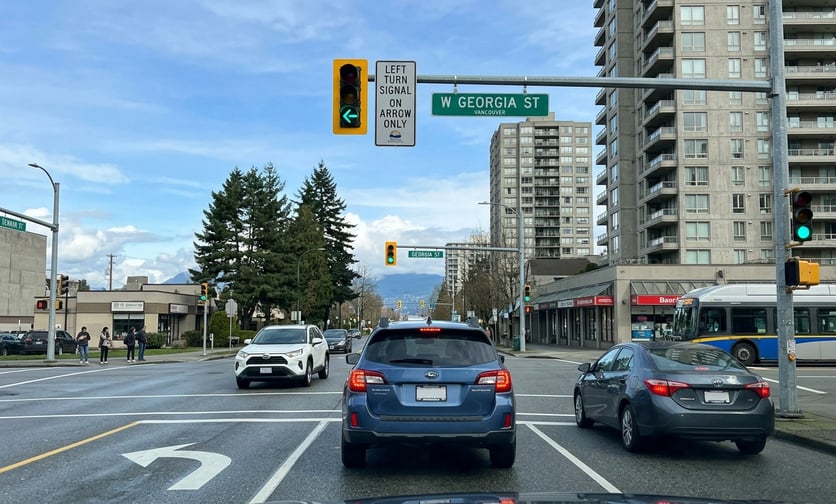
A BC tribunal cut a driver's fault rating from 100% to 25%, finding ICBC failed to explain why the other motorist wasn't negligent.
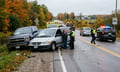
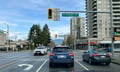
The dispute arose from a May 2024 collision at the intersection of Boleskine Road and Douglas Street in Victoria. The applicant was waiting in a left-turn lane behind another vehicle when a driver identified only as EDC came into view as the light turned yellow, then entered the intersection several seconds later without slowing. Insurance Corporation of British Columbia (ICBC), the respondent insurer, later found the applicant fully at fault. Dashcam audio captured the applicant impatiently wondering aloud whether the driver ahead of him needed "an invitation" to turn. Moments later, he followed the lead vehicle into the intersection; EDC's vehicle struck his as the light turned red.
In a September 25, 2024, responsibility letter, ICBC cited his failure to yield to oncoming traffic under the Motor Vehicle Act and attributed the collision primarily to his decision to follow closely behind the other vehicle without confirming it was safe to turn.
The applicant argued he should be held no more than 25% responsible, saying ICBC's investigation and conclusion were unreasonable. He was self-represented; ICBC was represented by an employee.
Civil Resolution Tribunal Vice Chair Christopher C. Rivers agreed ICBC's account of events was largely accurate and matched the dashcam video. The problem, he found, was procedural: ICBC never addressed whether EDC, who entered the intersection without slowing and would not have cleared it before the light turned red, had also acted negligently.
That gap mattered under the tribunal's precedent in De Paras v. ICBC, which requires a responsibility assessment to be reviewed for whether it is logically justified by the evidence and law - without deference to the insurer's own conclusions. The requirement that ICBC's process be proper, Rivers noted, concerns its investigation, not the outcome.
Drawing on case law addressing stale yellow lights and drivers' duty to watch for hazards, Rivers concluded EDC breached the Motor Vehicle Act's due-care provision by entering the intersection without slowing, several seconds after the light had changed. Establishing that EDC ran a yellow light outright wasn't necessary to reach that conclusion.
On the applicant's own share of the blame, Rivers agreed with his 25% estimate, based on his failure to yield to oncoming traffic. At the same time, Rivers found it would have been unreasonable for the applicant to expect EDC to keep driving through the intersection.
The tribunal ordered ICBC to amend its internal responsibility assessment to reflect the 25% finding and to reimburse the applicant's $125 in tribunal fees within 14 days, plus post-judgment interest.