Justin Camara (pictured) has a simple test for artificial intelligence in underwriting. It has to solve a problem, improve service or support a better decision. If it does none of those, he isn't interested.
"AI should enhance human judgment, not remove accountability," said Camara, chief executive of CFC, in an interview with Insurance Business. "We want to make sure that it's a human-led experience where AI is informing a decision, not making it."
Camara took charge of CFC's US operation early this year, after 16 years at Aspen, where he was most recently executive vice president and portfolio director for financial and professional liability. His appointment, and CFC's choice of former Truist Insurance Holdings chief John Howard as chair in May, are part of the specialist insurer's push to accelerate growth in the US, its largest market.
Asked what keeps pushing business into the excess and surplus lines market, Camara pointed first to a timing problem. Risk and exposure tend to change faster than the standard market can respond, he said, partly because state insurance departments control which products admitted carriers can launch and when.
That gap is widening, in his view, because of digital transformation, AI and business models that don't fit standard practice. He gave eHealth as an example: a category that barely existed before the pandemic, now that a large share of healthcare is delivered digitally.
Federal data show how embedded virtual care has become. Eight in 10 office-based physicians used telemedicine in 2024, according to the CDC's National Center for Health Statistics. That was down from 86.5% at the 2021 pandemic peak, but it still leaves telehealth a routine part of practice and a distinct exposure for insurers to price.
Those businesses need somewhere to buy cover, and Camara said E&S is the natural home. "You get specialty underwriting expertise," he said. "You get responsiveness and flexibility that you don't otherwise get in the standard markets."
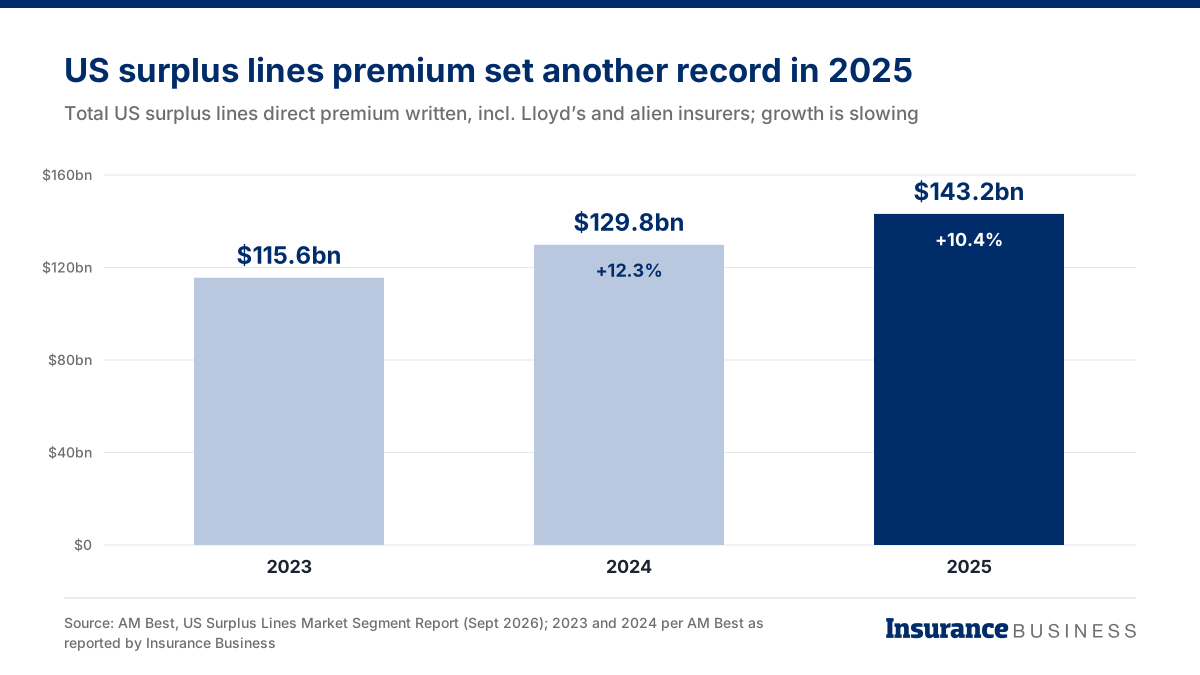
AM Best's figures show how far that shift has gone. US surplus lines premium reached a record of about $143 billion in 2025, up 10.4%, and surplus lines now account for 12.9% of all US property and casualty premium, up from 3.6% in 2000. Growth has slowed this year as rates soften: stamping offices tracked by the Wholesale & Specialty Insurance Association recorded $47.6 billion in premium in the first half of 2026, up 2.8%. But the number of items filed rose 16.9%, a sign that more risks are still moving into the channel.
Read next: Property softens, liability hardens: what E&S midyear data means for brokers
On the role of MGAs, Camara described the most successful ones in similar terms. They employ specialist underwriters, build new products, use data and technology to bring those products to market, and focus heavily on service.
Brokers, he said, use the channel "because they're getting access to better products, better experience and an easier trading experience." CFC's aim is to combine those with its own underwriting approach, proprietary data and technology.
On where AI is creating a real advantage, Camara was specific about CFC's priorities. The practical gain, he said, is faster and more consistent quoting. Consistency matters because brokers value it, and it supports better risk selection. Models increasingly inform an underwriter's decision, he said, and they cut administrative work, which frees underwriters to spend more time with brokers.
Read next: Your clients think cyber covers their AI risk. Most of the time, it doesn't
AI also shows up on the product side. CFC continues to cover AI-related risks, Camara said, and is adding affirmative cover to selected products "to reduce the ambiguity and give brokers and clients the comfort of understanding what the product is actually offering."
The E&S market is where that clarity is mostly being offered. In its September surplus lines report, AM Best said admitted insurers are concentrating on tighter AI exclusions in general liability policies, leaving the surplus lines market as the main route to affirmative, specialized AI coverage.
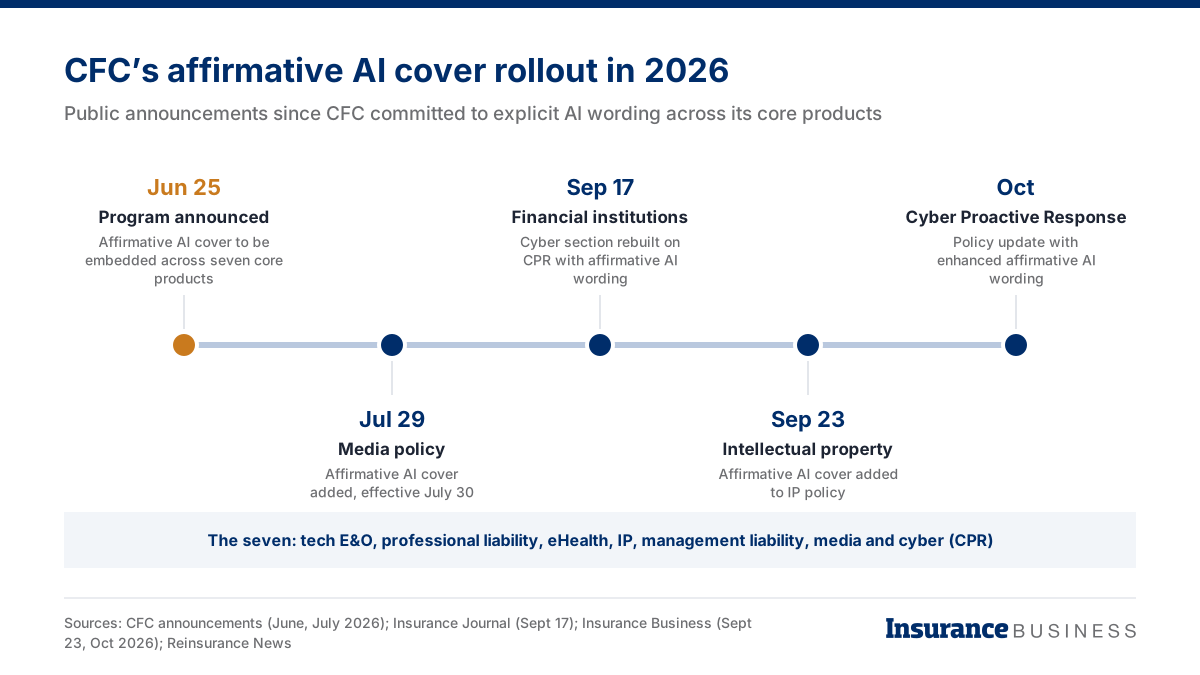
That program has been running since June, when CFC said it would embed affirmative AI cover across seven core products: technology E&O, professional liability, eHealth, intellectual property, management liability, media and its Cyber Proactive Response cyber policy. Since then it has added affirmative AI wording to its media policy, the cyber section of its financial institutions suite, its intellectual property policy and, in early October, an updated Cyber Proactive Response policy that confirms AI used against a policyholder, in phishing or intrusion for example, falls within existing cyber cover.
CFC isn't the only carrier making the move. Beazley, Coalition and AXA XL have also introduced affirmative AI language in cyber and technology lines over the past year. For brokers, an affirmative endorsement settles how a policy treats AI's involvement in a claim, but it doesn't replace checking the policy's scope, limits and exclusions.
Read next: The cyber market is still working out AI coverage – what retail brokers should ask now