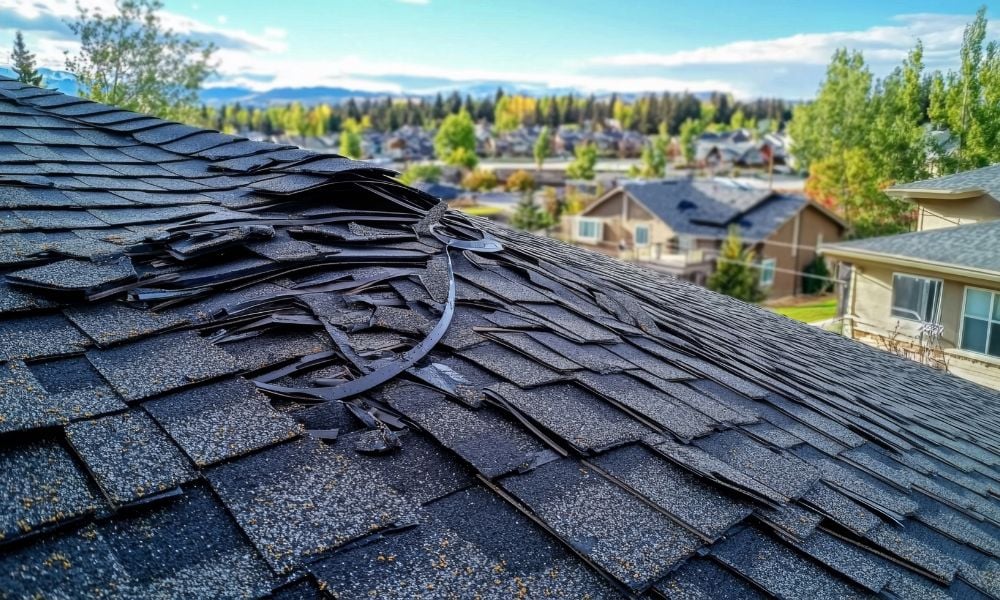
Alberta's hail season has started early in 2026. And the Insurance Bureau of Canada (IBC) is once again calling on the provincial government to mandate hail-resistant building materials. It’s a call the IBC has been making publicly since at least 2024, with no legislative response.
That gap between industry demand and government action is now showing up directly in the Alberta hail insurance market.
With hail season underway, this is what insurance professionals need to understand.
A survey of 38 Alberta residential insurers was conducted by the provincial regulator and presented at the National Insurance Conference of Canada (NICC) in September 2025. The survey found that three carriers had established full coverage blackout zones in the highest-risk areas.
David Sorensen, deputy superintendent of insurance for the Government of Alberta, said the number was lower than complaints had suggested — but confirmed the structural shift.
"Every insurer surveyed now applies higher deductibles to hail, and all have introduced limited payment terms — particularly on roofs and siding," Sorensen said. Replacement cost coverage that once guaranteed a new roof after every storm has largely disappeared across the market.
For brokers writing residential property business in Alberta's high-risk postal codes, that shift has fundamentally changed the renewal conversation.
Hail-specific deductibles have risen from a previous standard of $1,000 to $2,500–$5,000 with many carriers. Alberta homeowners saw premium increases of 15–25 per cent in 2026, following the 2025 storm season, according to IBC data. Some insurers have removed hail from base homeowners policies entirely and reclassified it as an optional add-on.
The IBC's June 23, 2026 guidance is the latest in a series of public calls for Alberta to mandate hail-resistant roofing and siding in new construction in high-risk zones.
The provincial government's response has not moved beyond reviewing options. Asked about building code reform following the August 2024 Calgary hailstorm, a spokesperson for Alberta's minister of municipal affairs said the province's code includes minimum environmental protections. "However, builders and homeowners are free to exceed minimum code requirements and choose materials that would make their home more resilient to extreme weather in their area," the spokesperson said, as reported by CBC in August 2024.
As of January 2026, Alberta's Ministry of Municipal Affairs said it was reviewing the 2025 National Model Codes but made no commitment to hail-specific requirements, according to reporting by ConstructConnect.
The next opportunity to embed mandatory hail-resistant standards in national building codes would not arise until the 2030 model codes cycle, according to experts cited by CBC in August 2024.
Calgary did have a working model.
The city's Resilient Roofing Rebate Program, launched after a 2020 hailstorm, offered homeowners $3,000 to upgrade to Class 4 impact-resistant roofing. The Institute for Catastrophic Loss Reduction (ICLR) found the program avoided roughly $13 million in damage at a total cost of $5.25 million to the city.
City council voted to end the program in May 2022 when its funding ran out. More than 1,500 applicants remained on the waiting list.
In June 2025, Calgary's city administration recommended against reviving it, instead asking the mayor to write to the province requesting a grant program for low-income homeowners.
IBC's Aaron Sutherland, vice-president for the Pacific and Western regions, has called on the province to revive programs of this kind. "These events have significant impacts on the cost of insurance," he said. "That's why IBC has called on the provincial government to give homeowners incentives to retrofit their properties with hail-resistant materials."
The scale of the problem explains why the industry's patience with the policy process is running out.
The August 2024 Calgary hailstorm generated more than 130,000 claims and approximately $3.25 billion in insured losses, according to Catastrophe Indices and Quantification Inc. (CatIQ). That made it the second-costliest disaster in Canadian history, behind only the 2016 Fort McMurray wildfires.
Alberta hail insurance costs are also part of a longer structural trend. Statistics Canada data, released June 16, 2026, showed homeowners' insurance premiums in Alberta increased 391.6 per cent from December 2005 to December 2025. This is the highest increase of any province in Canada.
Rates rose 55.8 per cent in Alberta between December 2020 and December 2025, against a national average of 38.6 per cent over the same period (Statistics Canada catalogue no. 11-621-M, June 2026).
For brokers, the practical intelligence is in the deductible differential the regulator is now actively promoting. A resilient property may attract a $2,500 hail deductible; a non-resilient one, $10,000. That $7,500 gap is a concrete renewal conversation — one that does not depend on whether the province ever acts on building codes.
For the full data context, see Statistics Canada's June 2026 analysis of extreme weather and home insurance and our earlier reporting on how Alberta's regulator is reshaping residential hail coverage.