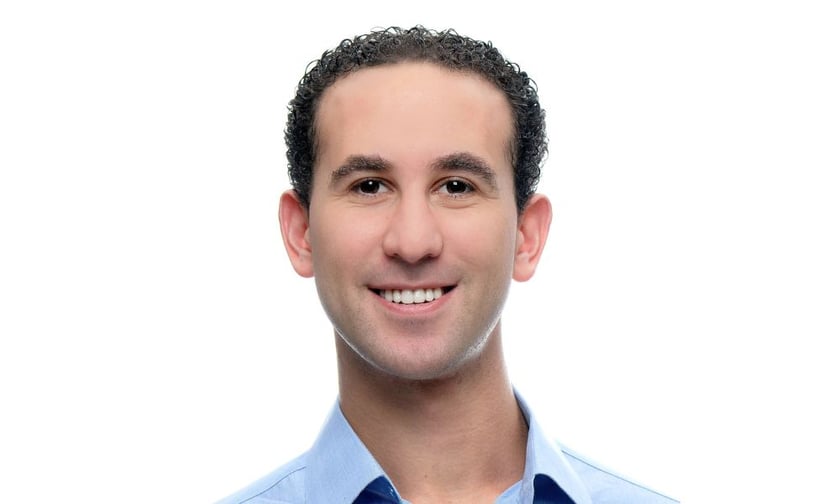
Customer non-payment is the risk keeping small business owners up at night, but it's not the risk most likely to actually shut their business down, according to Mariano Neiman (pictured), COO at Zensurance, a gap he said brokers are uniquely positioned to help clients understand.
Zensurance's survey found that 29% of owners identified non-payment for completed work as their single biggest risk, ahead of cyberattacks at 14% and theft or vandalism at 9%. Neiman said that ranking makes sense once you consider the financial position most small businesses are actually operating from.
"81% of owners told us that they're sitting on three months of cash reserves or less," Neiman said. "Four out of 10, they have less than one month's worth of cash."
With that little runway, Neiman said, the anxiety around non-payment tracks directly with how immediate and familiar the risk feels, rather than with how damaging it would actually be if it materialized.
"They do the job, they incur the costs and the time to do it, and then they're worried about whether they're going to get paid or not," Neiman said. "It could be because it's happened to them before, they're seeing it happen to other peers, or they're seeing the economy be so difficult for everyone that they think, what if they don't pay me?"
The risk that actually poses the greater existential threat, Neiman said, tends to rank much lower in owners' minds, precisely because most haven't experienced it firsthand.
"The challenge with that, and something interesting for brokers to really think about, is that's not necessarily the risk that will shut a business down," Neiman said. "When you think about the risk that will fully shut a business down, it's that big liability claim, that lawsuit. Even if there's no indemnity at the end, just the legal expenses can make you go under."
Theft, fire, flood, and business interruption sit lower on most owners' list of concerns for the same reason, Neiman said: unfamiliarity, not lower actual risk.
Thin cash reserves have also changed the math on what counts as a serious incident in the first place, Neiman said. A loss that would have been a manageable setback a few years ago can now be enough to threaten a business outright.
"You're a retail shop and you have a relatively small theft incident. They break into your store, they break your windows, they steal maybe only $5,000 worth of inventory," Neiman said. "But suddenly that's $5,000 worth of inventory you need to replace, maybe $5,000 to $10,000 of property damage you need to repair, and you have to shut down your business for two to four weeks. You still have your fixed costs, and a relatively small incident shuts down your business because you don't have the cash reserves to absorb it."
That fragility extends well beyond the business itself, Neiman said, since a large share of small business owners have blurred the line between business and personal finances entirely.
"About 39% of business owners told us that they're financing their business with their personal credit card or home equity," Neiman said. "So if suddenly something like that happens, it's not just a bad day for the business anymore. It starts affecting the home, it starts affecting the family, it starts affecting your personal credit score, it starts affecting your mortgage."
That entanglement, Neiman said, removes a safety net owners might otherwise rely on if a business ultimately fails and they need to start over.
Asked what he'd tell an owner weighing insurance against making payroll, Neiman said the comparison itself is usually misleading, since the two costs rarely sit anywhere near the same scale.
"I know meeting payroll is one of the toughest pressures a small business owner deals with, and it's not something insurance costs even come close to,” Neiman said. “Oftentimes, insurance runs less than a cell phone bill. Depending on the type and size of business, you're looking at $50 to $100 a month. And cutting it rarely ends up being the thing that actually solves a payroll problem."
For brokers specifically, Neiman said the moment calls for a different kind of conversation than the one that worked during better economic conditions.
"Brokers need to understand what their customers are going through," Neiman said. "This isn't a good economic cycle where customers are thinking about how to grow and reduce risk to that growth. This one is: how do I survive?"
That shift in mindset, he said, changes what a useful conversation with a client actually looks like, moving away from a binary choice between full coverage and none at all.
"The role of the broker is not to sell an insurance policy, but truly to educate and inform the small business owner, to help them understand and make the risks feel tangible and specific to them," Neiman said. "Decrease coverage where it can make sense, decrease limits, increase deductibles if the cost is truly the concern. But having that holistic conversation would be the advice."