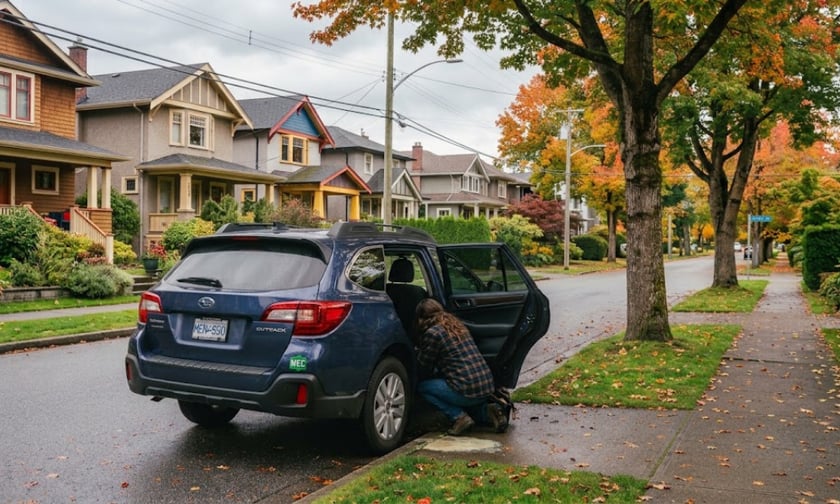
A British Columbia tribunal has upheld ICBC's finding that a Vancouver driver was 75% responsible after another vehicle struck her parked car's open door.
The Civil Resolution Tribunal dismissed the driver's challenge to the Insurance Corporation of British Columbia's responsibility determination stemming from a May 29, 2024 accident on W 63 Avenue in Vancouver.
The applicant's SUV was parallel parked with its rear driver-side door at least partially open while she vacuumed a spill inside the vehicle. Another driver, identified only as XD, struck the open door with a passenger-side mirror while passing. The applicant said the door had been open for about two minutes and that she had opened it only to the first notch. XD told ICBC they had not seen the door open and speculated it may have swung open further just as their vehicle passed.
ICBC initially found XD fully responsible the day after the accident, based on brief phone statements. After XD requested a secondary review, ICBC gathered further evidence and reassessed, issuing a responsibility letter on September 23, 2024, that found the applicant 75% responsible and XD 25% responsible.
The applicant said ICBC's investigation was flawed: it reversed its initial finding without good reason, never sent anyone to look at the scene, and took XD's account at face value despite its inconsistencies. Tribunal Member Peter Nyhuus rejected each point. He found ICBC had properly invited new evidence before reassessing, and that there was "nothing arbitrary or improper about ICBC changing its determination" based on that review. He also found the accident did not warrant an in-person investigation and that photographs and videos supplied by the applicant adequately showed the road's width.
On the substance, Nyhuus found ICBC reasonably concluded the applicant breached Motor Vehicle Act sections 203(1) and 203(2) by leaving her door open to traffic for two minutes while cleaning. Section 203(2) ties permissible door-open time to loading or unloading passengers, and Nyhuus addressed what happens when no passenger is involved at all. He found the legislature intended the provision to apply regardless of the door-opener's purpose, requiring the door be closed as soon as reasonably possible after completing whatever task prompted opening it.
Nyhuus found ICBC had also properly weighed XD's conduct under section 144's duty of care, agreeing XD should have noticed the open door and moved left to avoid it, and that XD bore some responsibility as well. But he found the heavier onus fell on the applicant as the driver who created the hazard, and that she had not shown ICBC's determination was improper or unreasonable.
The tribunal dismissed the applicant's claim for tribunal fees. ICBC would have been entitled to a fee award but waived it, and neither side sought dispute-related expenses.